
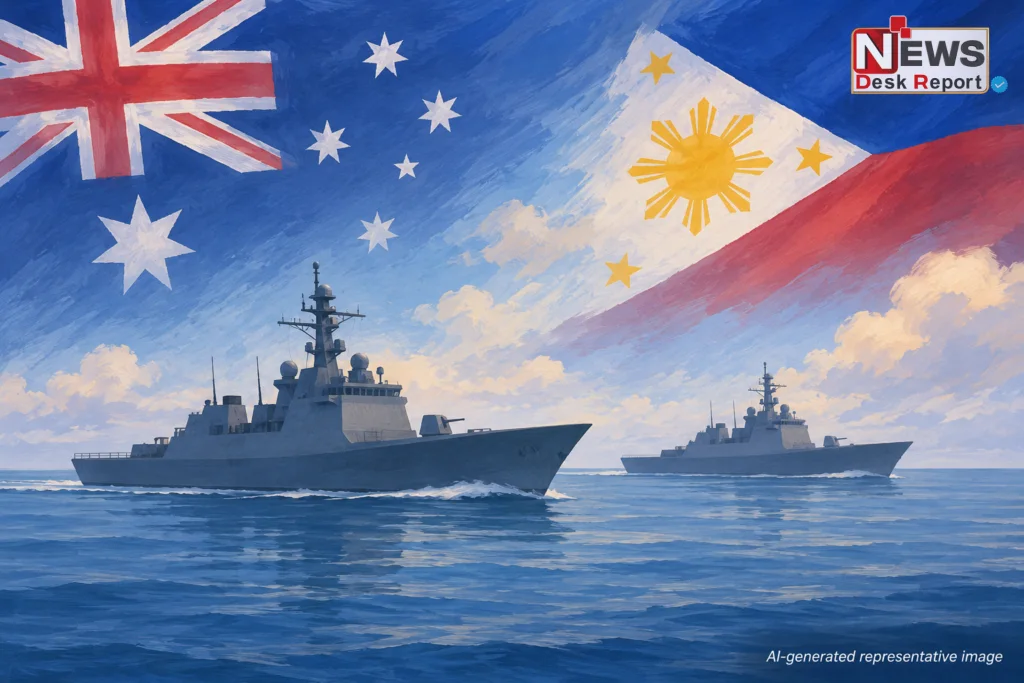
AI-generated representative image. Original illustration for News Desk Report; not a photograph of the reported event.
Australia and the Philippines signed a new Defence Cooperation Arrangement in Manila on Sunday, November 15, setting out priorities for closer military coordination, maritime awareness and information-sharing. Australian Prime Minister Anthony Albanese witnessed the signing during a visit to HMAS Stalwart.
A joint Australian government statement says the framework expands on the countries’ existing defence cooperation memorandum. It identifies strategic dialogue, planning, training, interoperability and defence infrastructure development among the areas of cooperation.
Practical cooperation, rather than a completed programme
The arrangement provides a framework for future activity. Its signing should not be read as confirmation that every infrastructure project or equipment initiative has already been delivered. Interoperability refers to the ability of forces to work together through compatible procedures, communications and training.
GMA News reported that Philippine Defence Secretary Gilberto Teodoro Jr. and Australian Ambassador Marc Innes-Brown signed the document. Teodoro described smoother coordination in military and security matters, including disaster response, as an intended benefit.
Wider maritime and cyber-security support
Australia separately announced additional investment in its Southeast Asia Maritime Partnerships. The government said the programme would support regional partners with aerial and surface drones, secure communications and operator training to improve maritime awareness and cyber resilience.
In his Manila press conference, Albanese said the partnership already involved around 200 defence activities and between 2,500 and 3,000 Australian Defence Force personnel. Those figures describe the existing cooperation he cited, rather than a new deployment announced under Sunday’s arrangement.
The signing comes in the 80th anniversary year of diplomatic relations between the two countries. The announced priorities concern practical security cooperation around important regional sea routes; the statement does not provide a completion timetable for every planned activity.
Read further regional developments in our International coverage.