
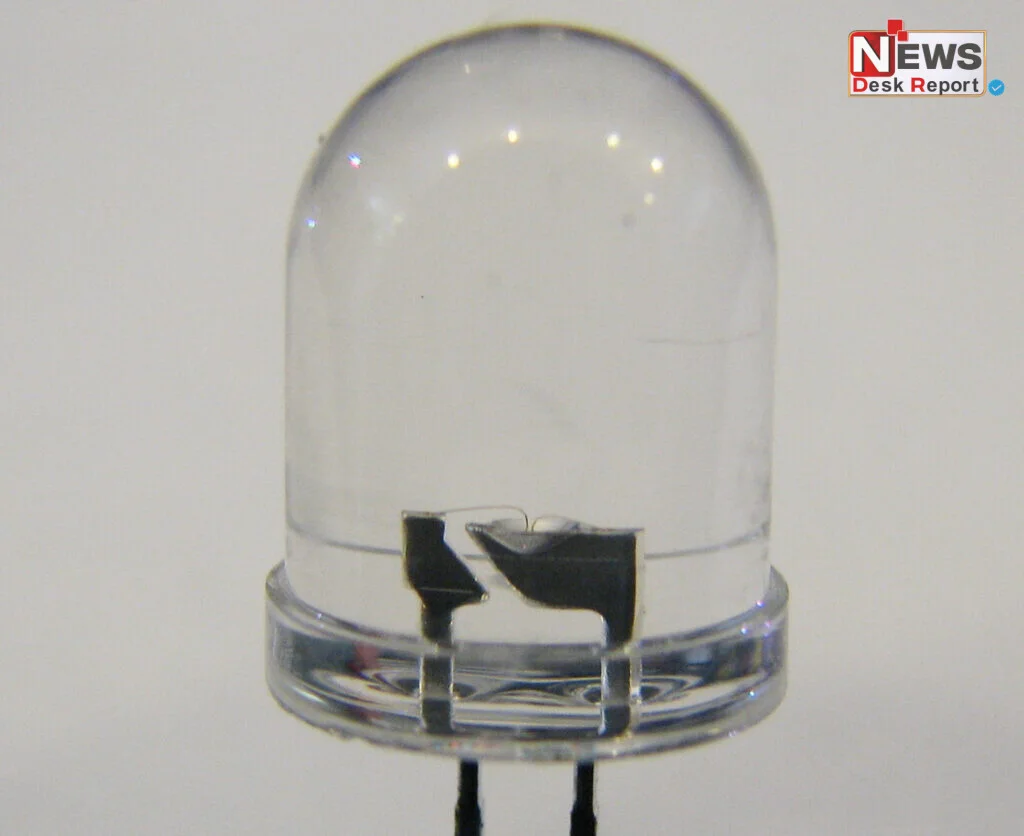
File photo: conventional white LED, July 2007; not the research prototype. Photo: Gophi; edit by Jacek Halicki / Wikimedia Commons, CC BY-SA 3.0. NDR resizing and branding; adapted image under the same licence.

BENGALURU, November 28: A government science briefing has highlighted a method designed to keep the colours in perovskite-based white light-emitting diodes from drifting as their materials interact. The work combines protection at the surface of nanocrystals with a thin barrier between light-emitting layers.
The November 27 Department of Science and Technology announcement describes research by the Centre for Nano and Soft Matter Sciences (CeNS), Bengaluru, and IIT Delhi. The underlying paper in Small was first published on February 12, 2026; Friday’s release is a later public briefing on that work.
Keeping red and green components separate
Halide ions can move between neighbouring perovskite nanocrystals, changing the colours they emit. That makes it difficult to maintain the intended combination of colours for white light.
The researchers used lead selenide to address vacancies at the crystal surface and an alumina coating deposited by atomic layer deposition to impede ion movement. They fabricated multilayer devices on glass and flexible plastic using spray coating.
The paper’s abstract reports stability beyond 12 hours of continuous illumination and colour-temperature adjustment by varying the driving current. These are laboratory results, rather than a service-life guarantee for a commercial lamp.
Further work before consumer use
The government briefing identifies lead toxicity and environmental refinement as issues to address before general-market use. It does not announce a retail product or a launch date.
Follow related developments in NDR’s Technical section.