
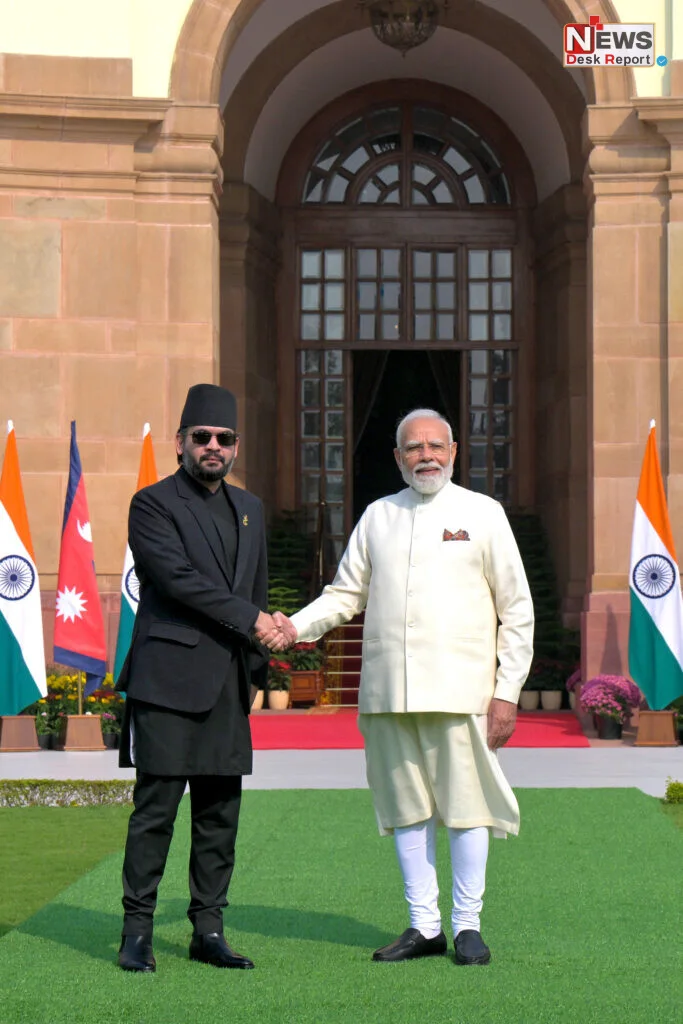
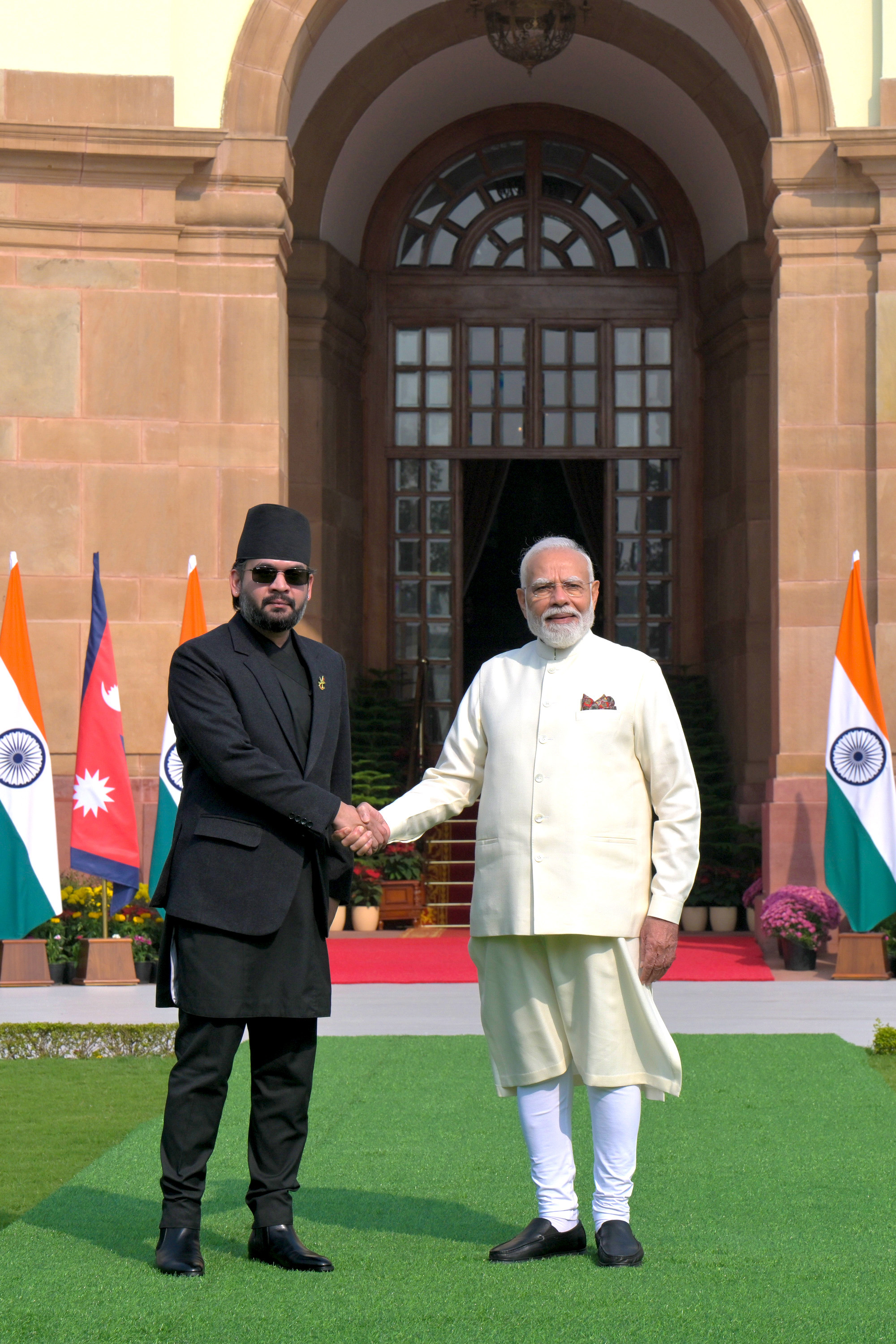
Narendra Modi and Nepal Prime Minister Balendra Shah at Hyderabad House, New Delhi, on November 23, 2026. Photo: Prime Minister’s Office / Press Information Bureau, Government of India; reproduced with source acknowledgement under the published PIB reuse policy. Resized and branded by NDR; no government endorsement implied.
India’s ₹15,000-crore development package for Nepal comprises a reconstruction and infrastructure grant alongside a larger energy-sector credit line, the two governments confirmed after Monday’s talks in New Delhi. The commitment is a central outcome of Prime Minister Balendra Shah’s November 22–23 State visit, rather than evidence that the full amount has already been disbursed.
The November 23 joint statement specifies a ₹3,500-crore grant for post-disaster reconstruction and new infrastructure, and a rupee-denominated ₹11,500-crore line of credit for energy projects. Specific projects and assistance arrangements remain subject to mutual consultation. Reuters independently reported the package after the leaders’ meeting.
Completed links and projects still to be built
The leaders flagged off the inaugural Sarayu-Kamala Express between Ayodhya and Janakpur, inaugurated the Dharchula–Darchula motorable bridge and dedicated phase II of the Motihari–Amlekhgunj petroleum pipeline. They also virtually laid foundation stones for the 669 MW Lower Arun hydroelectric project and a new Integrated Check Post at Banbasa.
Those actions describe different stages of implementation. An inaugurated connection is distinct from a project for which a foundation stone has been laid; the latter does not establish that construction is complete or electricity is already being generated.
India announced transit access through Deendayal Port at Kandla. Access to Paradip is conditional on the required infrastructure being in place, according to the joint statement.
Education and institutional cooperation
The two sides agreed on an offshore Indian Institute of Technology campus in Nepal. Eight memoranda cover areas including forensic research, police and civil-service training, traditional medicine, satellite communications, sustainable urban development, health, and livestock and fisheries.
The agreements set out cooperation; they do not by themselves open admissions to an IIT campus or create an application window for individual benefits. The joint statement does not provide an opening date for that campus.
These confirmed outcomes follow the programme described in NDR’s pre-talks report. The announcement took place on November 23; this follow-up separates the agreed financial and infrastructure measures from the earlier agenda.