
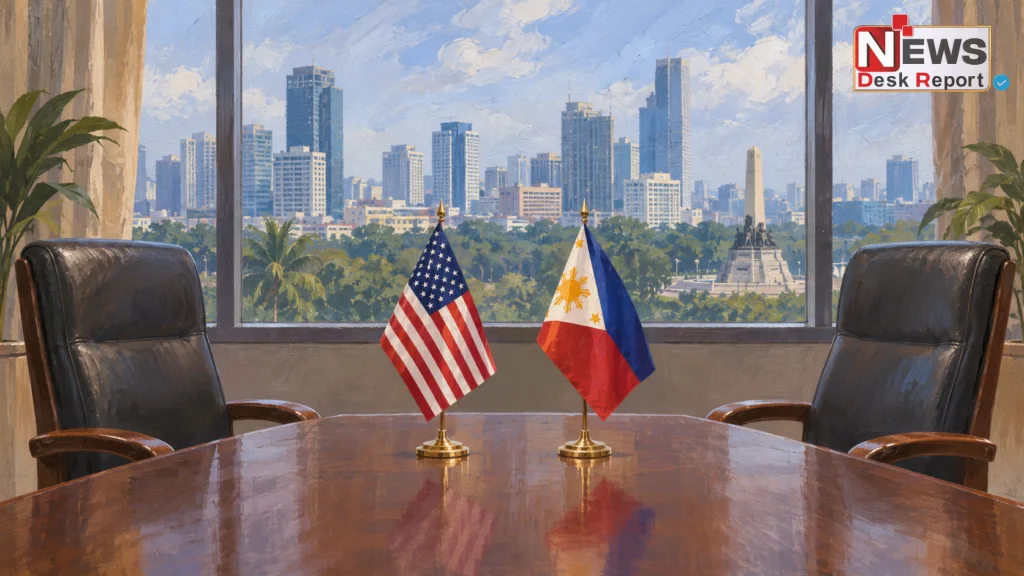
AI-generated representative image
United States President Donald Trump and Philippine President Ferdinand Marcos Jr. are scheduled to hold formal bilateral talks in Manila on Wednesday, November 18, before Trump travels to Shenzhen in China. The programme places the longstanding US–Philippines partnership alongside the wider regional diplomacy of his Asia visit.
Reuters’ November 18 report, carried by TV5, says the leaders’ programme includes bilateral talks and a working lunch before the China leg. It identifies Philippine interest in stronger US security assurances amid tensions in the South China Sea.
Security and economic ties
The Philippine News Agency’s official account had confirmed the planned bilateral engagement, describing defence and security, trade and investment, and regional developments as areas for discussion. It also noted cooperation involving critical minerals, semiconductors and emerging technologies.
Those subjects describe the scope of the visit. They do not, by themselves, establish that a new defence commitment, commercial agreement or investment package has been concluded. Any such outcome requires a separate announcement.
From the ASEAN gathering to Shenzhen
Trump arrived in the Philippines on November 17 for the Association of Southeast Asian Nations (ASEAN) gathering. The White House’s dated arrival record confirms that part of the trip. His visit returned him to the Philippines nine years after attending ASEAN meetings there in 2017.
The Philippine government’s account places the trip within an alliance spanning maritime security, defence modernisation and economic cooperation. It records a previous face-to-face meeting between the two presidents at the White House on July 22, 2025, and a telephone conversation in July 2026.
The formal Wednesday meeting follows the regional summit activity in Manila. Its announced agenda and Trump’s onward journey are confirmed elements of the programme; the substance of any final joint statement should be assessed against the text released by the two governments.
For further coverage of diplomacy and regional affairs, visit News Desk Report’s International section.