
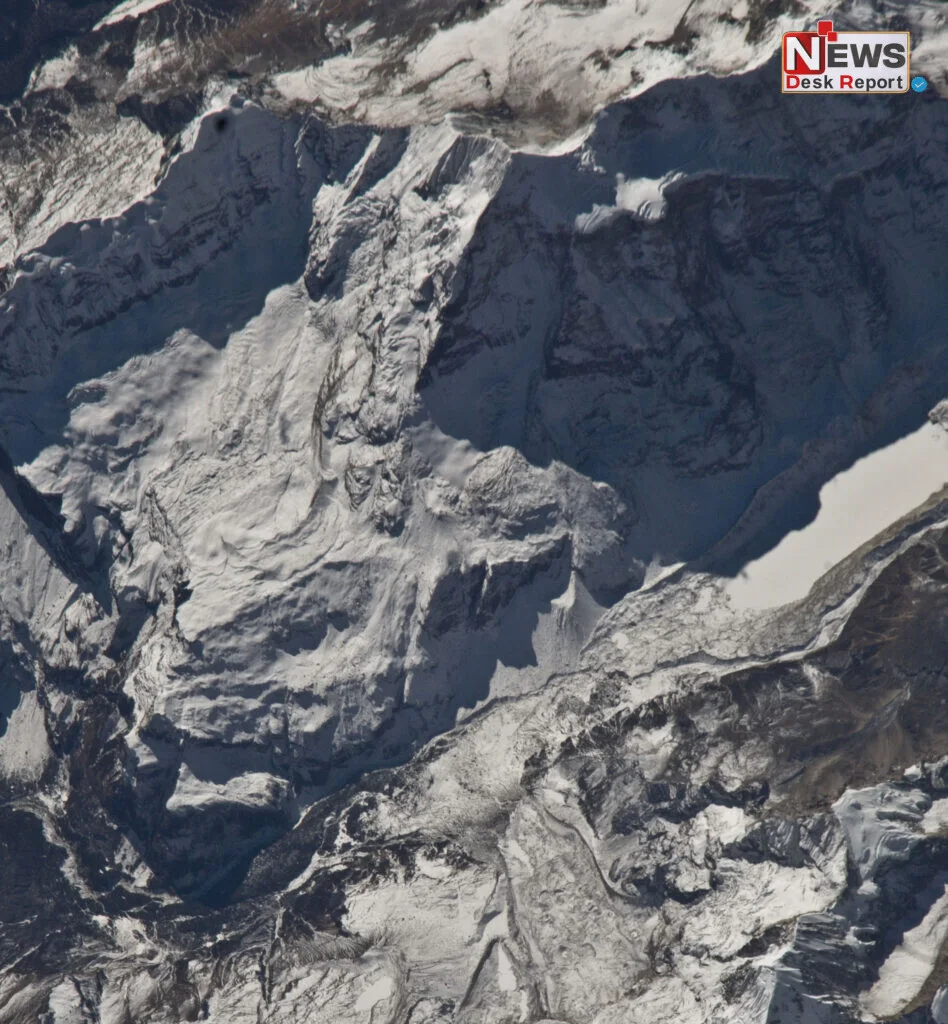
File photo: Lower Barun glacial lake region, Nepal, photographed from the International Space Station on 6 January 2011; not current lake conditions or project work. Credit: Earth Science and Remote Sensing Unit, NASA Johnson Space Center. Public-domain NASA image, cropped version via Wikimedia Commons; resized and branded by NDR.

KATHMANDU, November 26: Nepal has launched a $49.94-million project to reduce glacial lake flood risks for mountain communities and people downstream. The government and the United Nations Development Programme (UNDP) held the national inception workshop in Kathmandu on November 25.
The UNDP announcement says GLOF Sanjibani will run from 2026 to 2033 and directly benefit more than 385,000 people, 55% of them women. Nearly two million additional downstream residents are expected to benefit indirectly. These are project estimates.
Four lakes and stronger warning systems
A glacial lake outburst flood, or GLOF, occurs when water is suddenly released from a glacial lake. The programme combines work at selected lakes with monitoring, early warnings and preparedness in exposed communities.
Water-level reductions are planned at Dona, Lumding Tsho and Lower Barun lakes by three metres each, and at Hongu 2 by one metre. These are intended interventions, rather than completed reductions. The Rising Nepal’s November 26 report also details the four-lake plan.
Other measures include hydrometeorological monitoring, protective infrastructure and nature-based approaches. Local authorities and communities are to receive support for risk-informed planning and disaster preparedness.
Climate finance and implementation
A $36.16-million Green Climate Fund grant provides the largest share of funding. Nepal contributes $11.32 million, UNDP $2.14 million and the private sector $0.32 million, according to the project announcement.
The programme aims to reduce exposure and improve response capacity. Its launch does not mean the engineering work is finished or that flood risk has been eliminated.
Read more in our International coverage.