
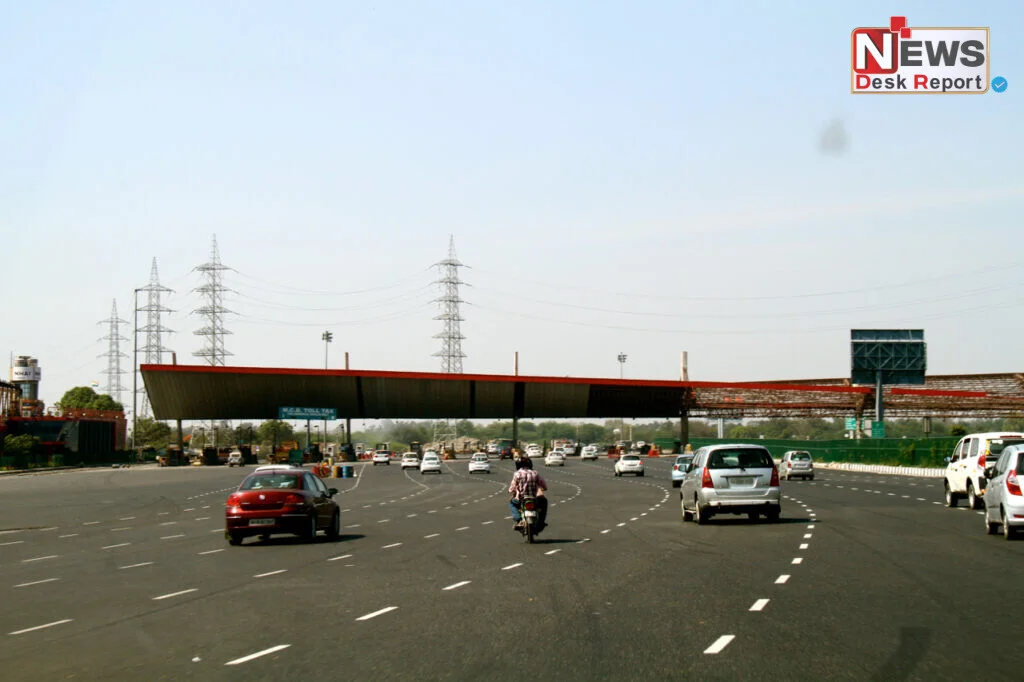
File photo: A conventional toll plaza in India, 22 March 2015; not an MLFF installation. Photo: Tapesh Yadav (TeshTesh) / Wikimedia Commons, CC BY-SA 4.0. Resized and branded by News Desk Report; adapted image under the same licence.

Net toll revenue across seven plazas using barrier-free Multi-Lane Free Flow (MLFF) technology rose 19.84% against their corresponding pre-implementation benchmarks, the National Highways Authority of India said in data released on 23 November. The figure is a cumulative comparison covering the installations’ operating periods, rather than a nationwide toll-revenue growth rate.
The road transport ministry’s release puts combined net revenue at about ₹538.95 crore, compared with a benchmark of approximately ₹449.72 crore. The difference is around ₹89.23 crore.
Seven plazas in the comparison, nine in operation
The system began at Choryasi in Gujarat on 1 May 2026. The comparison also covers Mundka, Daulatpura, Gharaunda, Manoharpura, Shahjahanpur and Paranur. Nemili and Chenasamudram, which began MLFF operations in November, are excluded from the seven-plaza figures.
The statement describes the position as of 31 October, while the accompanying table labels its reporting endpoint as 1 November. These are end-October operating figures published this week, not collections for today’s traffic. Business Standard’s report also identifies the seven-plaza scope and the exclusion of the November additions.
The weighted figure differs from the simple average
The table gives a simple average revenue increase of 21.10%, alongside the combined weighted increase of 19.84%. The latter is the aggregate result used in the headline. Individual results vary, so neither percentage means every installation recorded an identical gain.
MLFF is designed to collect tolls without vehicles stopping at a physical barrier. Higher receipts, however, do not by themselves measure how many minutes a commuter saved. This release’s revenue comparison should therefore be distinguished from a measured travel-time study. Follow further verified infrastructure and public-policy developments in our National section.