
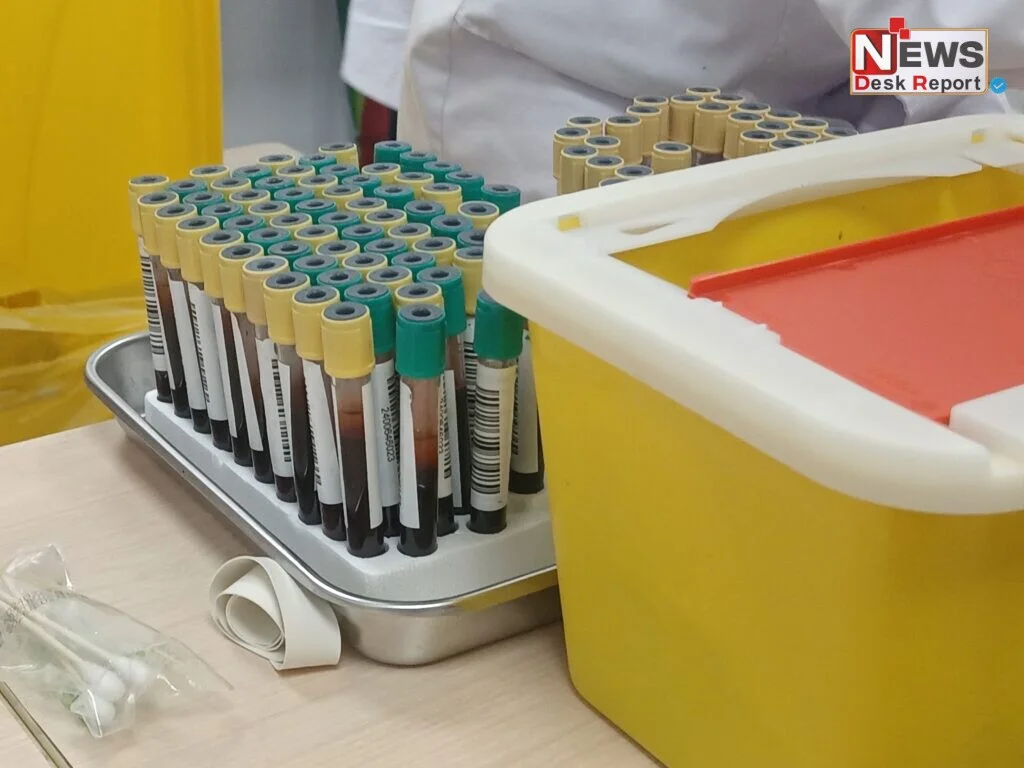
File photo: Blood test samples, 3 September 2024; not from SAMPADA fieldwork. Photo: Fumikas Sagisavas / Wikimedia Commons, CC0 1.0. Resized and branded by News Desk Report.

India’s newly released SAMPADA nutrition survey estimates that 55.9% of non-pregnant, non-lactating women aged 15–49 had anaemia, underlining a substantial health burden even as the government highlights lower prevalence than in earlier national surveys. The findings were released on 23 November; the field survey was conducted during 2023–25.
The Indian Council of Medical Research’s National Institute of Nutrition fact sheets put prevalence at 46.3% among girls aged 10–19 and 41.8% among children aged 12–59 months. The estimates refer to defined age and physiological groups, rather than a single percentage for all Indians.
What was measured
SAMPADA stands for Survey for Assessment of Markers of Population Health, Activity, Diet and Anthropometry. According to the official release, it covered more than two lakh people in over 81,000 households across 183 districts in 35 states and Union Territories. More than 1.7 lakh blood samples were analysed for haemoglobin.
The nationally representative, cross-sectional survey used venous blood and automated analysers. Its fact sheets explain that earlier national surveys used point-of-care devices. Because the measurement approach differs, the lower headline estimates should not, on their own, be read as proof of a like-for-like fall over time. Nor are these measurements of anaemia prevalence on 24 November 2026.
Why severity and group definitions matter
The government said severe anaemia affected fewer than 2% of people in most age groups. That qualification matters: the fact sheets estimate severe anaemia at 2.9% among non-pregnant, non-lactating women aged 15–49. A national summary therefore does not describe every group’s risk equally.
The survey also examined iron, folate and vitamin B12 status in a sub-sample. ICMR said the results support approaches tailored to different population groups. PTI’s report separately corroborated the release and survey coverage. More public-policy reporting is available in our National section.