


Guwahati’s solid waste management fails at every step, garbage reaches dumpsite unsegregated
The Supreme Court on August 4 directed the Union government to frame comprehensive guidelines for imposing and collecting environmental compensation for violations of the Solid Waste Management (SWM) Rules, 2026. The direction comes at a time when India’s waste management system continues to struggle with one of its most basic requirements, ensuring that waste is properly segregated, processed and disposed of.
ALSO READ: Over 200 Assam Jail Inmates Test HIV Positive, Drug Abuse Emerges as Key Concern
The SWM Rules, 2026, which came into force on April 1 this year, replaced the 2016 rules and introduced a revamped framework for garbage management across urban and rural local bodies. The new rules place greater emphasis on waste reduction, reuse, recycling and processing at source, rather than allowing cities to remain dependent on dumping yards and landfills.
India introduced its first Municipal Solid Waste (Management and Handling) Rules in 2000, followed by a revised framework in 2016. While the 2016 rules laid down provisions for waste segregation and scientific management, implementation remained a major challenge.
The 2026 rules seek to address some of these shortcomings by mandating four-stream segregation, establishing a national monitoring portal, increasing the responsibility of bulk waste generators and requiring time-bound action on legacy dumpsites.
But on the ground in Guwahati, the journey of waste tells a different story.
From the moment garbage leaves a household to the time it reaches the dumping site, segregation and processing appear to break down at multiple stages. The result is a steady movement of mixed waste towards dumpsites, while a large portion of the city’s daily garbage remains unprocessed.
What should happen to waste?
Under the new system, the journey of waste is supposed to begin at the household level.
Residents are expected to hand over segregated waste at their doorstep. From there, it should move to a primary collection point, followed by a secondary storage or transfer station and eventually a processing facility.
Wet waste should be directed towards composting or biogas generation. Dry waste should go to material recovery facilities, where it can be sorted and sent for recycling or recovery. Sanitary waste and special-care items such as paint cans, bulbs and old medicines are supposed to be handled separately at designated facilities.
Only inert waste that cannot be recovered is meant to end up at a sanitary landfill.
The system is designed to ensure that the bulk of waste does not simply travel from homes to a dumping ground.
But in Guwahati, the process is far from this prescribed journey.
How Guwahati’s solid waste moves
The Guwahati Municipal Corporation (GMC) is responsible for garbage management in the city and has engaged multiple non-government organisations (NGOs) for primary collection from households and residential complexes.
According to the GMC Mayor, door-to-door collection is the intended system, but a shortage of vehicles has affected its implementation.
“Out of 60 wards, 60 Wards GMC doesn't go everywhere. Normally, they should go door-to-door. Now, because of a shortage of vehicles, when they press the whistle, people bring out their garbage and give it. If segregated garbage is given, it stays segregated; otherwise, they segregate it themselves,” the Mayor said.
Once collected, the garbage is taken to secondary bin points across Guwahati.
There are around 70 to 80 such secondary points, according to the GMC Mayor. From these locations, GMC vehicles collect the waste and transport it to transfer stations.
“Transfer points are spread across many locations, with around 70 to 80 secondary points in total. As for major Transfer Stations, two are currently fully operational. One is functioning at full speed, and another new one is being constructed near Boragaon to handle waste from that area,” the Mayor said.
From the transfer stations, the garbage ultimately makes its way to the dumping site at Belortol near Boragaon.
“From transfer stations after a little sorting or processing, it is taken to our main dumping site. Our new dumping site is at Belortol, near Boragaon. Once taken to Belortol, about 300 tonnes of our garbage is processed daily,” the Mayor said.
However, the ground reality raises questions over how much sorting and segregation actually happens before the waste reaches the dumpsite.
Segregation breaks down at the collection stage
The most fundamental requirement of the new framework is segregation at source. Yet, this is where the system begins to falter.
At the household level, wet and dry waste are often not separated. Even where residents segregate their waste, the collection process does not necessarily preserve it.
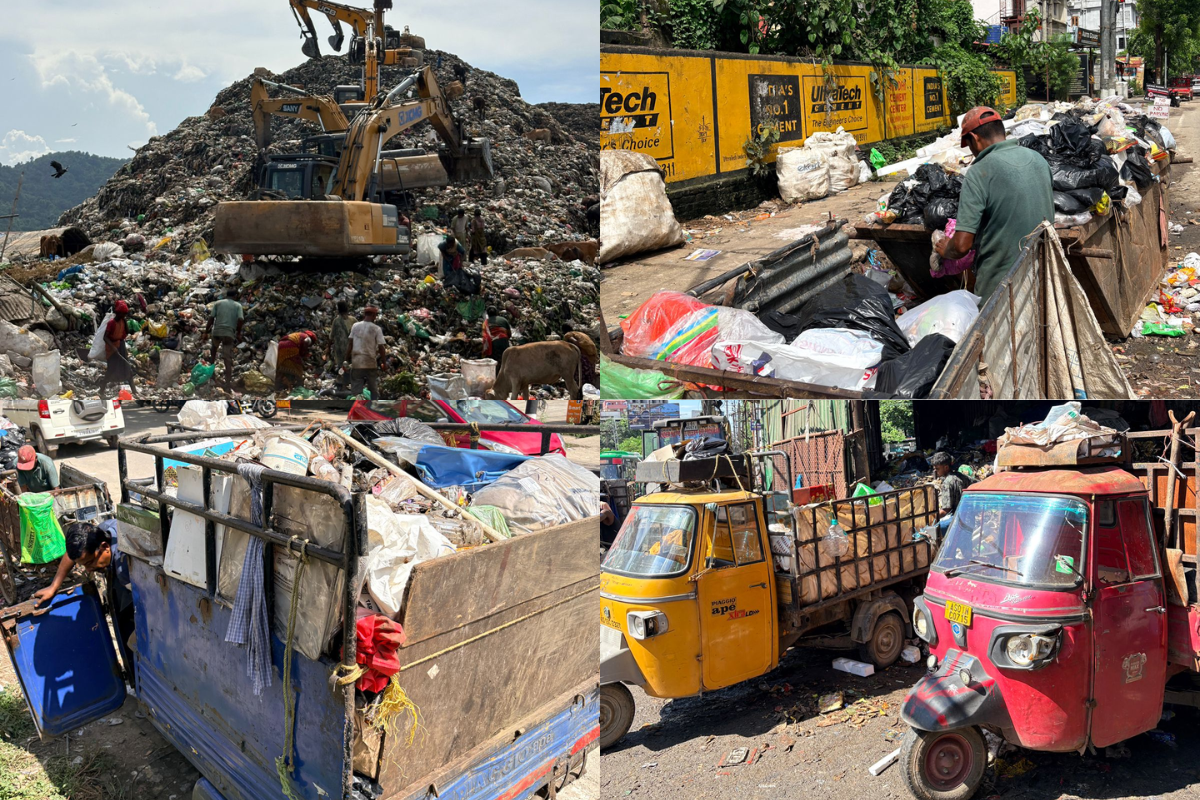
Several garbage collection vehicles observed during the ground reporting were found carrying mixed waste. Some also did not have separate compartments for wet and dry waste.
When asked why dry and wet waste were being transported together, a garbage collection vehicle driver said, “people do not give us different garbage bags resembling dry and wet garbage, so we are left with no choice but to carry altogether a mixed load of garbage.”
However, the same vehicle operating under an NGO did not have two separate compartments for dry and wet waste.
This creates a fundamental contradiction in the system. Even if a household segregates its waste, inadequate collection infrastructure can result in it being mixed again.
Segregation at source therefore risks becoming meaningless if it is not maintained throughout collection and transportation.
Secondary bin points offer little relief as ragpickers’ do the segregation
The problem continues at the secondary bin points, where waste remains largely mixed instead of being systematically segregated before transportation.
Ragpickers provide some level of segregation at these points, separating plastic bottles, single-use plastics and other recyclable material before selling them.
A ragpicker at Kahilipara said they are paid around Rs 3,000 by NGOs for separating plastic bottles, single-use plastics and other plastic material at the bin points. After selling the recovered plastic, they earn around Rs 9,000 a month.
Their work provides some recovery of recyclable material, but it is not a substitute for an organised segregation and recovery system.
The waste that remains continues towards the transfer stations in an unsegregated form.
Transfer stations see no major segregation or processing
The transfer station is supposed to play an important role in the waste management chain. According to a GMC official, the facilities have Material Recovery Facility (MRF) systems where recyclable materials such as bottles, metals and cardboard are recovered and segregated.
The remaining non-recyclable waste is then supposed to be compacted before being transported to the final disposal site.
But a different picture emerged from the ground.
A GMC supervisor at the transfer station on RGB Road near Nursery said that no such segregation of waste was taking place there.
The supervisor said the waste was being sent to the Belortol dumping site without segregation.
The contradiction between the official explanation and the statement of an official working at the transfer station raises a larger question: if segregation and recovery are not consistently taking place at the transfer stage, where exactly is the mixed waste supposed to be processed?
The answer, based on the ground situation, appears to be the dumping site.
700-800 tonnes collected, only 300 tonnes processed
The scale of the problem becomes clearer when the city’s daily waste collection and processing figures are compared.
Around 700 to 800 tonnes of garbage are collected every day in Guwahati, according to GMC officials. However, only around 300 tonnes are processed daily at the dumping site.
This leaves a significant portion of the city’s daily waste without adequate processing.
A GMC official acknowledged the gap.
“We are setting up more machines, and if we add another plant, capacity will increase,” the official said.
Until that additional capacity comes into operation, large quantities of waste continue to accumulate.
The legacy waste mountain in Guwahati’s Boragaon
Years of inadequate processing have already created a massive legacy waste problem in Guwahati.
Legacy waste refers to old garbage that has accumulated over the years at the dumping site.
According to the GMC official, waste had earlier been accumulating at nearly 1,200 metric tons a day. When private company Zigma surveyed the site around 2019-20, it found approximately 15 lakh tonnes of legacy waste.
“Zigma, a private company handles the legacy waste, the old waste, what was accumulated over the past years. Earlier, waste was continuously dumped, nearly 1200 metric tons was getting accumulated daily.
After giving the contract to Zigma, when they surveyed it around 2019-20, they found 15 lakh tons of legacy waste. We asked them to process it, and bit by bit, they are handling it now,” the official said.
The existence of this legacy waste reflects years of insufficient processing capacity.
As new mixed waste continues to arrive, the city faces the challenge of dealing with both its accumulated waste and fresh waste generated every day.
A system that creates its own waste burden
The central problem is not simply the quantity of garbage generated in Guwahati, but what happens to it after it is generated.
Waste that could potentially be composted, recycled or recovered becomes difficult to process once different categories are mixed together.
Contaminated organic waste cannot easily be used by composting facilities, while recyclers may not accept soiled paper and plastic. Consequently, waste that could otherwise have been recovered is pushed towards disposal.
The result is a system where waste travels through household collection, secondary bins, transfer stations and finally the dumping site without consistent segregation and processing.
The new SWM Rules, 2026, seek to move India away from precisely such a landfill-dependent approach.
But rules alone cannot change the way a city handles its garbage.
For Guwahati, the immediate challenge is to ensure that segregation begins at the household level and is maintained throughout collection, transportation, transfer and processing. It also requires adequate vehicles, appropriate collection infrastructure, functioning recovery facilities and sufficient processing capacity.
At present, the gap between what the system is supposed to do and what happens on the ground remains stark.
Guwahati collects hundreds of tonnes of garbage every day. Yet a significant portion does not undergo the processing required to keep it out of the dumping ground.
Until that gap is addressed, the city’s garbage problem will not simply remain a waste management issue; it will continue to create an ever-growing mountain of waste that the city will eventually have to confront.


