


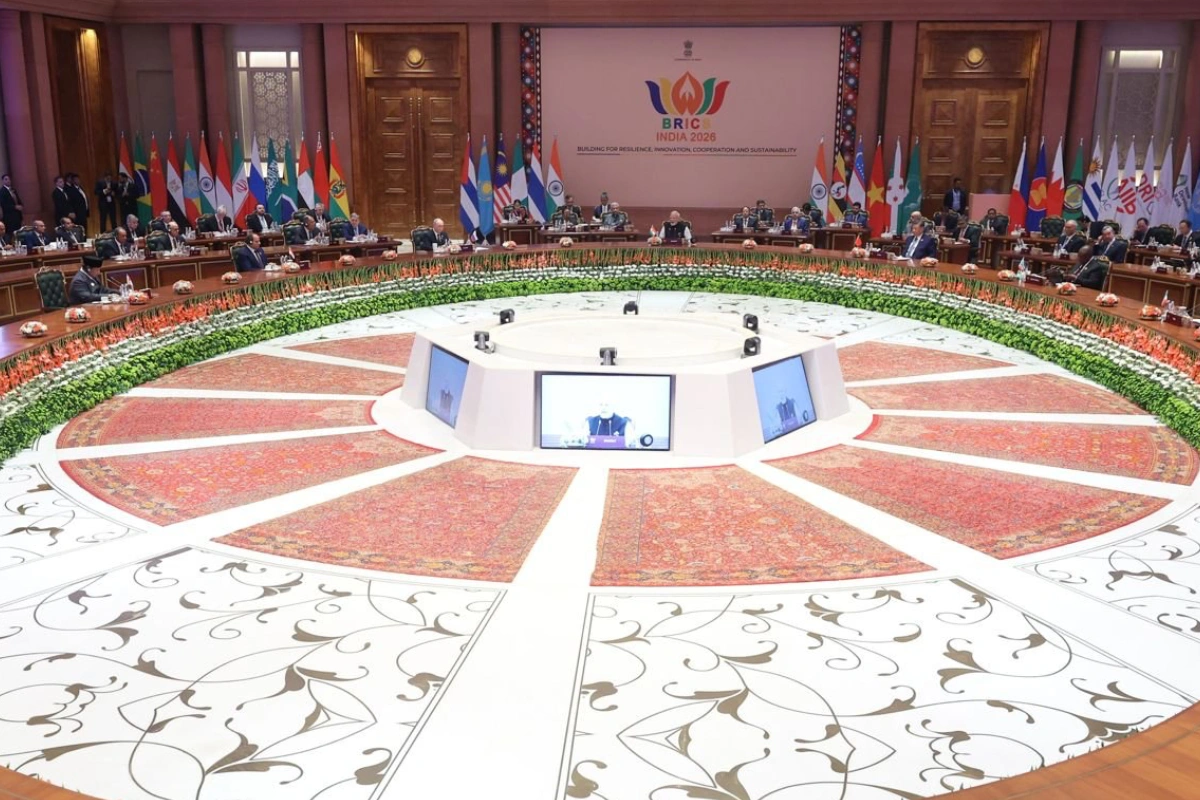
GUWAHATI: The BRICS countries on Saturday, September 12, unanimously adopted the New Delhi Declaration 2026 at the 18th BRICS Summit in New Delhi, marking a diplomatic success for India despite differences among member states over the ongoing crisis in West Asia.
ALSO READ: Greater One-Horned Rhino Population Reaches 4,075 Globally, Assam Accounts for Nearly 80%
The 45-page declaration, comprising 140 points, was adopted under the theme “Strengthening Cooperation to Promote Fair Competition, including in Renewable Energy Markets,” with a focus on sustainable energy transitions and greater economic cooperation among member countries.
Prime Minister Narendra Modi announced the adoption of the declaration at the conclusion of the opening day’s deliberations, in the presence of Chinese President Xi Jinping, Russian President Vladimir Putin and Iranian President Masoud Pezeshkian.
“No member has raised any objection. The New Delhi Declaration 2026 is adopted unanimously,” Modi said at the summit.
Diplomatic consensus amid West Asia tensions
India's successful effort to secure a consensus declaration came despite divergences between Iran and the United Arab Emirates over the West Asia crisis. Since BRICS operates on consensus, any objection from a member state could have prevented the adoption of a joint declaration.
While the document refrained from directly addressing the ongoing war or naming Iran in the context of the conflict, it called for dialogue and diplomacy to resolve international disputes. The declaration also condemned unilateral acts of war and stressed the importance of ensuring the safety of seafarers and commercial navigation amid military aggression in the Middle East.
It called for the protection of civilians and civilian infrastructure in accordance with the UN Charter, while emphasising respect for the sovereignty and territorial integrity of states.
Call for UN Security Council reforms
A key focus of the declaration was the need to reform multilateral institutions, including a “structural update” of the United Nations Security Council (UNSC).
The document called for greater representation of developing countries from Africa, Asia, Latin America and the Caribbean in global decision-making bodies.
China and Russia, both permanent members of the UN Security Council and represented at the summit, reiterated their support for the aspirations of Brazil and India to play a greater role at the United Nations, including on the Security Council.
“Today's discussion makes it evident that the changing world cannot be steered by outdated institutions; reforms are essential in representation, responsiveness and rule-making,” Modi said in his concluding remarks.
He also stressed the importance of ensuring equal participation for the Global South in the development of future technologies and the rules governing them.
Strong condemnation of terrorism
The BRICS declaration endorsed India's zero-tolerance policy towards all forms of terrorism and called for an end to double standards in counter-terrorism efforts.
The grouping condemned in the “strongest terms” the Pahalgam terror attack in Jammu and Kashmir in 2025, which killed 26 people.
The declaration backed a concerted international approach to combating terrorism and reaffirmed the need for cooperation among member states in addressing security challenges.
BRICS raises concerns over trade restrictions and sanctions
On economic cooperation, the declaration expressed serious concerns over the growing use of unilateral tariff and non-tariff measures that distort trade and are inconsistent with World Trade Organization (WTO) rules.
It criticised protectionist policies introduced under the guise of environmental objectives, warning that such measures could further reduce global trade, disrupt supply chains and create uncertainty in international commerce.
The declaration also called for increasing the use of local currencies in intra-BRICS trade instead of relying predominantly on the US dollar.
Without directly naming the United States, the grouping condemned unilateral coercive measures, including economic and secondary sanctions. It said such measures negatively affect the rights to development, health and food security of targeted states, disproportionately impacting vulnerable populations and deepening the digital divide.
India is chairing BRICS in 2026 under the theme “Building for Resilience, Innovation, Cooperation and Sustainability.”


