



KSU rally violence in Shillong spills into Assam, disrupting travel and straining ties between states
Violence during a Khasi Students’ Union (KSU) black-flag rally in Shillong on Wednesday has triggered tension between Assam and Meghalaya, with Assam-registered vehicles allegedly targeted during the unrest and Meghalaya-registered vehicles subsequently stopped in Assam.
ALSO READ: How Close Is Too Close? Guwahati Navigates Changing Relationship Boundaries at Work
What began as a protest over a five-point charter of demands before the Meghalaya government quickly escalated into vandalism and clashes, disrupting the movement of vehicles between the two neighbouring states and raising concerns over the impact on ordinary commuters, businesses and tourism.
The KSU rally was held in Shillong on Wednesday afternoon after the organisation pressed the Meghalaya government over five key demands. During the rally, the situation turned violent, with several vehicles, particularly those bearing Assam registration numbers, being vandalised and attacked. Stones and sticks were also reportedly pelted at vehicles.
Videos circulating on social media showed people throwing stones, kicking vehicles and jumping on top of cars while raising slogans. Several vehicles were damaged during the unrest, while allegations of assaults and damage to public property also emerged.
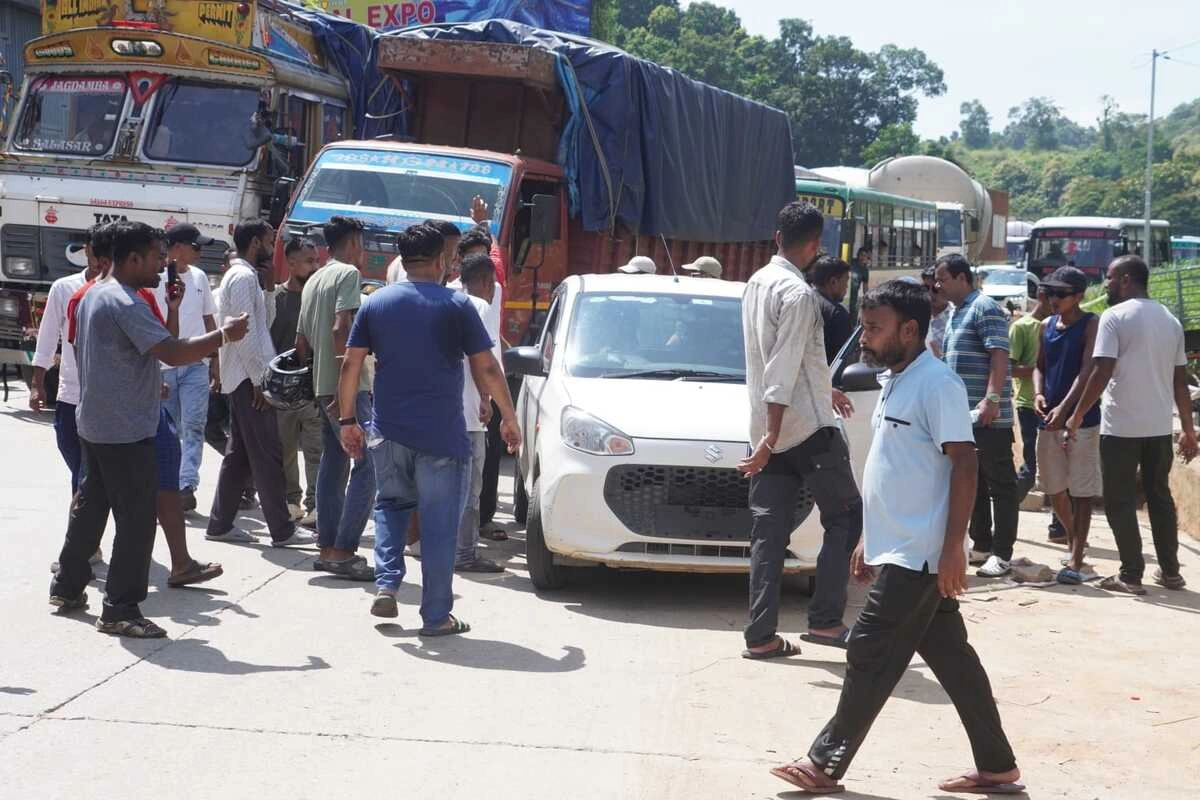
The situation soon spilled over into Assam. Following the circulation of videos showing Assam-registered vehicles being targeted in Shillong, vehicles from Meghalaya were stopped and pushed back from the Assam side, particularly in the Jorabat area of Guwahati, on Thursday. The disruption continued into Friday, leaving commuters and transport operators caught in the fallout.
The developments have raised concerns that an incident originating from a protest over issues within Meghalaya could increasingly take on an interstate dimension.
KSU's Five Demands
> The KSU's first demand was that the July 31 public hearing on the proposed Shree Cement project be declared null and void. It also sought departmental proceedings against the Deputy Commissioner, Superintendent of Police and members of the Meghalaya State Pollution Control Board involved in conducting the hearing.
> The second demand was the implementation of the Meghalaya Residents Safety and Security Act (MRSSA), 2016.
> The third called for the implementation of the Migrant Workmen Act Amendment, 2020.
> The fourth concerned various issues at the NEIGRIHMS, which the union said remained unresolved despite assurances from the government.
> The fifth demand related to transparency in government recruitment, including the abolition of personal interviews and reforms in the Meghalaya Public Service Commission and standard operating procedures for other recruitment boards.
A day after the violence, Meghalaya Deputy Chief Minister Prestone Tynsong rejected allegations of an intelligence failure during the KSU rally, saying permission had been granted after the organisers assured the authorities that the protest would remain peaceful.
“There is no such failure, but you need to understand one thing. When you look at social media, you could have seen it because these people, when they ask permission, the permission was granted with conditions,” Tynsong told the media.
He said KSU members had assured the government that the rally would conclude in “a very, very peaceful manner, and with dignity.”
However, he said that assurance was not upheld, pointing to the visuals of violence that emerged from Shillong.
Tynsong also said several people involved in the violence had covered or masked their faces and concealed the registration plates of their two-wheelers.
“This attitude clearly shows that their intention is not for the peace rally, not for the rally which they sought for, but it seems something else. So therefore, let me just tell you one thing, law will take its own course.
We will not allow this kind of things to happen,” he said.
The Deputy Chief Minister also appealed to citizens to remain calm, assuring them that the government would ensure their safety and that normal daily life continued.
Meanwhile, East Khasi Hills Deputy Commissioner Abhilash Baranwal appealed to the KSU to suspend further processions, saying Shillong needed time to recover from the violence during the August 19 rally.
Baranwal said the appeal was not intended to curb democratic rights but to “give Shillong space to breathe and heal.”
“From administration, we understand that as of now, the city is healing and the city is still recovering from the trauma that it suffered on Wednesday,” he said.
The DC said several children who witnessed the violence were still experiencing fear and trauma.
“What this city needs at this point is calm, restraint and some time to heal,” he said.
He urged the KSU to respect the orders issued by the administration and refrain from holding processions or sit-ins that could lead to confrontation with security forces.
“This order is not to curb any democratic right. This order has been brought out just to be able to afford the opportunity to residents of Shillong to breathe, to recover and to heal,” Baranwal said.
He also appealed to KSU members to consider the impact of further confrontation on children and families who had already witnessed the violence.
The East Khasi Hills district administration subsequently issued an order restricting large gatherings along with other law-and-order measures to prevent any further untoward incident.
Amid the tensions, allegations of excessive use of force by police personnel emerged after officers entered the KSU office in Jaiaw to apprehend some of its leaders late on Wednesday.
The allegations were rejected by East Khasi Hills Superintendent of Police Vivek Syiem, who said police went to the office to arrest members allegedly involved in the vandalism.
According to the SP, police faced resistance and petrol bombs were hurled at them, forcing personnel to use tear gas.
“That is not a fact,” Syiem said while rejecting the KSU's allegation of excessive use of force.
“In fact, police went there to arrest some of the members because they were involved in this whole vandalisation of vehicles and all that. But when the police went there, then they were received with stiff resistance and all that. Petrol bombs were thrown at the police, for which they had to, or they were forced to use tear gas just to disperse them,” he said.
KSU president Raymond Kharjana, general secretary Reuben Najiar and vice-president Pynkmenlang Sanmiet were arrested late Wednesday evening and taken to Sadar Police Station.
On Thursday, they were produced before a court and reportedly sent to 14 days of judicial custody.
The case against the three KSU leaders was registered under several provisions of the Bharatiya Nyaya Sanhita (BNS), including sections relating to unlawful assembly, assault and attempt to murder. It also includes Section 3(2) of the Prevention of Damage to Public Property Act and provisions under the Meghalaya Maintenance of Public Order Act.
The SP Syiem said police had trusted the rally organisers to comply with the conditions imposed while granting permission, but that trust had been broken.
“Since permission was sought for, we reposed that trust and we deployed police at strategic points only. But all these acts, criminal acts, were committed in places where police were not there, where police were far and few,” he said.
The SP added that failure to comply with conditions imposed on future rallies could make it difficult for organisations to obtain permission.
As the movement of vehicles between Assam and Meghalaya came close to a standstill on Thursday, the situation began to affect commuters, transport operators and businesses on both sides.
Vehicles bearing Meghalaya registration numbers were stopped in parts of Assam, while vehicles travelling from Assam towards Meghalaya also faced disruption.
The disruption came in response to the targeting of Assam-registered vehicles during the Shillong violence, but also raised concerns about ordinary commuters becoming caught in a cycle of retaliation.
The consequences were particularly significant for people who regularly travel between Guwahati and Shillong for work, education, business, healthcare and tourism.
Amid the escalating tension, Meghalaya Chief Minister Conrad K Sangma held a telephonic conversation with Assam Chief Minister Himanta Biswa Sarma, with both governments seeking to prevent further escalation and restore normal movement between the two states.
Following the conversation, Sangma said both states had agreed to work together to normalise the situation.
“Designated Cabinet Ministers from both States will meet to take the discussions forward and explore ways to restore peace, trust and normalcy. Appeal to citizens of both States to maintain peace, harmony and restraint,” he said.
Sangma stressed that Meghalaya and Assam shared deep bonds and called for collective efforts to protect those ties.
Sarma also conveyed Assam's concern over the incidents in Shillong, particularly those involving Assam-registered vehicles.
The Assam Chief Minister said Cabinet Minister Atul Bora had been asked to coordinate closely with the authorities in Meghalaya and work towards ensuring that peace and normalcy prevailed between the two states.
“Assam and Meghalaya are sister States, bound by deep historical, cultural and people-to-people ties. Mutual respect, restraint and sensitivity must guide us at all times,” Sarma said.
He added that both states must work to preserve the harmony, friendship and goodwill that have long defined relations between their people.
The KSU's demands concern issues within Meghalaya, but the violence quickly spilled beyond the protest, with Assam-registered vehicles targeted in Shillong and Meghalaya-registered vehicles subsequently stopped in Assam.
The fallout has affected people far removed from the dispute. Businesses, transport operators, tourists and daily commuters on both sides are bearing the consequences of a conflict they had no part in.
The KSU does not represent every Khasi, just as an incident involving people from one state cannot define an entire community. What matters now is preventing individual acts of violence from turning into wider hostility between Assam and Meghalaya.
Both states share deep social, economic and people-to-people ties. Restoring normal movement, ensuring accountability for the violence and preventing retaliatory actions must remain the immediate priorities.
When tensions rise between neighbouring states, it is ultimately ordinary people who pay the price. That is why Assam and Meghalaya must ensure that the latest confrontation does not become another cycle of mistrust and retaliation.


