



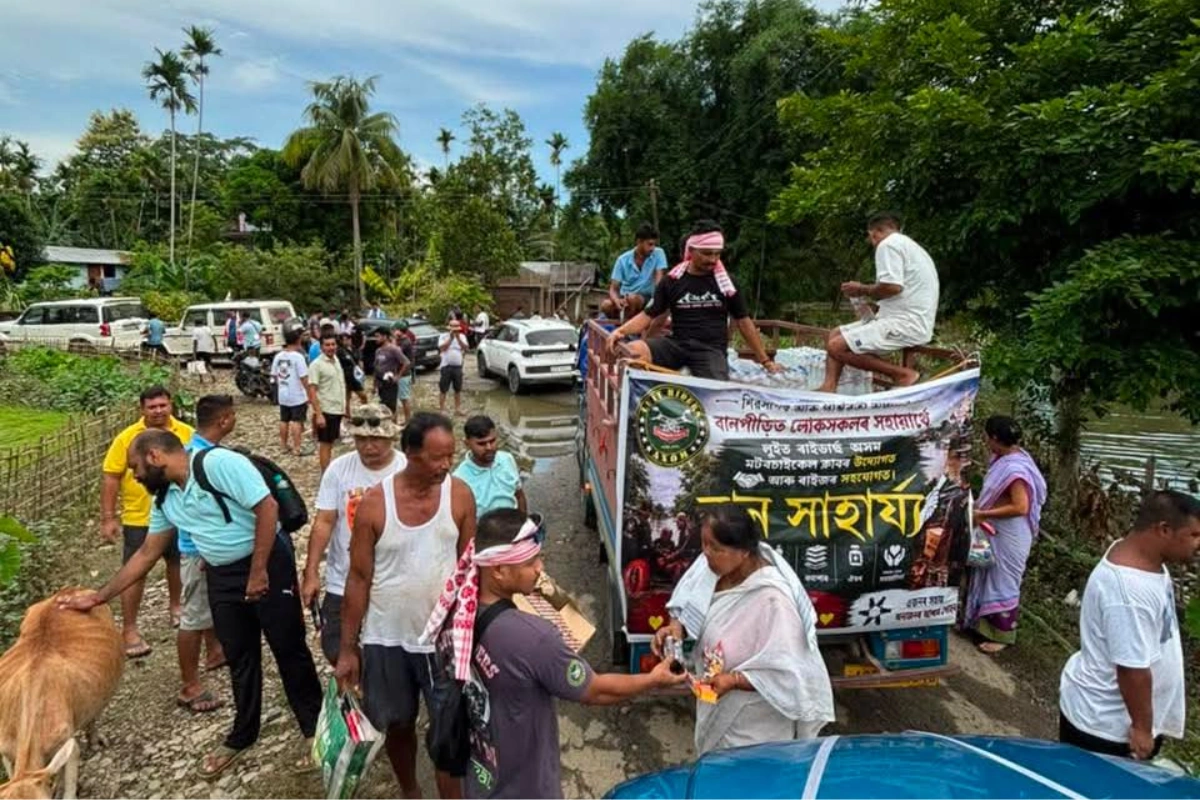
From relief materials to medical camps, people across Assam are coming together to support flood-hit communities
For Assam, floods have long been more than a natural disaster; they have become an annual reality that shapes the lives of millions. Every monsoon, swollen rivers, particularly the Brahmaputra and its tributaries, inundate villages, damage homes, destroy crops, and displace thousands of families. While the state has witnessed decades of discussions around flood management and mitigation, the humanitarian response from ordinary citizens has remained one of the strongest constants.
ALSO READ: Power Cuts, Food Shortages and Business Losses Add to Sivasagar's Flood Woes
The spirit of helping those in distress has long been deeply rooted in Assam's history. During the devastating floods of the 1970s, renowned singer Jayanta Hazarika, along with several artists, inspired hope through the initiative Xur Bahini. One of his most memorable songs, "Luitor Boliya Baan, Toi Koloinu Dhapoli Meliso," became a poignant reminder of the Brahmaputra's untamed nature and the resilience of the people living along its banks. More than five decades later, the river continues to overflow almost every year, while the message of solidarity carried through music still resonates across the state.
The floods of 2026 have once again left a trail of destruction across Assam. As this report was being filed, the official death toll in the state had reached 80. Districts in Upper Assam, including Sivasagar, Charaideo, Jorhat and Dibrugarh, remain among the worst affected, with thousands of people struggling to rebuild their lives after losing homes, livelihoods and essential belongings.
Yet, amid the devastation, countless individuals, community groups, non-governmental organisations and volunteers have stepped forward to provide relief. Their efforts go beyond distributing food; they seek to restore dignity, provide healthcare, improve sanitation and support vulnerable sections of society.
One such initiative is being led by Tezpur-based singer Bidisha Devi, who, along with a small team of five to six members, decided to organise a flood relief drive after witnessing the scale of the crisis. According to Bidisha, the idea took shape around July 18 or 19, when the group began mobilising resources with the hope of making a meaningful difference.
Initially, donations arrived gradually, allowing the team to plan the distribution of essential commodities such as food supplies and sanitation materials. Their first objective was to reach more than 600 affected individuals with basic relief materials.
As public support continued to grow, the initiative expanded in scope. Bidisha shared that many of her friends living outside India also contributed generously alongside local donors, enabling the team to address the needs of more vulnerable sections of the flood-hit population.
"When more funds came, we thought of helping pregnant women, and got lists of women from Joysagar Outpost," she said.
The team began this specialised initiative on July 30, visiting Betbari village. During their first visit, they assisted two expectant mothers, including one woman who was nine months pregnant. Besides providing Rs. 2,500 in financial assistance, the women also received dry fruits, cereal and Mother's Horlicks to support their nutritional requirements during pregnancy.
Bidisha added that the team intends to provide similar assistance to other pregnant women identified through the local administration, with a target of reaching around 50 beneficiaries.
While Bidisha Devi's team has focused on vulnerable mothers, another volunteer-driven initiative has concentrated on delivering essential food supplies and preparing for long-term health interventions.
A group of riders from Guwahati and Dibrugarh has been actively travelling to remote flood-affected villages to distribute relief materials. Speaking about the first phase of their operation, team member Mr. Sarma said they had already covered several villages, including Hahsora, Chetia Gaon, Bhajoni Gaon, Digholpasi Gaon, Latum Gaon and Hilakuti, among others.
The volunteers distributed essential food items such as rice, pulses, edible oil and milk to nearly 600 people affected by the floods.
However, the group's plans extend beyond immediate food relief. Mr. Sarma explained that the second phase of their campaign would begin on Sunday in Nimaijan, where the focus would shift towards healthcare and sanitation.
The team plans to organise health check-up camps while simultaneously distributing hygiene kits and medical essentials, including soap, medicines, mosquito coils, oral rehydration solution (ORS), antiseptics, sanitary napkins etc. The initiative reflects the growing recognition among volunteers that disease prevention becomes equally important once floodwaters begin to recede.
Healthcare has also become the central focus of another large-scale relief initiative spearheaded by a trust led by noted writer Rita Choudhury.
The trust organised a comprehensive three-day flood relief drive across multiple locations, combining medical assistance with community outreach.
On the first day, a health camp was organised at Panibeel in Jamunamukh Rangamanch Auditorium. The second day witnessed another medical camp at Hulang Katoni, hosted at Khanamukh Dupohia School. The final phase of the programme was conducted at Sontok Bihubor Nepali Khuti, with organisers targeting between 500 and 600 beneficiaries over the course of the three-day campaign.
Speaking about the effort, team member Rituparna Bordoloi highlighted the collaborative nature of the initiative.
"The team was assisted by a group of doctors and nurses from USTM with medicines provided by GMCH, and we were also associated with the Lady Doctor Association," she said.
She further acknowledged the support received from local residents, noting that community participation significantly strengthened the relief operations.
"Many local people also came forward to help us, and we are always grateful to them," she added.
The involvement of healthcare professionals has played a crucial role in addressing post-flood medical concerns, particularly in areas where access to hospitals and primary health centres remains difficult due to damaged roads and inundated villages.
Meanwhile, another volunteer group from Sonapur has adopted a different strategy by combining relief distribution with on-ground volunteering. Rather than making short visits, the team intends to stay in the affected areas for several days to ensure sustained assistance.
Pallab Medhi, one of the members of the Sonapur-based group, said sanitation remains their primary concern, especially in flood-affected villages where poor hygiene often leads to outbreaks of waterborne diseases.
"Our main motive is to provide sanitisation. We will also provide food that can last families for three to four days, and we plan to stay there while carrying out the relief work," he said.
According to Medhi, nearly 20 volunteers will participate in the initiative, working directly with local communities to distribute supplies and improve sanitation conditions in flood-hit areas.
Although each organisation has adopted a different approach, some focusing on food, others on healthcare, maternal welfare or sanitation, their common objective remains the same: reaching people who need help the most. The combined efforts of artists, riders, doctors, social workers and local volunteers demonstrate how community-led action often becomes the first line of support when disasters strike.
As Assam continues to grapple with recurring floods year after year, the stories emerging from this year’s relief effort serve as powerful reminders that resilience is built not only through infrastructure but also through collective compassion. From financial assistance for pregnant women to medical camps in remote villages, from food distribution to sanitation drives, these initiatives reflect the unwavering commitment of ordinary people determined to stand beside those facing extraordinary hardship.
While the Brahmaputra continues to test Assam every monsoon, it also reveals another enduring truth: that in times of crisis, the state's greatest strength lies in its people. Their willingness to volunteer, donate and work together ensures that even amid loss and uncertainty, hope continues to flow alongside the river, offering affected communities the courage to rebuild and move forward.


