



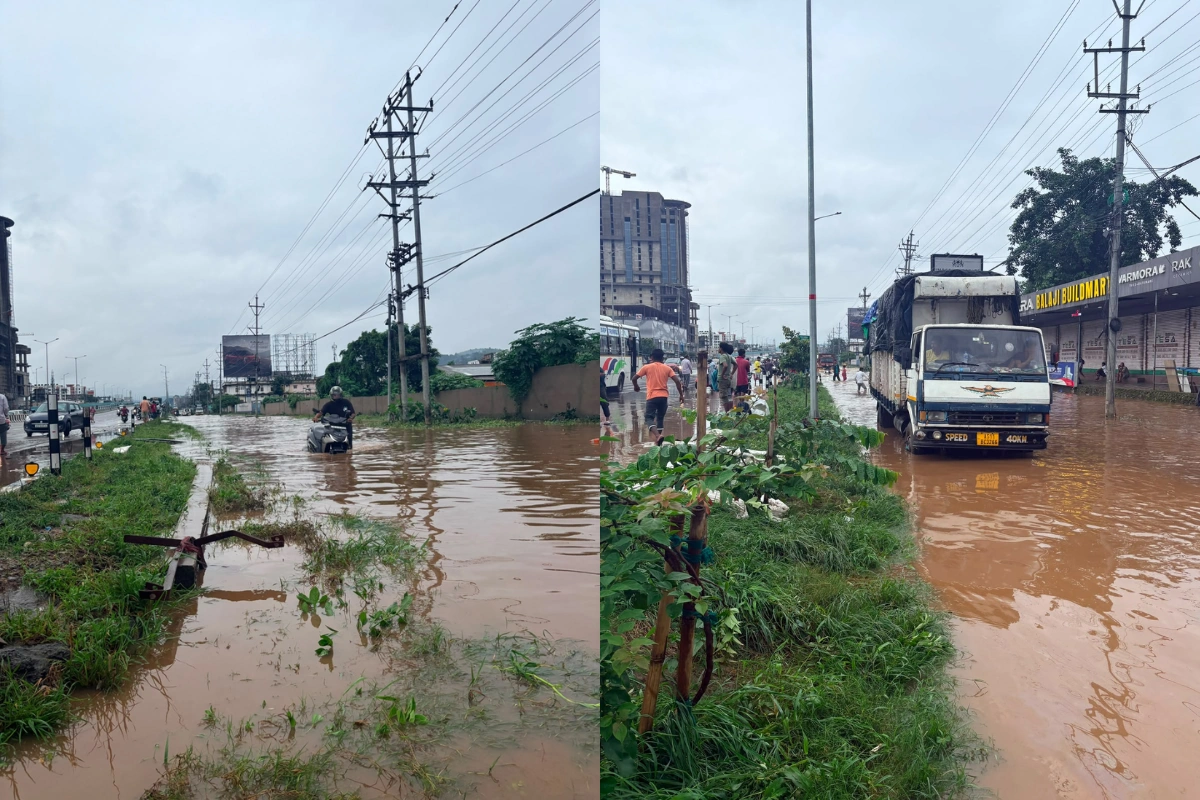
NH-27 faces repeated waterlogging during heavy rain, affecting commuters, businesses and residents along the stretch
On Guwahati’s National Highway 27 bypass, it does not take hours of rainfall for traffic to come to a standstill. Residents living along the 23-kilometre stretch between Jalukbari and Khanapara say that just 30 minutes of incessant rain is enough to leave roads submerged, service lanes inundated, shops flooded and vehicles stranded.
ALSO READ: Ground Report: Floods Leave Sivasagar Families Homeless, Crops and Livestock Washed Away
The irony is difficult to miss. More than Rs. 300 crore has been spent on constructing four major six-lane flyovers at Boragaon, Gorchuk, Lokhra and Basistha to improve connectivity and ease congestion along one of the Northeast’s busiest transport corridors. Carrying nearly 50,000 vehicles every day, the highway serves as a crucial gateway connecting Guwahati with Upper Assam, Shillong and other parts of the region.
Yet, every spell of heavy rain brings back the same problem: waterlogging.
For residents and shopkeepers living alongside the highway, flooding has become a recurring ordeal.
“There is a tremendous amount of waterlogging here. All the water coming down from the Basistha flyover flows straight into our shops and onto this road,” said a shopkeeper in the Khanapara-Koinadhara area. “The water becomes knee-deep. Drains overflow in reverse, and after just one to one-and-a-half hours of rain, it becomes impossible for people or motorbikes to pass.”
Another resident near Basistha raised similar concerns, saying rainwater regularly enters shops and residential compounds.
“Water accumulation is very high here. All the runoff ends up in this area. Just two to three hours of rain submerges the locality. Work has been going on, but the problem continues,” the resident said.
Several residents claimed that the situation has become noticeably worse in recent years.
A resident who regularly travels along the Khanapara-Jalukbari stretch said areas that earlier remained unaffected now witness flooding even after brief spells of rainfall.
“Footpaths that were once safe from waterlogging now get completely submerged. Even 20 to 30 minutes of rain causes water to rise onto footpaths and enter verandas and shops. This level of flooding was not present in previous years. It has become severe after the construction of the flyover, as clogged drains cause backflow,” the resident said.
Similar complaints were reported from Nalapara along the service road.
“We had nearly two feet of water entering our compounds. Waterlogging existed earlier too, but it was never this severe. The drains need to be cleared and deepened because all the runoff from nearby areas collects here,” another resident said.
The flooding is not limited to Khanapara and affects multiple points along the corridor.
Near the ISBT flyover, residents and business owners said heavy rain frequently disrupts daily life.
“There is a Balaji Mandir alongside the ISBT flyover. During heavy rainfall, water entered the temple and remained waist-deep for nearly a week. They had to close the main gate, and we could not even open our shops.
Half an hour of heavy rain is enough to flood the entire road and stop the movement of vehicles and people,” said a street vendor.
Another resident near Excel Care Hospital described similar conditions.
“Just one hour of rain creates severe waterlogging and massive traffic jams. Vehicles stall, pedestrians cannot cross, and the service road under the flyover becomes knee-deep in water. Hospital staff, patients and visitors face immense difficulty. The drainage system should be cleaned during the dry season because waterlogging has become worse after the flyover’s construction,” the resident said.
According to the National Highways Authority of India (NHAI), the highway itself has a dedicated drainage system with 14 outlets designed to carry water away from NH-27.
However, officials said the infrastructure is now handling far more water than it was originally designed for.
“While there are only 14 designated drainage outlets, nearly 144 inlets from different parts of Guwahati discharge water into the highway’s drainage network. As a result, runoff from across the city converges onto the national highway, overwhelming the existing system during periods of heavy rainfall,” an NHAI official said.
NHAI officials said they have already written to the Assam government seeking a long-term solution to the problem.
They also maintained that agencies responsible for maintaining city drains, including the Guwahati Municipal Corporation (GMC), must ensure that drainage channels remain free of garbage and obstructions so that water can flow without blockage.
A GMC official, however, said the drainage challenge cannot be viewed in isolation.
According to the official, NH-27 required a drainage system designed specifically for Guwahati’s geographical conditions.
“NHAI should have built a better drainage system because the conditions in Guwahati are different from other cities,” the GMC official said.
The official added that the Guwahati Metropolitan Development Authority (GMDA) is currently constructing a stormwater drainage system alongside the national highway.
The GMC official also pointed to the city’s topography and rapid hill cutting as factors aggravating the situation.
“When it rains, water flows aggressively from the hills towards National Highway 27. Extensive hill cutting has increased the speed and volume of runoff, which is why even a short spell of rain causes waterlogging on the highway,” the official said.
The GMC official stressed that no single agency can solve the problem alone and called for coordinated action among all civic bodies.
The recurring flooding along NH-27, despite significant investment in flyover infrastructure, highlights a larger urban planning challenge.
While the flyovers have improved traffic movement above ground, residents say the roads beneath continue to struggle with inadequate drainage whenever heavy rain occurs.
With multiple agencies responsible for roads, stormwater management and urban development, the lack of coordination has emerged as a major concern for residents and commuters who face repeated disruptions every monsoon.
As Guwahati continues to expand and rainfall patterns become increasingly unpredictable, residents warn that temporary solutions will not be enough. Without a comprehensive drainage plan, regular maintenance and infrastructure designed to handle rising water flow, stretches of NH-27 may continue to remain vulnerable to flooding, affecting businesses, emergency services, commuters and thousands of residents living along the corridor.


