


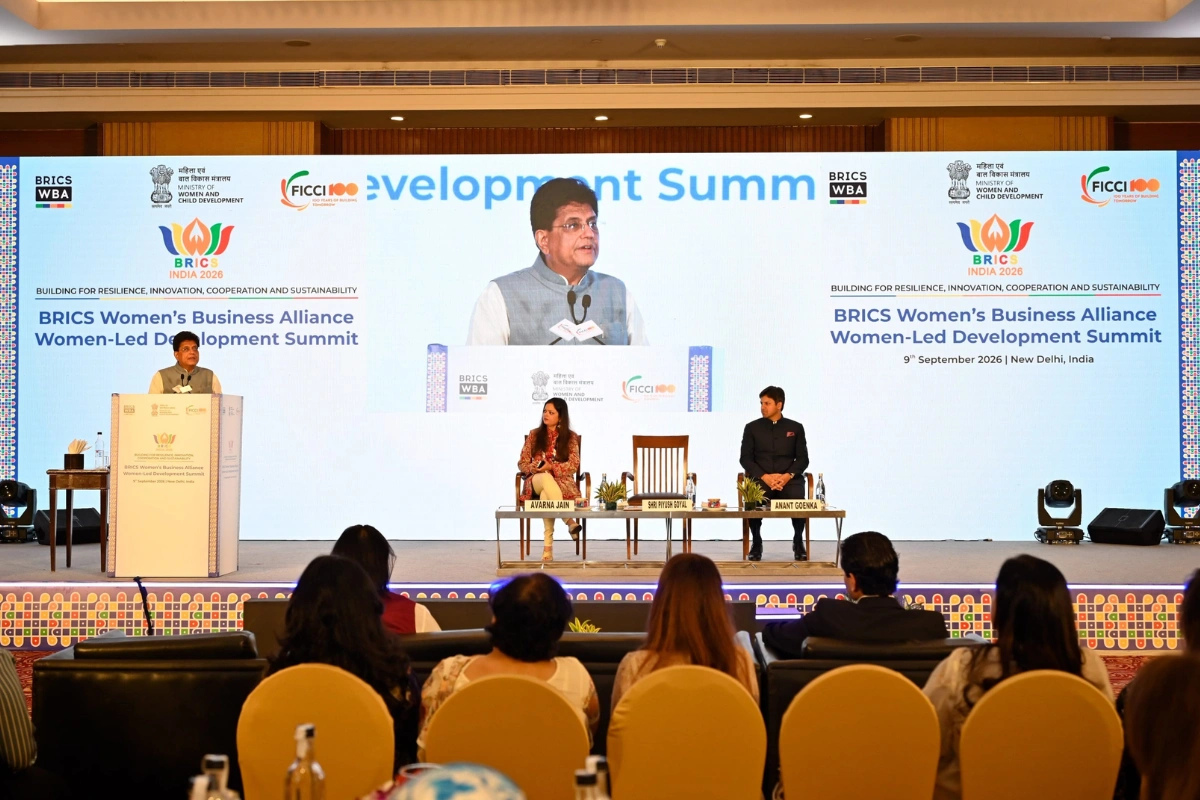
GUWAHATI: Union Minister of Commerce and Industry Shri Piyush Goyal on Wednesday, September 9, called upon BRICS countries to work together to expand opportunities for women entrepreneurs and women-led enterprises in international trade, stressing the need for easier access to credit, markets and predictable rules of business.
ALSO READ: Bilpar Durga Puja Committee in Guwahati’s Rehabari to Celebrate Diamond Jubilee with Diamond-Themed Pandal
Addressing the BRICS WBA Women-Led Development Conference, he said that an entrepreneur seeking to enter international business has to cross three key borders: access to credit, access to buyers and markets, and access to predictable rules that encourage free trade and open opportunities.
Goyal said India would like to bring the lessons learnt from its experience in addressing the challenges faced by entrepreneurs, particularly women entrepreneurs, to the BRICS Women’s Business Alliance and the larger BRICS business engagement. He said India has focused on empowering women financially, socially and through education, skills and improved quality of life, with the objective of making women the drivers of the country’s growth.
Highlighting India’s experience in expanding financial inclusion among women, Goyal said that around twelve years ago, most women, particularly in rural India, did not have bank accounts, assets in their own names or credit histories and were often not eligible for loans. He said India has since put houses in the names of women, opened nearly 300 million bank accounts for them and provided collateral-free loans to women seeking to start their own work, including those without a credit history.
He said around 100 million rural women are today members of nine million self-help groups, small cooperatives or groups of women working together on different ideas and enterprises.
The number of women earning more than ₹1 lakh in personal income has crossed 30 million. These women are referred to as ‘Lakhpati Didis’, he said, adding that India hopes to continue expanding both their number and their income.
Goyal said that India has provided around 560 million loans to small entrepreneurs, with more than 68 per cent of these loans going to women entrepreneurs.
He said the objective is to ensure that women become economically independent and are not dependent on other family members. He added that when women stand on their own feet, they can become drivers of India’s growth engine.
He noted that India’s female workforce participation had been around 19 per cent until about a decade ago and expressed confidence that as income levels rise, education improves, skills develop and talent comes forward, the number will increase to 50 per cent or more.
He said that in developed societies, the proportion of women in the formal workforce has crossed 50 per cent. Goyal emphasised that India can achieve a significant delta in economic growth as more women enter the formal workforce.
He said the government’s effort is to ensure equal opportunity and availability of the tools required for a person to start a business or become an earning member of the family.
This, he said, is the essence of women-led development, as distinct from merely women development.
Goyal said that educating or skilling a woman supports the entire family, as she leads the family and helps provide children with a better future.
He said that across various schemes and programmes focused on women’s development and women-led development, women should not be viewed merely as beneficiaries but as the architects of New India.
On expanding access to international markets, Goyal referred to the meeting of BRICS Commerce and Industry Ministers held in Jaipur last month, where ministers agreed on voluntary principles for assessing small exporters.
He said the assessment should not be based only on invoices and payments, but also on the entrepreneur’s ability and the change from the past to the present and the future.
He said foreign trade should not be viewed only as a collateralised business, but as an opportunity to integrate societies and businesses and provide opportunities to marginalised sections that may otherwise never imagine going overseas.
He said BRICS countries had also agreed in the Jaipur Consensus to explore a common BRICS platform for international trade, which could help address the second challenge faced by entrepreneurs, namely access to markets and buyers.
Goyal said that once such a platform is built, a product requirement in any one BRICS member country could be known to the other members, while invoices raised between participants could also be publicised and made known across the platform.
He said a number of financial intermediaries could join the platform to support women entrepreneurs and small entrepreneurs as trade among BRICS countries expands.
Referring to the BRICS work plan on member countries’ shared understanding on global value chains, Goyal urged governments to encourage women-owned enterprises to participate more actively in international expositions, conferences, seminars, exhibitions and business forums.
He said this would enable engagement across multiple platforms.
He urged BRICS countries to consider more women-led business delegations on a sectoral basis. He suggested that BRICS countries could organise sector-specific women-led delegations, such as a fully women-led textile delegation travelling from one BRICS member country to another.
He said such delegations could receive greater traction and help integrate value chains while creating opportunities for women entrepreneurs to engage with markets beyond BRICS as well.
On the third challenge of predictable rules for doing business, Goyal said business cannot be conducted without sufficient predictability and certainty, open borders and an environment that encourages free trade.
He said all BRICS members have committed to protecting and strengthening the multilateral trading system within WTO rules of trade, which would provide policy space for less developed and developing nations.
Goyal said BRICS members should work towards a common platform enabling electronic trade documents, e-invoices, electronic bills of lading and e-customs declarations. He also referred to the voluntary principles agreed upon to facilitate the delivery of services online across borders, while respecting and protecting each country’s laws.
Calling for greater engagement among BRICS countries, Goyal said dialogue and diplomacy are the way forward towards a more prosperous future for member countries, partner countries and the world.
At a time when global trade is showing signs of strain and the world is facing significant challenges in a VUCA environment marked by volatility and uncertainty, with two wars currently underway, he stressed the importance of collective efforts to increase business among BRICS countries while continuing to engage with the rest of the world.


