



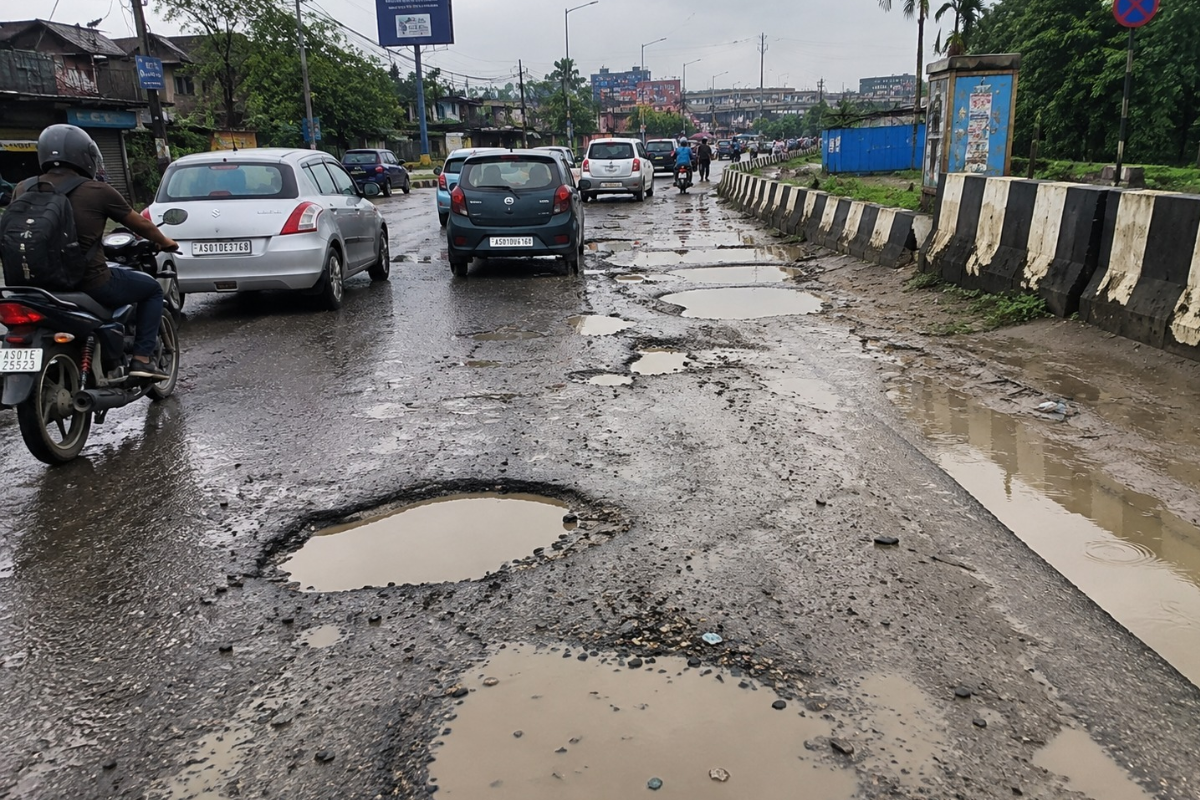
Assam’s roads: Where every journey comes with a warning
The road does not have to collapse to kill. Sometimes a pothole is enough.
ALSO READ: Guwahati Railway Station Scores on Cleanliness, Falls Short on Food and Toilets
On August 30, a journey towards Guwahati on National Highway 27 turned into a nightmare near Khetri-Nalgedra after a commercial passenger traveller reportedly lost control after hitting a large pothole, crossed the central divider and crashed head-on into an oncoming truck. Six to seven people were killed and several others injured in the devastating collision. What should have been an ordinary journey on one of Assam’s major highways became a reminder of a question the state has been avoiding for years: how safe are Assam’s roads for the people who are forced to use them every day?
The Khetri tragedy has once again pushed Assam’s roads into the spotlight, but the uncomfortable truth is that the problem did not begin with one pothole, one highway or one accident. It is a statewide crisis.
From Guwahati to the Barak Valley, from Sadiya to Dhubri, from the plains to the hills of Dima Hasao, roads across Assam increasingly resemble unfinished infrastructure projects rather than dependable arteries of movement. Potholes appear after rain, road shoulders disappear into mud, drains overflow, construction stretches remain incomplete and freshly repaired surfaces begin deteriorating with alarming speed.
For the ordinary commuter, the distinction between a national highway, a state highway or a road maintained by another agency is meaningless. They do not travel according to departmental jurisdictions. They travel from home to work, from village to town, from hospital to hospital and from one district to another. And wherever they travel, the same question follows them: why are Assam’s roads so poor despite the enormous sums being spent on infrastructure?
Assam has around 4,077 km of national highways and approximately 3,500 km of state highways. National highways largely fall under agencies such as the National Highways Authority of India and the National Highways and Infrastructure Development Corporation Limited, while state highways are primarily the responsibility of the Public Works Department. There are therefore multiple agencies, multiple contractors and multiple layers of responsibility.
But when a commuter’s vehicle falls into a pothole, there is only one road.
And when that pothole contributes to a fatal accident, there is only one family left to mourn.
The political debate following the Khetri accident quickly turned towards toll collection. Two days after the tragedy, Assam Chief Minister Himanta Biswa Sarma pushed back against attempts to directly link the accident with toll collection and demands for reduction or exemption of toll tax on the damaged highway stretch. Sarma pointed out that Assam pays around Rs. 1,000 crore in tolls annually while receiving nearly ₹1 lakh crore from the Centre through various schemes.
The larger issue, however, is not whether tolls alone caused the accident.
The real issue is whether citizens paying tolls and taxes are receiving infrastructure that meets even the most basic standards of safety.
The numbers make the question impossible to ignore.
In 2023, NHAI collected ₹452.22 crore from nine toll plazas in Assam. Madanpur accounted for ₹117.68 crore, Nazirakhat ₹91.13 crore, Dahalpara ₹63.16 crore, Patgaon ₹61.55 crore, Raha ₹58.43 crore, Mikirati Hawgaon ₹31.61 crore and Galia ₹24.01 crore. Even smaller toll plazas such as Manderdisa and Balachera generated crores.
The commuter therefore faces an increasingly uncomfortable equation: pay at the toll booth, pay at the petrol pump, pay the mechanic when the suspension breaks, pay for tyres damaged by potholes and finally pay with anxiety every time a family member takes the highway.
The toll receipt, at least, comes with a printed amount.
The cost of a broken suspension does not.
The cost of an accident cannot be calculated.
The cost of a life is beyond accounting.
Guwahati-based social activist and Padmashree awardee Ajoy Kumar Dutta summed up the condition of Assam’s highways after a recent journey in brutally simple terms.
“In Assam after every 50 to 100 meters the vehicle made some noise which happens when you travel on an uneven road,” he said, adding that after crossing Sreerampur and entering Bengal, “there was no sound at all and the roads were very even.”
His comparison with states such as Kerala and Rajasthan is particularly uncomfortable because it demolishes the argument that Assam’s geography alone explains everything.
Assam has heavy rainfall. It has soft and clayey soil in several areas. It has floods, landslides and waterlogging. These are genuine engineering challenges. But they cannot become permanent excuses for permanent failure.
If another state can design roads to withstand its own climatic and geographical conditions, why should Assam accept bad roads as an unavoidable feature of life?
Dutta believes contractor accountability must become central to the system. His suggestion is stark: contractors should not receive the bulk of their payments immediately after construction but should remain financially accountable for the road for years, with payments linked to performance and maintenance.
That would fundamentally change the incentive structure.
At present, the public often sees a familiar cycle. A road is constructed. It begins deteriorating. Potholes appear. Complaints grow. Repairs are announced. Machinery arrives. Potholes are filled. The monsoon returns. The potholes return.
And the cycle begins again.
Meanwhile, officials can point to surveys, tenders, contracts, maintenance schedules and technical specifications.
One NHIDCL official has said roads are surveyed twice a year using Network Survey Vehicles equipped with lasers and GPS. The technology sounds sophisticated. The explanation is less reassuring. Road surfaces may have a designed lifespan of around 15 years, while the top bituminous layer may last around five years under suitable conditions.
But citizens are not asking whether a road has theoretically been designed to survive for 15 years.
They are asking why it becomes dangerous long before that.
The same official pointed towards waterlogging and clogged drains, noting that unless drains are kept clear, waterlogging will continue damaging roads and leaving them uneven.
That admission exposes another layer of Assam’s road crisis.
A road is not merely asphalt.
It is drainage, slope management, shoulders, culverts, embankments and maintenance. Build a beautiful highway and allow water to remain trapped underneath it, and nature will eventually win. Construct an expensive road without maintaining its drainage system and the taxpayer effectively pays twice, once for construction and again for repairs.
The problem becomes even more frightening in Assam’s hills.
In Dima Hasao, authorities have spoken about horizontal boring with perforated pipes, gabion walls, drainage wells, subsurface drainage, geotextiles, viaducts and multi-point extensometers. These are sophisticated engineering responses to an extraordinarily difficult terrain.
But for the motorist travelling through the hills, the technical vocabulary means little when a landslide blocks the road or a deteriorating stretch becomes a death trap during the monsoon.
Officials themselves acknowledge the vulnerability. Steep slopes, unstable soil strata, high clay content and annual rainfall exceeding 2,500 mm make several stretches particularly susceptible to landslides.
But precisely because these vulnerabilities are known, the standard of preparedness should be higher, not lower.
Assam cannot keep discovering every monsoon that it rains heavily.
The same story is repeated across the state.
In parts of Sipajhar, the condition of roads has reportedly become so bad that parents have had to carry children to school. In Golaghat, stretches near Numaligarh have faced severe waterlogging and deterioration.
In Sivasagar, residents have turned giant potholes into symbols of public anger, even using them for mock fishing demonstrations. On the Lakwa-Rajgarh road, reports of ambulances struggling through muddy and damaged stretches underline the human cost of poor connectivity.
And in Guwahati, the problem takes a particularly ugly form.
The state’s largest city can boast of flyovers, widening projects and ambitious urban infrastructure plans, but a spell of rain is enough to expose the fragility beneath the surface. Roads flood. Potholes disappear beneath dirty water. Motorcyclists lose balance. Cars crawl through submerged craters. Traffic slows to a crawl.
The city’s road problem is therefore not simply a question of asphalt.
It is a drainage problem, a planning problem and ultimately a governance problem.
The same authorities that complain about waterlogging cannot ignore the condition of drains. Municipal agencies cannot blame rainfall indefinitely when garbage routinely finds its way into drainage channels.
Highway agencies cannot simply blame urban encroachment when coordination with local authorities is essential to protecting highway infrastructure.
Responsibility has become fragmented.
Accountability has become invisible.
The citizen remains stuck in the middle.
There is also a deeper economic cost.
Bad roads do not merely damage cars. They damage the economy.
A commercial vehicle travelling on poor roads consumes more fuel and suffers greater wear and tear. Goods take longer to reach markets. Public transport becomes unreliable. Ambulances lose precious minutes.
School buses face greater risks. Two-wheelers become particularly vulnerable. Daily wage earners lose time in traffic. Businesses pay more for logistics.
For a state trying to attract investment, promote tourism and sell itself as the gateway to the Northeast, this is not a minor embarrassment.
It is an economic handicap.
A state cannot advertise connectivity while its roads punish connectivity.
It cannot speak about logistics corridors while commuters fear every pothole.
It cannot celebrate infrastructure investment while basic maintenance remains an afterthought.
And it cannot treat every fatal crash as an isolated event caused by driver error, bad weather or unfortunate circumstances.
Road accidents have multiple causes. Speed, fatigue, mechanical failure, reckless driving and poor visibility can all contribute. Therefore, no responsible assessment should automatically declare that a particular pothole caused a particular death without an investigation establishing the facts.
But that caution cannot become an excuse to ignore dangerous road conditions.
If a road contains a large pothole capable of destabilising a vehicle, the existence of that hazard itself demands accountability.
The question should be brutally simple: who knew about it, when was it reported, who was responsible for repairing it, why was it not repaired and what system failed before the accident occurred?
Those questions need answers not only after people die but before they do.
Assam’s road crisis also exposes the weakness of quality control.
A contractor should not merely be judged on whether a road was inaugurated on time. The real test should be whether the road remains safe years after the ribbon-cutting ceremony.
The obsession with completing projects and announcing them has to give way to a culture of maintaining them.
Payment systems should reward durability. Defects should carry financial consequences. Independent quality audits should be strengthened. Road safety inspections should be transparent. Hazardous potholes should have mandatory response timelines. Drainage should be treated as part of road infrastructure rather than an unrelated municipal concern.
And agencies must stop behaving as though their jurisdiction ends at an invisible departmental boundary.
The highway does not know whether a drain belongs to NHAI, NHIDCL, PWD or a municipal body.
Water does not know.
Traffic does not know.
And death certainly does not care.
The proposed use of technology and citizen-reporting mechanisms could help identify potholes and other hazards faster. But an app cannot repair a road. A dashboard cannot fill a crater. A complaint number is meaningless if complaints disappear into bureaucratic files.
Technology can identify failure.
Only accountability can fix it.
The Khetri-Nalgedra tragedy should therefore not disappear from public memory after the political arguments over tolls fade away. The dead cannot be brought back, but their deaths can force a serious examination of how Assam builds, maintains and monitors its roads.
The state does not need another promise that roads will become world-class.
It needs roads that simply work.
It needs highways where a driver does not have to constantly scan the surface for craters. It needs state roads where an ambulance can reach a hospital without getting trapped in mud. It needs drainage systems that function before, during and after the monsoon. It needs contractors who remain accountable long after the inauguration photographs disappear from newspapers.
Most importantly, Assam needs to stop normalising bad roads.
For too long, commuters have adjusted themselves to infrastructure instead of infrastructure being designed around commuters. They slow down, swerve around potholes, repair vehicles, leave home earlier, endure dust and waterlogging and accept broken roads as part of everyday life.
That acceptance is dangerous.
A pothole is not merely a hole in asphalt. It is a hole in accountability.
A broken road is not merely an inconvenience. It is a failure of public infrastructure.
And when a vehicle crashes because a road hazard was left unattended, the question cannot simply be who was driving.
The question must also be: who was responsible for the road?
Until Assam asks that question relentlessly, the state’s roads will continue to tell the same story—of ambitious announcements above the surface and neglected maintenance underneath it.
Every toll plaza may collect its money.
Every department may defend its jurisdiction.
Every contractor may cite technical specifications.
Every monsoon may be blamed on nature.
But the commuter knows the truth.
The road is still broken.
And every broken road carries a warning that Assam can no longer afford to ignore.


