



Guwahati residents taxed without services, raising questions over GMC's accountability
At a time when the Guwahati Municipal Corporation (GMC) is tightening its grip on civic discipline with a sweeping "Spot Fine Schedule for a Cleaner, Healthier & Greater Guwahati," a more fundamental question is beginning to echo across the city's flooded lanes and garbage-strewn bylanes: can a civic body that has struggled to deliver basic services for years claim the moral authority to penalise its taxpayers?
ALSO READ: Behind the Wheel: Green Bus Drivers Say Guwahati's Traffic Problems Go Beyond Them
The new sanitation rules are ambitious on paper. Littering, illegal dumping, public urination, spitting, burning waste and the use of banned plastics will now invite spot fines. More serious violations, such as dumping construction debris or blocking drains, carry penalties of up to ₹25,000. The message from GMC is clear: discipline will be enforced, and citizens must do their part.
But beneath this push for compliance lies a growing resentment among residents who feel that the civic contract has long been broken—not by the people, but by the very institution now wielding the stick.
While GMC managed to collect around ₹82 crore in property tax from 1.1 lakh holdings during the 2025–26 financial year, it fell short of its ₹130 crore target. Around 50,000 households have yet to pay. For the corporation, this is a compliance issue. For many residents, it is a silent but telling protest.
"We are not refusing to pay because we don't want to," says a resident of Zoo Road Tiniali. "We are refusing because we don't see where the money is going."
That sentiment is rooted in lived reality. Across Guwahati, basic civic services, the very services bundled into property tax, remain inconsistent, unreliable or altogether absent. Property tax in Guwahati is more than a levy on property. It includes charges for water supply, street lighting, garbage collection and drainage maintenance. In theory, it is the backbone of urban governance. In practice, it has become a symbol of the disconnect between taxation and service delivery.
A former GMC councillor, now part of the BJP's state executive committee, puts it bluntly: "GMC is supposed to supply water, maintain drainage, collect garbage, ensure clean streets and working streetlights, but they are supplying water to only 30% of the city. How then do they justify taxing 100% of households?"
The question strikes at the heart of the issue, the widening gap between taxation and service delivery.
For many, the frustration is not just about inefficiency but what they see as systemic neglect. Padma Shri awardee and former legislator Ajoy Kumar Dutta voices what many feel but few articulate publicly. "Earlier I paid ₹6,000; now it's ₹8,000, but for what? GMC says it won't supply water anymore even though they're still charging a water tax," he says. His criticism goes beyond finances. "There is no proper drainage, garbage collection is poor, and the civic body is not fulfilling its most basic responsibilities. The Mayor should not think he is God. He was elected by the taxpayers. Where is the introspection?"
The lack of introspection is visible on the streets.
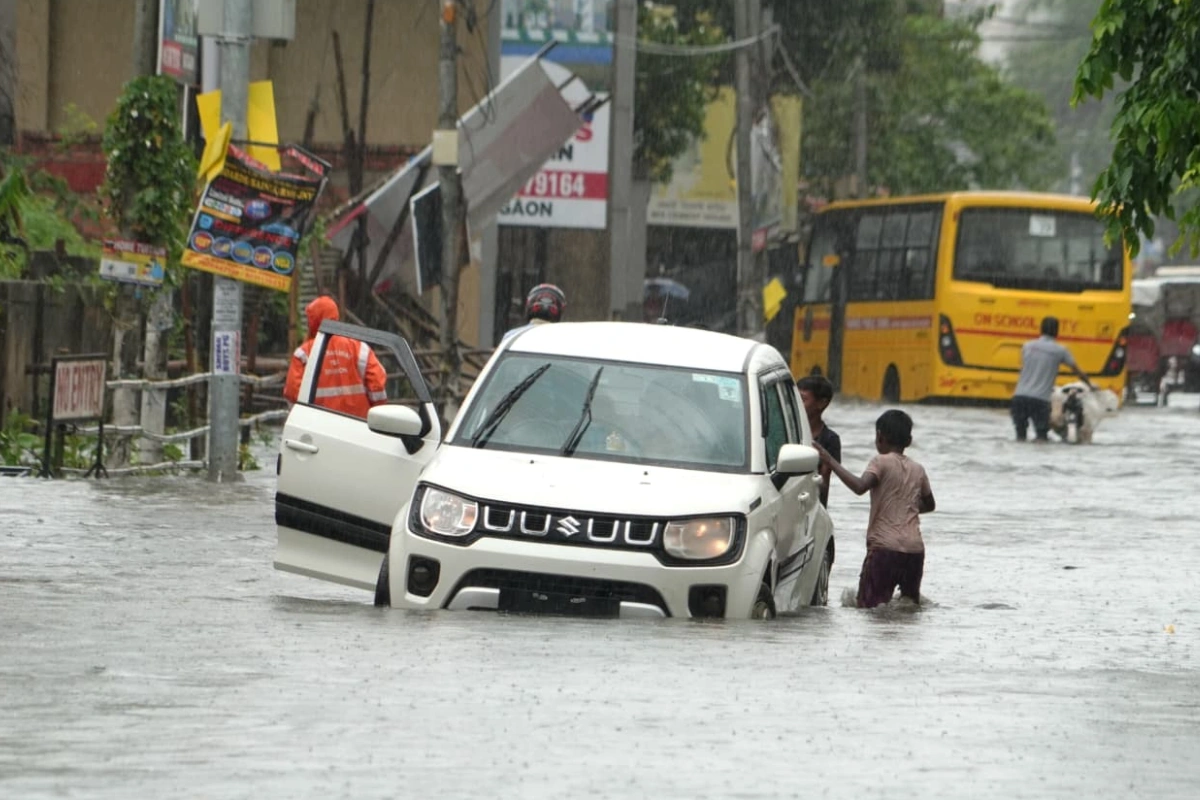
In Sarvoday Nagar under Ward 54, roads remain submerged in drain water for nearly half the year. Moderate rainfall is enough to turn neighbourhoods into stagnant pools. In areas like Anil Nagar, Nabin Nagar, Rajgarh and Rukminigaon, waterlogging is no longer an occasional disruption but an expected seasonal reality. Residents plan their lives around floods that arrive not from rivers, but from clogged drains.
In commercial hubs like Fancy Bazaar and Paltan Bazaar, garbage piles up despite being the economic heart of the city. GMC's experiments with waste management, involving NGOs, ward committees and private contractors, have come and gone, leaving behind a system that still struggles to ensure daily collection.
"Sometimes garbage is not picked up for two or three days," says a shop owner in Paltan Bazaar. "Then suddenly they come and fine people for littering. Isn't that ironic?"
Street lighting, another component funded by property tax, paints a similarly uneven picture. While certain stretches boast LED upgrades, large parts of the city, especially inner lanes and newly developed areas, remain in darkness. Ironically, projects like streetlight expansion are often handled by Guwahati Smart City Limited (GSCL), not GMC, even though the tax for lighting is collected by the latter.
For residents, this raises uncomfortable questions about duplication and accountability. Who is responsible for what, and more importantly, who is answerable?
The answers, when they come, often sound like bureaucratic deflection.
Deputy Mayor Smita Roy recently stated that only 30–40% of households are paying property tax, even as she maintained that GMC is "providing all possible services." She cited instances of freshly cleaned streets being littered again within minutes, attributing poor civic conditions to public behaviour. She also pointed out that drainage and road works fall under the Public Works Department (PWD), not GMC.
But for taxpayers, these distinctions offer little comfort.
"That's bureaucratic buck-passing," says Dutta. "Taxpayers don't want excuses. They want results."
The most glaring failure, however, lies underground, or rather, in the lack of anything underground.
Guwahati still does not have a comprehensive sewerage system. Despite being one of the largest cities in the Northeast, it continues to depend on outdated open drains and ad hoc septic solutions. The result is not just inconvenience but a looming public health crisis. During the monsoons, contaminated water mixes with floodwaters, creating ideal conditions for vector-borne diseases.
And yet, the scavenging tax continues to be collected.
This contradiction, between collection and delivery, is at the core of the growing anger.
Even as GMC ramps up its efforts to widen the tax net through a Rs 2.7 crore door-to-door Geographic Information System (GIS) survey under the Smart House Numbering System (SHNS), critics argue that the priorities are misplaced. Every property will soon have a QR code. Every taxpayer will be identified.
But what about the services they are paying for?
"They are spending crores to identify defaulters," says Prashant Sharma, a resident. "But what about spending on cleaning drains or laying proper sewage lines? We pay tax, and in return, we wade through knee-deep water every monsoon."
The optics are hard to ignore. On one hand is a civic body aggressively pursuing revenue through digital systems, SMS reminders and now spot fines. On the other is a city struggling with basic sanitation, drainage and infrastructure.
For many, it feels like a one-sided transaction, one where the citizen pays and the system defaults.
The irony deepens when the same civic body seeks to enforce discipline through penalties. While the intention to improve sanitation is commendable, enforcement without credibility risks backfiring. Civic discipline cannot be built on fines alone; it requires trust. And trust, once eroded, is not easily restored.
This is not to absolve citizens of responsibility. Public apathy, littering and disregard for civic norms are real issues. But they exist within a broader ecosystem, one where governance failures have normalised dysfunction.
When drains remain clogged for months, garbage collection is erratic, streetlights don't work and floods return every year despite repeated promises, it becomes difficult to convince citizens that the problem lies solely with them.
Urban governance is a two-way contract. Taxes are not donations; they are payments for services. When that contract is repeatedly breached, compliance becomes a question of faith.
GMC today stands at a crossroads. It can continue down the path of aggressive collection and punitive enforcement, hoping enforcement will somehow compensate for systemic gaps. Or it can pause, introspect and rebuild trust by prioritising service delivery.
Ultimately, the legitimacy of taxation rests not only on legal authority but on moral credibility.
In Guwahati today, that credibility is increasingly being questioned.
Before imposing fines on citizens for blocking drains, perhaps the corporation must first answer why those drains remain clogged year after year. Before penalising households for sanitation violations, it must explain why garbage collection remains inconsistent. Before expanding its tax base, it must justify how existing funds are being utilised.
The demand from taxpayers is not unreasonable. It is, in fact, the very foundation of democratic governance: accountability.
Until that is addressed, every fine imposed, every notice issued and every rupee collected will carry an uncomfortable undertone, not of civic responsibility, but of institutional neglect.
And that, more than any act of littering, is what truly dirties the idea of a "Cleaner, Healthier & Greater Guwahati."


