



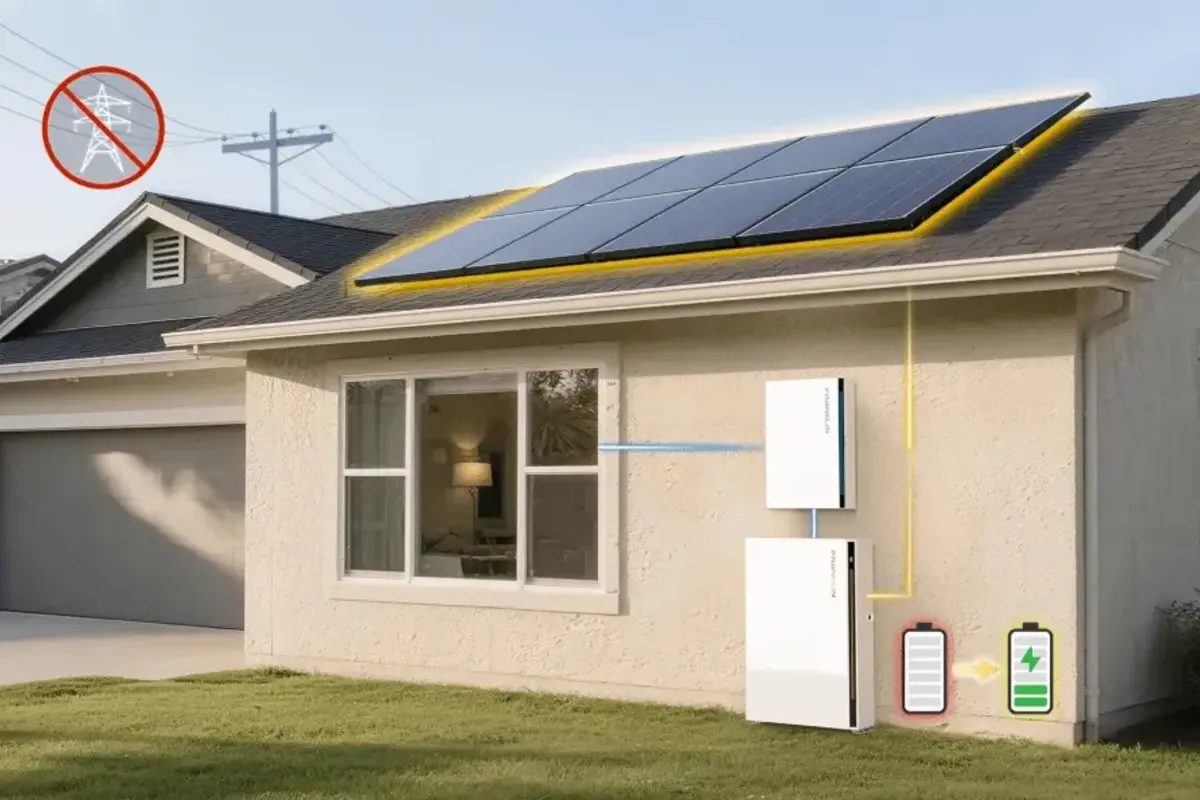
With electricity bills steadily climbing, switching your home to clean energy can help reduce dependence on conventional power and manage long-term electricity expenses.
However, there is no single setup that works for every household. Homeowners generally choose between three main types of solar systems: on grid, off grid, and hybrid. Each option differs in grid connectivity, battery requirements, installation costs, backup capability, and overall energy management. Here, a solar panel is an integral and important component of every solar system, as it captures sunlight and converts it into usable electricity for the property.
This blog explains how each solar system works, its practical advantages, and the household requirements it can support.
On-grid Solar Systems: The Most Popular Choice
An on-grid (or grid-tied) system is the most common configuration for urban and suburban residential properties. In this setup, your equipment is directly connected to your local utility grid.
Power generated system flows straight into your home, supporting your daily energy needs. When the system produces surplus electricity, the excess power is either exported to the utility grid or stored in a battery, depending on your system configuration.
Conversely, during the night or on heavily overcast days when your setup isn't producing enough power, you smoothly draw electricity back from the grid.
> Cost-effective: On-grid systems do not require expensive battery storage.
> Net Metering Revenue: You receive credits on your utility bills for the excess energy you send back to the grid, dramatically lowering your monthly overheads.
> Central Subsidy Support: Eligible residential rooftop installations can receive a Central Subsidy under the PM Surya Ghar Muft Bijli Yojana. The assistance can reach ₹78,000 for qualifying systems of 3kW or above.
> State-level Support: Some states may provide additional subsidies or incentives over and above the Central Subsidy. Availability and eligibility depend on the relevant state policy. For example, Delhi provides state incentives alongside the MNRE Central Financial Assistance.
> High ROI: Lower upfront costs mean a much quicker return on your investment, making it highly appealing for budget-conscious homeowners.
Off-grid Solar Systems: Complete Independence
An off-grid system is completely detached from the traditional electrical grid. It relies entirely on its own generation and storage capabilities, making it ideal for remote locations where extending utility lines is physically or financially impractical.
As there is no grid connection to rely on when the sun goes down, an off-grid setup must be paired with a strong battery bank. During daylight hours, a solar panel installation generates electricity to run your home and simultaneously charges the batteries. At night, your household runs exclusively on the stored energy.
> Total Energy Independence: You are completely immune to utility power outages, grid failures, and rising electricity tariffs. Your power supply is entirely under your control.
> Perfect for Remote Areas: Enables comfortable modern living in rural locations, cabins, or deep countryside areas where grid expansion is completely unavailable.
> 100% Green Living: It offers a fully self-reliant lifestyle that minimises your carbon footprint to the absolute minimum.
Hybrid Solar Systems: Balancing Reliability and Efficiency
A hybrid system combines the strengths of both on-grid and off-grid configurations. It remains connected to the traditional utility grid while also incorporating a dedicated battery storage solution.
During a typical sunny day, your solar panel array powers your home and tops up your backup batteries. Any additional energy produced after battery charging is complete is transferred to the utility grid via net metering. If a storm hits and causes a blackout, the system instantly disconnects from the grid and switches over to battery power, keeping your lights on seamlessly.
> Continuous Power Supply: You enjoy uninterrupted electricity during blackouts while maintaining the financial advantages of grid connectivity.
> Optimised Energy Use: You can store energy when grid rates are high and consume it later, further lowering your bills.
> Maximum Flexibility: It gives you complete control over how and when you use your power, adjusting easily to your shifting household consumption needs.
Government Support: The PM Surya Ghar Muft Bijli Yojana
The PM Surya Ghar Muft Bijli Yojana provides Central Subsidy support for eligible residential rooftop solar installations. Under the applicable subsidy structure, qualifying households may receive up to ₹78,000 for systems of 3kW or above.
Certain states may also offer a separate State Subsidy, generation-based incentive, or another form of financial assistance. These benefits are not uniform across India, so homeowners should check the latest rules issued by their state government and local electricity distribution company before calculating the final installation cost.
Subsidy eligibility can also depend on factors such as the system type, approved capacity, empanelled vendor, installation standards, grid connection, and application process. Therefore, homeowners should verify both the central subsidy and any applicable state subsidy before selecting a Solar System.
Which System Fits Your Home Best?
To make the final decision, assess your home against these three primary scenarios:
> Choose On-Grid If: You live in an urban or suburban area with a highly reliable grid, your main objective is to eliminate your monthly electricity bills, and you want the fastest return on investment. This setup is also the easiest to pair with the PM Surya Ghar Yojana incentives.
> Choose Off-Grid If: You are building or living in a remote location without access to the utility grid, or you are completely committed to an eco-friendly lifestyle independent of corporate utility providers.
> Choose Hybrid If: You live in an area prone to frequent power cuts but still want to enjoy the financial perks of net metering and government subsidies. It provides premium peace of mind alongside robust financial returns.
Make the Next Step Towards Smarter Energy
Before making a decision, it is important to assess your household's energy requirements, local grid reliability, available roof space, and eligibility for government incentives or subsidy programmes.
Choosing the right system can help ensure consistent performance and long-term value for years to come. Partnering with experienced energy solution providers such as Eastman Auto & Power Limited can make the transition smoother by offering reliable solar solutions to your needs. With the right planning and technology, solar energy can become a dependable part of your home's future.
(This is a syndicated feed)


