



Repeated disasters: Why Assam must turn its smaller rivers into the state's biggest flood defence
The devastating floods that ravaged Upper Assam this year have exposed a harsh reality that policymakers can no longer afford to ignore. For decades, flood management in Assam has largely revolved around the mighty Brahmaputra, with embankments, dredging and river monitoring focused primarily on the state's largest river. But this year's floods proved that the biggest threat did not come from the Brahmaputra. Instead, it came from the state's neglected tributaries, exposing the urgent need to rethink Assam's entire approach to flood management and river development.
ALSO READ: Seasonal Diseases Rise as Monsoon Sweeps Across Assam
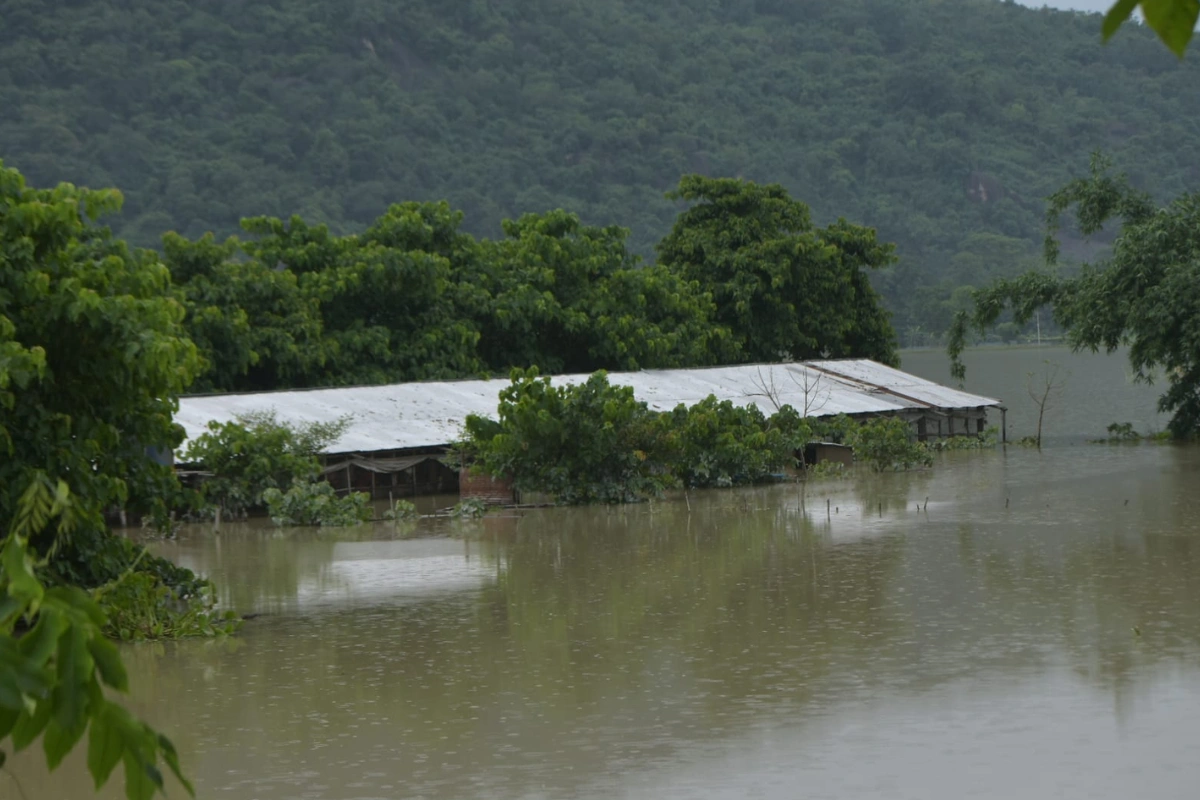
The scale of devastation has been unprecedented in districts that were never considered highly flood-prone. Sivasagar, Charaideo and Jorhat, districts with no significant history of catastrophic floods, emerged as the worst affected this monsoon. Villages were inundated, thousands of livestock were washed away, standing crops were destroyed, and several people lost their lives in what has become one of the worst flood disasters to hit Upper Assam in recent years.
According to the Assam State Disaster Management Authority (ASDMA), 883 villages remained submerged, while 24,124 people took shelter in 103 relief camps. Rescue and relief operations continued for days as floodwaters cut off road communication and isolated hundreds of villages.
Chief Minister Himanta Biswa Sarma attributed the disaster to a rare combination of extreme weather events. "The unprecedented devastation is a result of cloudbursts upstream in adjoining Nagaland, along with localised rainfall that was 436 per cent above normal. Thousands of livestock have been washed away and villagers who were never prepared for such devastation have suffered immensely," he said.
The Chief Minister said agencies, including the Indian Air Force, the National Disaster Response Force, the State Disaster Response Force and district administrations, were working round the clock, carrying out rescue and evacuation operations through helicopters and boats.
What makes this year's floods different is that they were not triggered by the Brahmaputra breaching danger levels. According to the ASDMA, rivers such as the Buridihing, Dikhou, Disang and Dhansiri were in spate, causing extensive flooding across Upper Assam. The destruction demonstrated that smaller rivers, when neglected, can be just as destructive as the state's largest river.
Hydrologists and river experts believe this year's floods have underlined the importance of paying greater attention to Assam's tributaries rather than concentrating almost exclusively on the Brahmaputra. Smaller rivers respond much more quickly to intense rainfall. Once their carrying capacity is reduced because of siltation, encroachment or lack of maintenance, they overflow rapidly, inundating surrounding areas within hours.
The same pattern can be seen every monsoon in Guwahati.
The city witnesses widespread waterlogging even after a few hours of heavy rainfall. Contrary to popular perception, these floods are rarely caused by the Brahmaputra. Instead, they result from overflowing tributaries such as the Bharalu, Bahini and Basistha rivers, which have gradually lost their natural carrying capacity after decades of encroachment, pollution and neglect.
Ironically, these same rivers could become part of the solution.
Urban planners and engineers argue that if these tributaries are restored and utilised as waterways, they would receive regular maintenance throughout the year, significantly improving their carrying capacity while also creating an alternative mode of urban transport.
The idea is not entirely new.
During the Advantage Assam summit in 2018, ride-hailing company Ola signed a Memorandum of Understanding with the Assam government for a pilot river taxi service on the Brahmaputra. Although the project never materialised, it did generate discussions on the potential of water-based transportation in the city.
Even earlier, while preparing Guwahati's Smart City proposal in 2015, planners had explored the possibility of converting the Bharalu into a navigable waterway.
A senior source associated with the Smart City proposal recalled that the idea was part of the original vision.
"When Guwahati prepared its Smart City proposal, converting the Bharalu into a waterway was one of the proposals. After Guwahati Smart City Limited was formed, no such project was taken up and the proposal remained on paper," the source said on condition of anonymity.
For social activist, former legislator and Padma Shri awardee Ajoy Kumar Dutta, restoring Guwahati's rivers is no longer merely an environmental issue but an urban planning necessity.
"Bahini, Bharalu and Basistha are today treated as drainage systems, whereas they are beautiful rivers that can be developed into navigable waterways," Dutta said.
He believes navigation itself can transform public behaviour towards rivers.
"If river taxis start operating, the rivers will automatically receive greater attention. People will think twice before throwing garbage into rivers that are being used for transport. There will be a psychological change," he said.
Dutta believes Assam need not look only towards Europe for inspiration.
"Forget Venice, Chicago or Bangkok. The Assam government should learn from cities like Ahmedabad, Varanasi and Kochi. Gujarat has shown how even a relatively small river like the Sabarmati can be transformed into an important urban asset," he said.
He also criticised the state's priorities in promoting tourism.
"We are being shown seaplanes while there is no serious effort to develop the beautiful rivers flowing through Guwahati itself," he added.
City-based engineer J.N. Khataniar believes concerns over river depth are often exaggerated.
"Nobody is suggesting large ships. River taxis and small passenger boats can certainly operate in the Bharalu and Basistha. During the monsoon there is sufficient water, while in winter, proper planning and management of sluice gates can make navigation possible," he said.
Architect Ranel Das echoed the same view, saying navigation during the monsoon is technically feasible and that winter operations can be managed through engineering interventions.
Officials acknowledge that discussions on developing Guwahati's rivers have continued over the years. While proposals ranging from river taxis on the Brahmaputra to navigable waterways on the Bharalu, Bahini and
Basistha have been examined at different points, none has progressed beyond the planning stage. Officials maintain that fresh feasibility studies are under consideration, although no implementing agency has yet been formally assigned.
Experts say the larger lesson extends far beyond Guwahati.
Throughout Assam, tributaries are remembered only during floods. For the rest of the year, they receive little attention beyond occasional desiltation or emergency repairs. Rivers that could support tourism, fisheries, irrigation, local transport and recreation remain neglected until they overflow.
Globally, rivers that perform multiple economic functions receive far better maintenance than those viewed merely as drainage channels. Navigation requires regular dredging, removal of encroachments, maintenance of embankments and monitoring of water quality. These activities, undertaken consistently, also improve flood management.
The transformation of Guwahati's rivers, therefore, offers an opportunity not only to improve urban mobility but also to strengthen the city's resilience against flooding.
Historically, the Bharalu and Basistha were not drains. They were natural rivers around which settlements developed. Rapid urbanisation, the absence of a comprehensive sewerage network, unchecked encroachments and years of neglect gradually reduced them to polluted drainage channels. Every monsoon, those neglected rivers remind the city of the cost of ignoring its natural waterways.
This year's floods in Upper Assam have delivered an equally powerful message. The Buridihing, Dikhou, Disang and Dhansiri have demonstrated that tributaries can unleash devastation comparable to larger rivers when their natural flow is obstructed or when extreme rainfall strikes.
Climate experts have repeatedly warned that extreme rainfall events are becoming more frequent and more intense. As climate variability increases, Assam's flood management strategy can no longer remain centred solely on the Brahmaputra. The state's hundreds of tributaries require continuous monitoring, scientific restoration and productive utilisation throughout the year.
The lesson from this monsoon is unmistakable. Assam's smaller rivers cannot remain forgotten waterways that receive attention only after they overflow. Whether through navigation, tourism, fisheries, ecological restoration or urban transport, these tributaries must become active assets rather than neglected liabilities. If they are maintained, monitored and economically utilised throughout the year, they can become one of
Assam's strongest defences against recurring floods instead of continuing to be among their biggest causes.


