



Rising flyovers, rising floodwaters: Is Guwahati’s infrastructure push outpacing its planning?
A City Rising Above Traffic
The transformation of Guwahati over the past two decades has been impossible to ignore. Massive flyovers now cut across the skyline, concrete pillars dominate major junctions, and elevated corridors stretch across some of the city’s busiest intersections. In its bid to tackle worsening traffic congestion, Guwahati has aggressively embraced a flyover-driven model of urban development.
Today, the city has 24 flyovers and bridges either operational or forming part of its rapidly expanding transport network. From Ganeshguri and Six Mile to Maligaon, Noonmati and Ulubari, Guwahati appears determined to rise above its traffic crisis, quite literally.
But beneath the flyovers, another crisis continues to deepen.
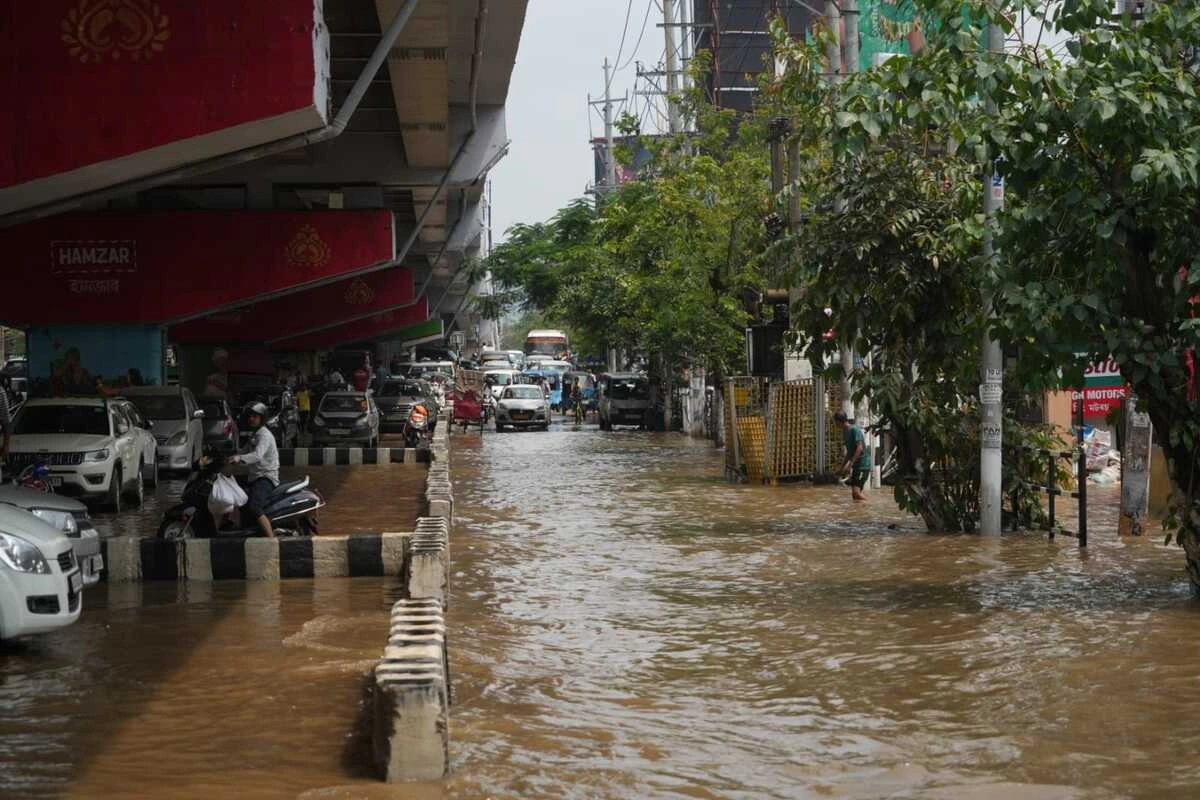
Every monsoon, large stretches under and around these elevated structures turn into waterlogged pockets, paralysing traffic, flooding neighbourhoods and reigniting a growing public debate: Is Guwahati’s infrastructure boom worsening its drainage disaster?
An increasing number of residents now allege that several localities which once escaped severe flooding have started witnessing regular waterlogging after nearby flyovers were constructed. The concerns have fuelled larger questions over whether the city’s infrastructure projects are being implemented without adequate drainage planning, environmental consideration or long-term urban vision.
When Flyovers Meet Floodwaters
On rainy days, the contradiction becomes strikingly visible. Vehicles move steadily above while roads below disappear under muddy floodwater. At Ganeshguri, Six Mile, Bhangagarh, Maligaon and several stretches along NH-27, traffic often collapses entirely during heavy rainfall. Water accumulates beneath flyovers, drains overflow and commuters remain stranded for hours.
“What is the use of building flyovers if the roads below become rivers every time it rains?” asked Raju Das, a private employee stuck in a traffic jam near Six Mile during a recent downpour. “Earlier traffic was bad. Now it’s traffic plus flooding.”
The criticism comes despite enormous public spending on elevated infrastructure over the years.
The Bishnu Rabha Flyover at Ganeshguri, among Guwahati’s earliest major flyovers, was constructed in the early 2000s to address mounting congestion in one of the city’s busiest commercial zones. In 2020, a 425.5-metre extension was inaugurated to improve connectivity toward RG Baruah Road.
Similarly, the 1.65-kilometre Six Mile Flyover, whose construction began around 2005–06 and opened in 2009, was expected to significantly ease traffic movement in eastern Guwahati. Yet despite being relatively new, the structure has already undergone repeated repair and restoration works, including major interventions in 2023 and 2024.
Now, residents are increasingly questioning whether some of these projects may also be aggravating waterlogging in surrounding areas.
“Nobody Thought About the Rainwater”
Padma Shri awardee Ajoy Kumar Dutta believes the problem lies not in the concept of flyovers themselves, but in the absence of scientific urban planning.
“Flyovers are not permanent solutions in Guwahati, and in Guwahati they are not planned properly, which is why people suffer,” Dutta said. “Almost every flyover witnesses waterlogging beneath it during monsoon because there is no planned drainage system.”
According to Dutta, the city has expanded vertically without strengthening its most basic urban infrastructure.
“There is no storm-water drainage system in Guwahati and no drainage master plan,” he said. “If you continue constructing flyovers without integrated drainage systems, naturally waterlogging will worsen.”
Dutta specifically pointed to the Noonmati–Dighalipukhuri flyover corridor.
“After the construction of the Noonmati–Dighalipukhuri flyover, areas like Lamb Road go underwater even during small downpours,” he said. “That clearly indicates poor drainage planning.”
Residents across the city are increasingly echoing similar concerns.
In Rukminigaon, several locals claim severe waterlogging became more frequent after the construction of the Super Market flyover.
“Earlier this locality did not suffer like this,” said resident Pranab Kalita while standing beside a flooded roadside lane. “Now even thirty minutes of rain is enough for water to start accumulating rapidly.”
Kalita said residents had repeatedly raised concerns during the construction phase, but little attention was paid to drainage planning.
“The focus was entirely on completing the flyover quickly. Nobody thought about where the rainwater would go.”
Another resident, Monalisa Sharma, said floodwater now routinely enters residential compounds during heavy rainfall.
“The water remains for hours,” she said. “Children cannot go outside, vehicles get damaged and mosquito problems increase. We feel the locality’s drainage pattern has changed after the flyover construction.”
At Barsapara, residents voiced similar concerns regarding the Cycle Factory flyover.
“We are not engineers, but we can clearly see the difference,” said local businessman Dipankar Nath. “Waterlogging has become much worse after the flyover came up.”
A City Choking During Every Rainfall
The situation is equally severe along portions of NH-27, particularly at Lokhra, Boragaon and Gorchuk, where heavy rainfall routinely brings traffic to a standstill.
“Cars stop, buses stop, everything stops,” said cab driver Abdul Rahman. “People spend hours trapped on roads. Even ambulances struggle to move.”
According to Rahman, the problem becomes worse because flooding occurs precisely where traffic from multiple directions merges beneath flyovers.
“When roads below get flooded, vehicles spill into service lanes and nearby intersections. Then congestion spreads everywhere.”
At Ganeshguri, one of the city’s busiest commercial hubs, commuters say traffic jams during rainfall have become unbearable despite the presence of multiple flyovers and elevated corridors.
“The city keeps building flyovers but nobody is fixing the drainage,” said college student Ananya Bora. “Whenever it rains, roads below become impossible to cross.”
Shopkeepers at Bhangagarh expressed similar frustration.
“Customers avoid coming during rainy days because water accumulates everywhere,” said businessman Nilotpal Deka. “The irony is that flyovers were supposed to improve urban life, but now many areas beneath them become unusable during monsoon.”
The Larger Urban Planning Crisis
Urban experts argue that Guwahati’s drainage crisis is linked to a much broader pattern of unplanned urbanisation.
Over the years, wetlands have shrunk, natural drainage channels have been encroached upon and hills have been cut for construction. Environmentalists warn that these ecological disruptions, combined with poorly integrated infrastructure projects, are making flooding increasingly severe.
Environmental activist Arup Kumar Sarma said Guwahati’s natural drainage systems have been systematically weakened.
“Earlier, rainwater would spread across wetlands and natural channels,” Sarma said. “Today many of those areas have either been filled up or heavily encroached upon.”
According to Sarma, flyovers themselves may not directly create flooding, but they can intensify existing weaknesses when not supported by proper drainage planning.
“A flyover generates enormous runoff during rain. If nearby drainage systems are weak, blocked or undersised, water will naturally accumulate.”
Urban planner Hiranya Saikia believes Guwahati’s infrastructure approach remains fragmented.
“We are constructing isolated projects instead of building integrated urban systems,” he said. “Drainage, mobility, sewage and environmental planning should function together.”
Saikia added that many Indian cities have already realised that flyovers alone cannot permanently solve urban congestion.
“Flyovers provide temporary relief, but eventually congestion catches up because vehicle numbers continue increasing,” he said. “If public transport remains weak and urban planning remains poor, flyovers simply shift bottlenecks from one location to another.”
Poor Maintenance, Growing Frustration
Residents also complain about poor maintenance of drainage systems surrounding flyovers.
At Ulubari, locals pointed toward drains clogged with plastic waste, silt and debris.
“Even where drains exist, they are rarely cleaned properly,” said resident Pankaj Sharma. “During rain, water immediately overflows onto roads.”
Motorcyclist Riya Das said waterlogging beneath flyovers creates dangerous driving conditions.
“There are potholes hidden under the water,” she said. “Many bikers skid or lose control. At night it becomes even more dangerous.”
Criticism of Guwahati’s flyover model has also intensified because several corridors continue to suffer severe congestion despite years of construction and enormous investment.
At Six Mile, traffic frequently stretches toward Khanapara and Jayanagar during peak office hours. Ganeshguri remains heavily congested despite multiple elevated structures, while Maligaon and Jalukbari continue to witness major bottlenecks.
“People expected flyovers to permanently solve congestion,” said commuter Diganta Medhi. “But traffic is still terrible and now flooding has become another problem.”
What the Authorities Say
Government officials, however, reject allegations that flyovers are directly responsible for waterlogging.
A senior Public Works Department (Roads) official, speaking on condition of anonymity, acknowledged Guwahati’s drainage shortcomings but defended the engineering behind flyover projects.
“It is true that Guwahati lacks a proper storm-water drainage system and a drainage master plan,” the official said. “But flyovers are not the reason for waterlogging.”
According to the official, rainwater from flyovers is designed to flow into adjacent drainage networks.
“The water coming down from flyovers enters nearby drains. The real issue is that the city’s drainage infrastructure itself is inadequate.”
A senior National Highways Authority of India official similarly maintained that drainage provisions are incorporated into flyover construction projects.
“Flyovers constructed anywhere include provisions for rainwater discharge into nearby drainage systems,” the official said. “Drainage infrastructure is upgraded accordingly during implementation.”
Residents, however, argue that such upgrades remain insufficient for Guwahati’s monsoon realities.
“The problem is visible every year,” said resident Bhaskar Mahanta near Lokhra. “If the drainage systems were truly adequate, roads would not flood like this repeatedly.”
Development Above, Crisis Below
Many citizens now believe Guwahati urgently requires a comprehensive drainage master plan before more elevated infrastructure projects are sanctioned.
“We are building the city upside down,” said social activist Nabajyoti Bora. “Instead of first fixing drainage and sewage systems, we are prioritising giant concrete structures.”
Bora argued that political visibility often shapes infrastructure priorities.
“Flyovers are visible symbols of development. They look modern and impressive. But underground drainage systems are ignored because they are not glamorous.”
Several civic groups are now demanding scientific hydrological studies around major flyover corridors to examine whether the structures have altered natural water flow patterns. Others are calling for independent audits of flyover projects to evaluate their traffic efficiency, maintenance costs and environmental impact.
Meanwhile, for ordinary residents, the struggle continues.
Office-goers leave home early fearing rain-induced gridlock. Shopkeepers stack sandbags outside storefronts during monsoon months. Parents worry about children wading through floodwater beside busy roads.
At Maligaon, resident Jayanta Das summed up the growing frustration.
“The city is rising higher with every new flyover,” he said while watching vehicles crawl through waterlogged streets below an elevated corridor. “But people on the ground are suffering more every year.”
As Guwahati continues expanding into a modern urban centre, its flyovers remain symbols of ambition, speed and infrastructural growth. Yet beneath those towering concrete structures lies another reality, flooded roads, overwhelmed drains and a growing fear that the city’s development may be moving faster than its planning.
Unless Guwahati addresses its chronic drainage crisis with the same urgency it has shown toward building flyovers, many residents fear the city could continue sinking deeper into monsoon chaos, no matter how high its roads rise above the ground.


