



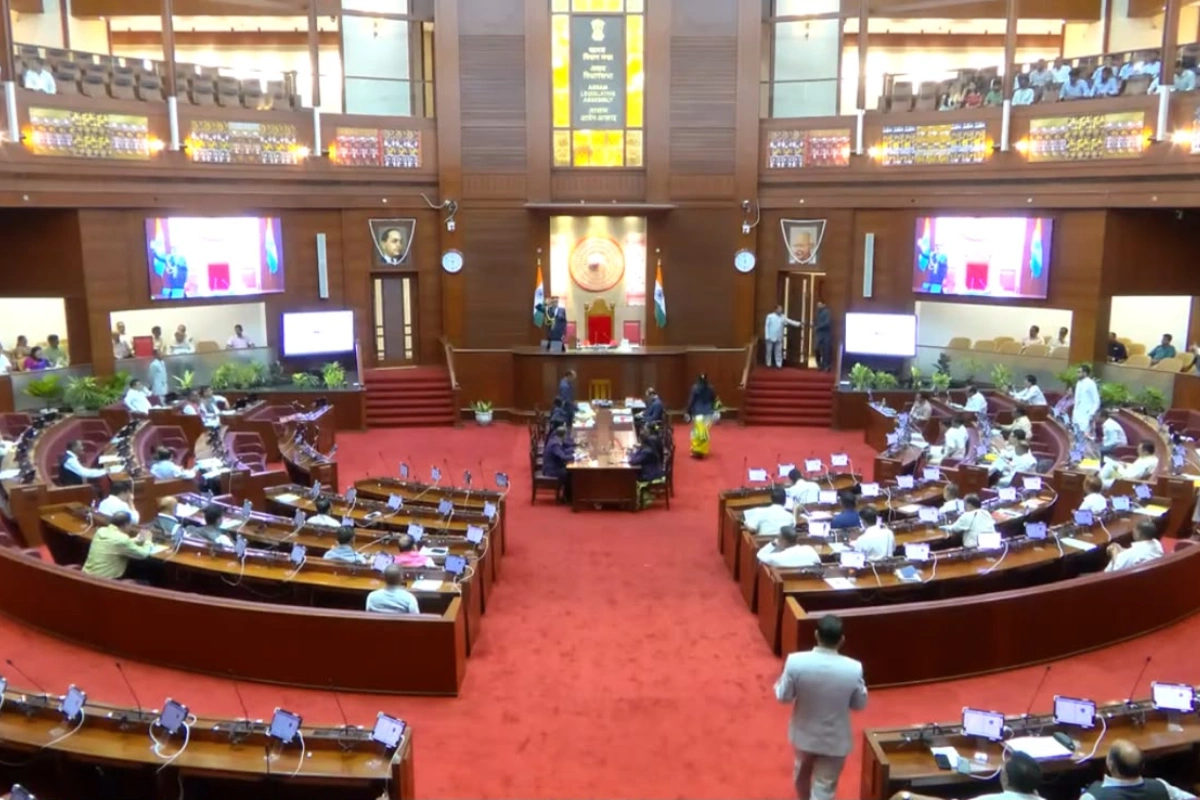
GUWAHATI: The Assam Budget for 2026–27 lays out an expansive and politically calibrated roadmap that blends welfare commitments with an ambitious push toward economic transformation. With a strong emphasis on entrepreneurship, infrastructure expansion, cultural identity, and emerging sectors such as semiconductors and artificial intelligence, the government has attempted to present a vision of Assam as a rising economic hub in the Northeast. Yet, beneath the breadth of announcements lies a familiar tension between ambition and execution, raising critical questions about fiscal sustainability and long-term impact.
ALSO READ: GMC Issues ₹15,000 Penalty for Illegal Dumping of Construction Waste on A.M. Road
At the heart of the budget is a continued reliance on welfare-driven growth. The expansion of the Chief Minister’s Atmanirbhar Asom Abhijan (CMAAA) underscores the government’s commitment to promoting self-employment and entrepreneurship. Having already supported nearly one lakh beneficiaries in earlier phases, the scheme will now extend assistance to an additional 50,000 youth, with the long-term goal of empowering 10 lakh entrepreneurs over five years . This is accompanied by a ₹500 crore allocation, signalling both scale and political importance. Similarly, women-centric initiatives remain prominent, with around 30 lakh women having already received enterprise funds and over 9 lakh emerging as “Lakhpati Baideus” . The budget further strengthens this approach by enabling collateral-free loans and easing financial barriers for women entrepreneurs.
Such measures reflect continuity with previous budgets, where welfare and direct benefit schemes have been central. However, past experience suggests that scaling up beneficiary numbers does not automatically translate into sustainable economic outcomes. The effectiveness of entrepreneurship schemes depends heavily on access to markets, training, and long-term viability—areas where implementation has often lagged behind intent. Without robust monitoring and evaluation mechanisms, there is a risk that these programmes may prioritise reach over impact.
Infrastructure development forms another cornerstone of the budget, with several high-value projects announced across sectors. The ₹2,500 crore plan to shift Guwahati’s overhead power network underground represents a major urban modernisation effort . The development of the Dibrugarh Capital Region as a second administrative hub, backed by a ₹500 crore allocation, reflects an attempt to decentralise growth and reduce pressure on Guwahati . In addition, the government has proposed a feasibility study for a metro rail system along the Guwahati Ring Road, aiming to address urban congestion and improve mobility .
Compared to earlier budgets, which focused largely on roads, bridges, and basic urban infrastructure, the current budget marks a shift toward more technologically advanced and capital-intensive projects. The proposed semiconductor ecosystem, with an estimated outlay of ₹1,164 crore, and investments in aerospace manufacturing indicate a deliberate move to position Assam within high-value global supply chains . While this represents a bold strategic pivot, it also raises concerns about preparedness. The success of such initiatives depends on the availability of skilled labour, supporting industries, and institutional capacity. In the absence of these, there is a risk that large investments may not yield proportional returns, echoing challenges seen in previous infrastructure projects.
The agriculture and rural economy continue to receive attention, though largely within an incremental framework. The government highlights significant growth in allied sectors, including a 33 percent increase in fish production, a 51 percent rise in egg output, and a 28 percent increase in milk production over the past five years . Building on this, the budget introduces a ₹500 crore Dairy Expansion Mission and outlines plans to achieve self-sufficiency in key food products. There is also a renewed focus on promoting high-value agricultural exports through GI-tagged products and organic farming.
While these measures align with trends observed in earlier budgets, structural challenges persist. Rising non-performing assets in the Kisan Credit Card scheme, amounting to ₹1,935 crore and affecting over 3 lakh farmers, point to underlying financial stress in the agricultural sector . Moreover, the budget offers limited discussion on climate resilience, a critical issue for a state frequently affected by floods. As a result, the emphasis on production growth may not fully address the vulnerabilities faced by farmers.
Youth employment and skill development emerge as another key focus area, reflecting a shift in policy orientation. Initiatives such as the expansion of foreign language training under the CM-FLIGHT scheme and the introduction of an AVGC-XR policy for creative industries aim to prepare young people for global opportunities. Financial assistance of up to ₹1.5 lakh per candidate for overseas workforce preparation further underscores this approach . Unlike earlier budgets, which placed greater emphasis on direct job creation, the current strategy appears to prioritise employability and skill enhancement.
This shift, while pragmatic, also highlights the limitations of the local job market. By focusing on global employment opportunities, the government implicitly acknowledges the challenges of generating sufficient jobs within the state. However, training alone does not guarantee employment, and the absence of large-scale industrial expansion raises concerns about whether the skill development initiatives will translate into meaningful economic gains.
The budget also devotes considerable attention to cultural preservation and identity, with initiatives aimed at promoting Assam’s heritage on national and international platforms. Plans to produce films on historical figures, organise large-scale cultural events, and pursue UNESCO recognition for key cultural elements reflect a strategic use of cultural capital . While such efforts can enhance tourism and strengthen regional identity, they also invite criticism for potentially diverting resources from core developmental priorities.
Tourism itself is positioned as a major growth driver, with the introduction of a comprehensive homestay policy, subsidies for hospitality infrastructure, and improved international connectivity. Assam already attracts over 76 lakh domestic tourists annually, and the government aims to further expand this base . However, past budgets have similarly emphasised tourism without achieving transformative results, largely due to gaps in infrastructure and limited private sector participation. The success of current initiatives will depend on effective implementation and coordination.
A notable feature of the 2026–27 budget is its emphasis on governance reform through technology. The introduction of AI-powered citizen service platforms, integrated digital systems for public finance management, and expanded e-governance initiatives signal a move toward more transparent and efficient administration . While this represents a significant step forward compared to previous budgets, challenges such as the digital divide, data security, and administrative capacity could limit the impact of these reforms.
Despite the breadth of initiatives, the budget leaves several critical fiscal questions unanswered. The combination of expanded welfare schemes, large infrastructure investments, and new high-cost projects suggests increased expenditure commitments. However, there is limited discussion on revenue generation, debt management, or fiscal deficit targets. This lack of clarity is consistent with concerns raised in previous budgets, where optimistic projections have often been accompanied by rising debt levels.
In this context, the 2026–27 budget can be seen as both a continuation and an evolution of past policy trends. It retains the core elements of welfare-driven governance while introducing new dimensions of technological and industrial ambition. Whether this represents a genuine turning point for Assam’s economy will depend on the government’s ability to balance ambition with execution, and growth with fiscal discipline.
Ultimately, the budget reflects a state seeking to redefine its economic trajectory while navigating structural constraints. It offers a compelling vision of transformation but stops short of addressing the deeper challenges that could determine its success. As in previous years, the true test will lie not in the scale of announcements but in their delivery on the ground.


