



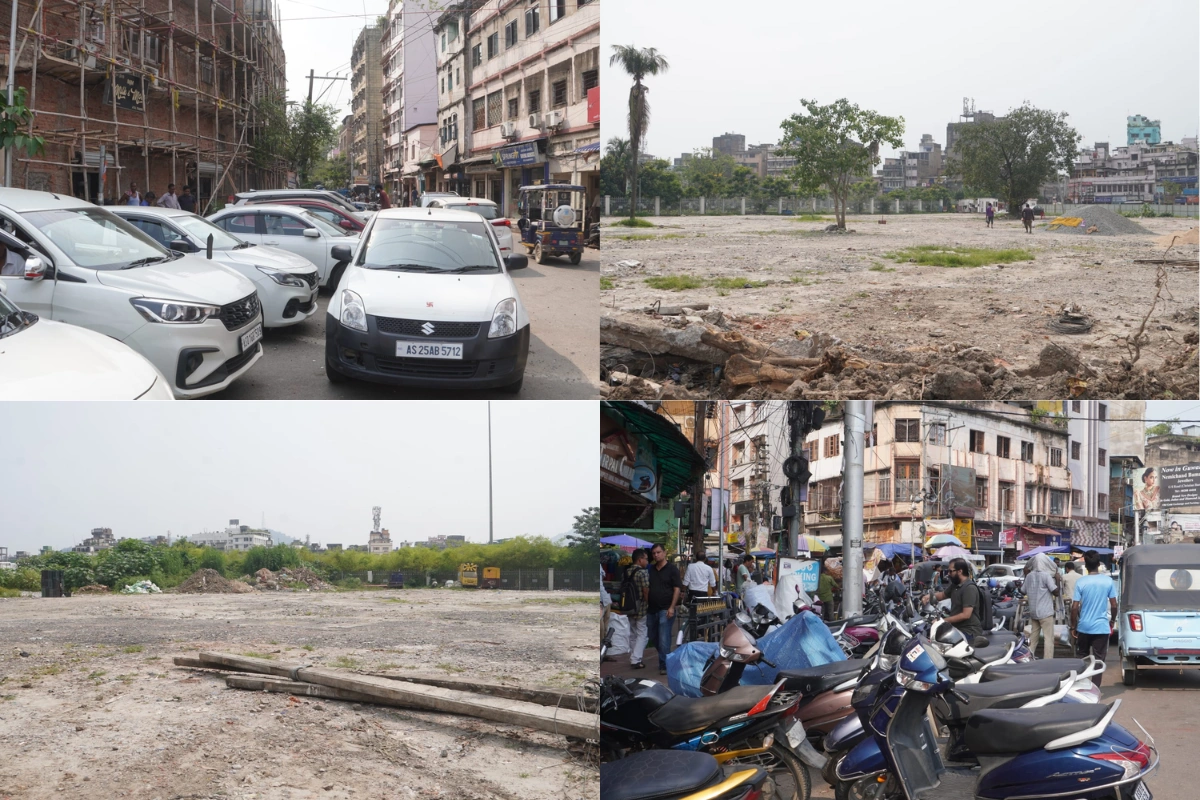
Closure of the Jail Road parking facility in Fancy Bazar has triggered congestion, disrupted trade, and affected business activity
The continued closure of the Jail Road parking facility in Fancy Bazar has triggered concern among traders, residents, and business organisations, who say the lack of organised parking is disrupting trade, worsening congestion, and affecting customer access in one of Guwahati’s busiest commercial hubs.
ALSO READ: Rising LPG Prices Put Pressure on Guwahati Eateries to Cut Menus, Raise Rates
Stakeholders said the situation has worsened over the past two months since the facility was shut, forcing vehicles to occupy roadside spaces across the locality. Traders alleged that this has disrupted loading and unloading operations, slowed commercial movement, and increased daily traffic congestion in the market area.
Residents and business representatives said they are not opposed to ongoing development projects, including riverfront works and a proposed hospital, but argued that alternative parking arrangements should have been made beforehand.
“The parking facility has been shifted to Lachit Ghat, but the question is whether people will actually go there after purchasing goods from this market,” a resident said, adding that development and supporting infrastructure must progress together. They also proposed a multilevel parking facility capable of accommodating 1,000–2,000 vehicles.
Another resident said the relocation has created difficulties, especially for elderly people, families, and customers carrying goods.
A garbage treatment plant is located beside the Jail Road parking area in the heart of Fancy Bazar. There is ample unused space available within the premises. If the concerned authorities consider utilizing this unused area for parking, it could help ease the parking shortage in the area and ensure convenience for daily commuters and visitors in the busy commercial hub.
Traders said roadside parking has increased sharply since the closure, leading to frequent congestion and obstructing commercial vehicles. “Earlier, loading and unloading took place inside the parking area, but now these activities are happening on the roads,” a businessman said, adding that emergency movement could also be affected in view of the proposed hospital.
Several traders claimed the situation has reduced customer footfall and affected business activity. “Customers now avoid the market due to lack of parking and fear of challans. Footfall has declined by nearly 10 to 20 per cent,” one businessman said.
They further said the downturn in sales has had a direct impact on employment in the market.
According to traders, several establishments have reduced casual and support staff, while some small businesses have cut back on daily wage workers and part-time employees due to falling revenue. “Earlier, higher customer turnout allowed us to employ more workers. Now, with reduced sales, many shops have been forced to limit staff,” a trader said.
Another trader said Fancy Bazar, a major commercial hub attracting buyers from across the Northeast, requires proper parking infrastructure. “People travel from Manipur, Nagaland, Mizoram, Arunachal Pradesh, Dimapur, and Shillong to purchase goods in bulk. An alternative parking facility is essential,” he said.
Representatives of the Central Guwahati Citizen Forum echoed similar concerns, stating that while development initiatives have improved the area, the absence of adequate parking has hurt local businesses.
“Customers cannot access the market conveniently without proper parking facilities,” a representative said.
Another trader said business activity has steadily declined since the closure nearly two months ago, adding that customers from nearby towns such as Rangia, Mangaldai, and Nalbari are also facing difficulties.
Stakeholders said the worsening parking shortage in Fancy Bazar has become a critical barrier to normal commercial activity, intensifying congestion and disrupting the steady flow of trade in the city’s busiest market hub. They warned that continued neglect of parking infrastructure will further strain mobility, hamper logistics, and reduce customer access, with direct consequences for business viability and employment in the area.
While supporting ongoing development projects in and around the locality, they stressed that such initiatives must be backed by essential civic infrastructure to ensure practical usability on the ground. Without coordinated planning, they argued, even well-intended urban improvements risk creating operational gridlocks that undermine their intended benefits and place additional pressure on already overburdened market spaces.
Traders and residents collectively called for immediate intervention and a long-term, structured solution, including high-capacity or multilevel parking facilities, to restore order and improve circulation. They maintained that only an integrated approach to development and infrastructure can safeguard both economic activity and public convenience, while ensuring that one does not come at the cost of the other in the long run.


