



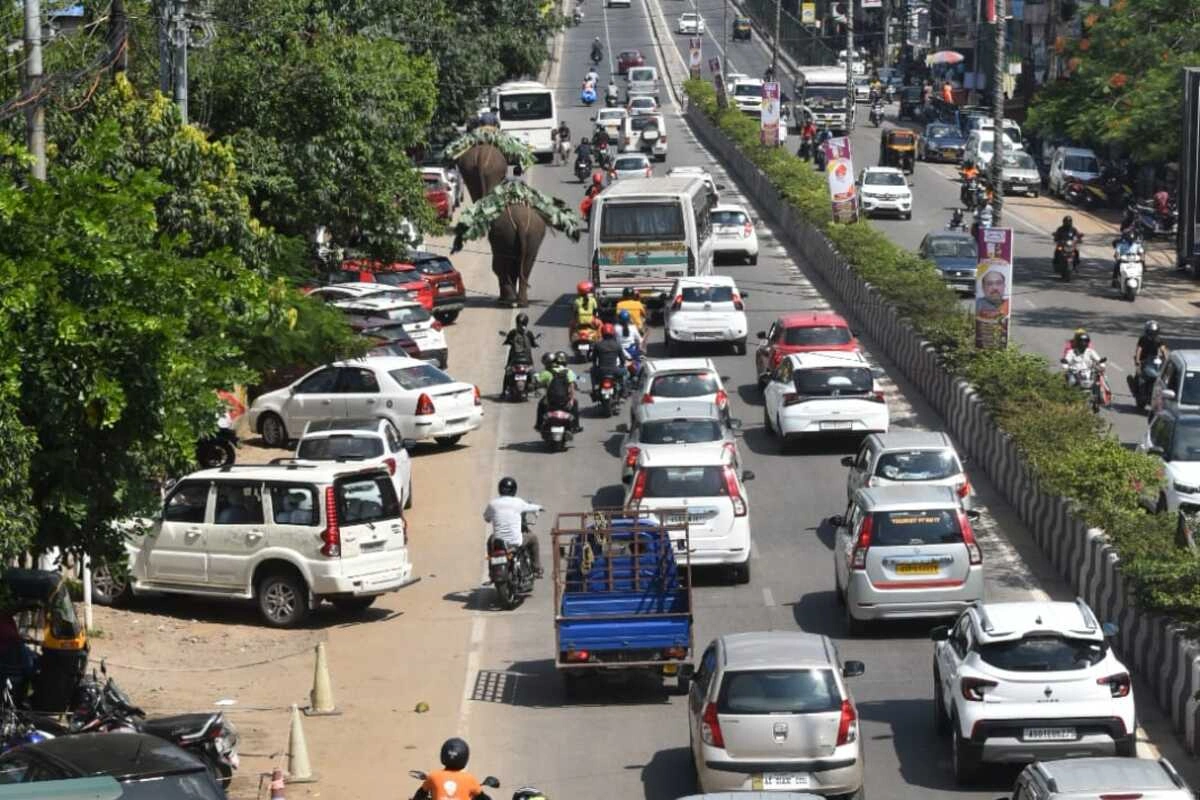
Residents in Guwahati allege official vehicles often violate traffic rules with little accountability, raising concerns over road safety and privilege
Rash driving on the busy roads of Guwahati has long remained a major concern for commuters, pedestrians and traffic authorities. Traffic personnel can be rarely seen penalising motorists for speeding, dangerous overtaking, signal jumping and violating basic road rules. Challans are issued but mostly for 'no parking', awareness drives are conducted and strict warnings are circulated to the public. Adding salt to the injury, a section of vehicles appears to move through the city with a different set of rules altogether.
ALSO READ: Heavy Vehicle Movement, Lack of Streetlights Worsen Guwahati's Basistha Road
For many residents, vehicles carrying the “Govt of Assam” sticker have increasingly become symbols of unchecked authority on public roads. Whether it is speeding through congested roads, forcing vehicles to make way, abrupt lane changes or ignoring traffic discipline, many commuters allege that official vehicles often operate with an assumed immunity rarely questioned publicly.
The concern is not merely about traffic violations but about the growing perception that accountability differs depending on who occupies the vehicle. For ordinary citizens, even minor violations can invite fines and legal action. But when vehicles linked to government offices or senior officials are involved, residents believe enforcement often becomes silent, hesitant or invisible.
Across Guwahati’s roads, from GS Road to VIP Road and from Dispur to Panbazar, commuters say encounters with aggressively driven official vehicles have become common. Many motorists claim they are often forced to suddenly pull aside or slow down when convoys or government vehicles approach at high speed.
For office-goers already struggling through the city’s traffic congestion, such moments create not only inconvenience but also fear. Several commuters say there is an unspoken pressure on roads whenever vehicles with government markings appear behind them.
“It feels like the road suddenly belongs to them,” said a commuter travelling daily through the Secretariat area. “You are expected to immediately make way even if traffic is heavy. If an ordinary person drives like that, action would be taken instantly.”
Another resident from Beltola said official vehicles often display behaviour that sends a message of superiority. “Everyone on the road is going somewhere important. But these vehicles behave as if only their work matters and the public must adjust,” he said.
The issue becomes even more sensitive because these vehicles are maintained using public funds and operate on roads built from taxpayers’ money. For many citizens, the frustration lies in the contradiction between public service and public behaviour.
While government officials themselves may not always be driving the vehicles, residents and traffic sources suggest that drivers attached to departments often misuse the influence associated with official vehicles.
Speeding through signals, using pressure horns unnecessarily and intimidating smaller vehicles are among the complaints repeatedly raised by commuters.
A source from Guwahati Traffic Police, speaking on condition of anonymity, acknowledged the concern and pointed towards the role of drivers operating such vehicles.
“The drivers of the government vehicles are usually the ones to blame. They take advantage of the situation thinking everything is integrated. However, it is also the duty of the DTO to enforce strict actions but that has been bare minimum,” the source said.
The statement reflects a concern that has quietly existed within public discussions for years but rarely receives direct attention. Traffic enforcement in Guwahati is highly visible when it comes to the general public.
Helmet checks, drunken driving drives and document inspections are carried out regularly. However, many residents feel the same strictness is not always visible when official vehicles are involved.
This perception has been reinforced by previous incidents involving escort vehicles and official convoys that attracted public attention following serious accidents. In some cases, fatal mishaps involving escort vehicles had sparked outrage and raised questions regarding speed, road conduct and responsibility. Yet many residents believe that the follow-up action in such cases often remains unclear.
Unlike cases involving ordinary citizens, where arrests and legal procedures are publicly highlighted, incidents linked to official vehicles frequently appear to fade away from public conversation after initial reports.
Residents say the absence of transparent updates contributes to the feeling that accountability is selective.
“There have been accidents before involving escort vehicles. People talked about them for some days and then everything became quiet. Nobody really knows what action was taken afterwards,” said a resident of Khanapara.
Another commuter expressed concern over what he described as “invisible privilege” on roads. “Traffic rules should apply equally. But on the road, people know which vehicles they can question and which they cannot,” he said.
The larger issue also reflects the broader culture surrounding authority and public behaviour in urban spaces. In Guwahati, as in many Indian cities, official symbols such as government stickers, beacon lights in earlier years and escort presence often create a psychological distance between certain vehicles and ordinary traffic.
Traffic management in Guwahati is already under pressure due to increasing vehicle numbers, narrow roads and constant congestion. In such a situation, aggressive driving by any category of vehicle increases risks for everyone on the road.
Pedestrians, cyclists and two-wheeler riders remain particularly vulnerable. Sudden speeding or reckless overtaking by larger vehicles can create panic and dangerous situations, especially during peak hours.
Residents say the fear becomes greater when the vehicle involved appears linked to authority because people hesitate to react or complain openly.
Some commuters also pointed out that drivers attached to official vehicles may themselves face indirect pressure to maintain strict schedules and move quickly through traffic. However, residents argue that urgency cannot justify unsafe road behaviour.
An official from District Road Safety Committee believe that institutional discipline must begin with public agencies themselves. Government vehicles, they say, should ideally set examples of lawful and responsible driving instead of contributing to the perception of privilege on roads.
At the same time, enforcing accountability remains a sensitive issue. Traffic personnel on duty may often find themselves in difficult situations while dealing with official vehicles linked to influential departments or senior offices. This creates a complicated environment where enforcement becomes inconsistent.
The mention of the District Transport Office by the traffic source also brings attention to the role of administrative monitoring. While traffic police regulate road movement, transport authorities are responsible for broader vehicle regulation and driver conduct. However, residents feel strict action against official vehicle misuse remains limited.
Public frustration is also rooted in everyday experiences. Office-goers delayed in traffic, parents carrying children on two-wheelers and elderly commuters crossing roads all share the same infrastructure. When some vehicles appear exempt from patience and discipline, resentment naturally grows among ordinary road users.
“There is already enough stress on Guwahati roads. Rash driving by anyone is dangerous. But when it comes from vehicles representing the government, it sends the wrong message,” said a school teacher from Uzanbazar.
Several residents also believe that behavioural reform is needed across all sections of society, including those linked to public offices. While awareness campaigns often target the general public, many feel similar emphasis should be placed on training and monitoring drivers attached to government departments.
The issue goes beyond isolated incidents and enters the larger debate about equality before law. Roads are among the few truly shared public spaces where people from different social and professional backgrounds interact daily. Any perception that some individuals are above basic rules creates visible public anger.
Many commuters say they are not against official movement or security arrangements where genuinely required. Their concern lies with unnecessary aggression, misuse of authority and absence of visible accountability.
In recent years, Guwahati has witnessed rapid urban growth, increasing traffic pressure and rising accident risks. Under such conditions, citizens expect stronger discipline from all categories of road users, especially those representing public institutions.
For now, however, the feeling among many residents remains that while traffic laws exist for everyone on paper, their implementation on the ground often depends on who is behind the wheel and what sticker is displayed on the vehicle. And until that perception changes, frustration on Guwahati’s roads is likely to continue growing alongside the city’s traffic itself.


