


The modern sports fan has become difficult to impress. At home, there are ultra-HD broadcasts, instant statistics, multiple camera angles, live betting markets, and endless second-screen content.
To justify the cost and effort of attending games in person, stadiums are being forced to reinvent themselves.
Around the world, sports organizations, technology companies, and entertainment brands are investing billions into connected venues designed to make every visit feel unique.
Big brands such as RajBet casino are also part of this broader transformation, as betting, data, and live sports increasingly intersect inside one seamless fan experience.
Stadium Is Becoming a Smart Entertainment Platform
For decades, stadium design focused primarily on capacity. Today, the goal is engagement. Venue operators increasingly measure success not only by attendance figures but by how much interaction occurs before, during, and after the game.
One of the most frequently cited examples is Tottenham Hotspur Stadium in London.
The venue was designed as a technology-first project with extensive Wi-Fi coverage, mobile ticketing, cashless payments, and one of the most advanced operational infrastructures in professional sports.
What makes this important is not the technology itself but the fact that it removes friction from the fan experience.
How Smart Stadium Technologies Change Matchday Experiences
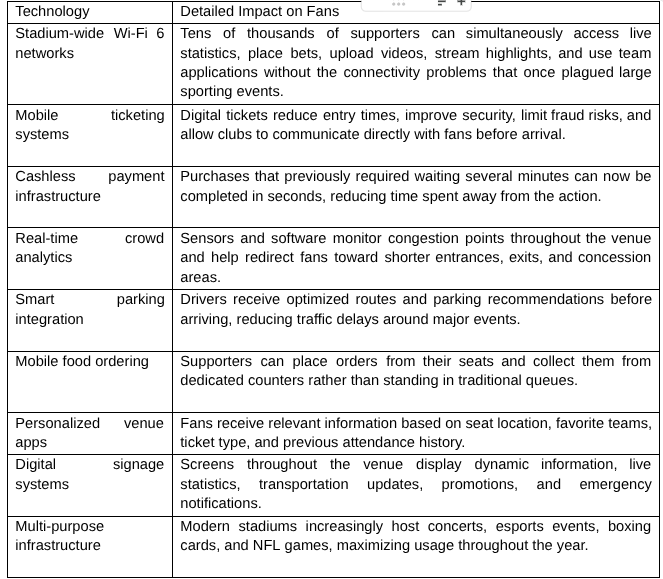
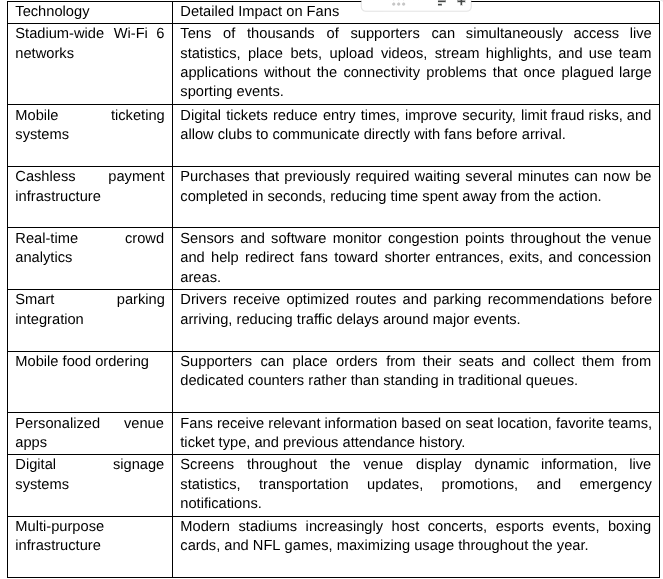
Technology becomes truly valuable when fans stop noticing it. Nobody attends a football match to admire network infrastructure. The objective is creating an environment where everything feels easier, faster, and more enjoyable.
What Supporters Gain From Modern Stadium Design:
> Less waiting and more watching, as digital ticketing, mobile payments, and crowd management systems significantly reduce time spent in queues.
> Better access to information, allowing supporters to view statistics, lineups, tactical data, and replay clips while remaining inside the live atmosphere.
> Improved betting experiences, since stable connectivity allows real-time market access during critical moments of a match.
> Greater convenience for families, who often value smoother entry procedures and easier navigation more than hardcore supporters do.
> Enhanced social sharing opportunities, as reliable mobile networks allow fans to post videos and photos instantly.
> More personalised experiences, with apps delivering tailored recommendations, promotions, and content based on individual behavior.
> Increased comfort during sold-out events, because crowd-flow technologies reduce bottlenecks around concessions and restrooms.
> A stronger sense of connection, since digital tools help supporters remain engaged before kickoff, during breaks, and after the final whistle.
> Access to services that were previously impossible, including seat upgrades, instant merchandise purchases, and mobile concierge features.
The result is a venue that feels less like a giant concrete structure and more like an interactive entertainment ecosystem. That transformation is becoming one of the defining trends of modern sports business.
Augmented Reality Is Mixing Watching and Participating
The next generation of stadium innovation focuses on immersion rather than convenience. Once basic connectivity became widespread, organizations started exploring how digital experiences could enhance what fans actually see.
A useful real-world example comes from SoFi Stadium in Los Angeles, home of the Los Angeles Rams.
The venue has experimented with augmented reality experiences that allow fans to view synchronized digital content layered onto the physical stadium environment through their smartphones. What once sounded futuristic is now becoming commercially viable.
Emerging AR Experiences Inside Stadiums
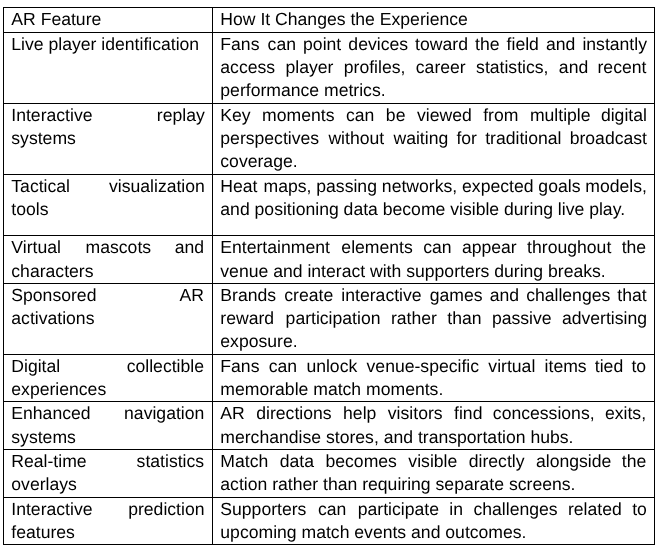
The commercial implications are enormous because AR transforms spectators from observers into active participants. Sports organizations have spent decades searching for ways to increase engagement without disrupting the game itself.
Two or three years ago many executives talked about immersive experiences as future possibilities. Increasingly, they are becoming current business models.
Features Likely To Become Common Before 2035:
> Prediction games integrated directly into stadium applications, allowing supporters to forecast goals, corners, touchdowns, or player performances throughout an event.
> Personalised camera-angle selection, enabling fans to access alternative perspectives tailored to their interests.
> Dynamic statistics overlays, showing everything from sprint speed to expected scoring probabilities.
> Seat-specific digital experiences, where different sections receive customized content and rewards.
> Fantasy sports integration, allowing participants to monitor teams and players while attending live matches.
> Interactive sponsor campaigns, which reward participation instead of relying on traditional advertising methods.
> Virtual merchandise previews, helping fans visualize products before making purchases.
> Augmented reality celebrations, creating shared digital experiences following major moments.
> Live social engagement systems, connecting stadium audiences with supporters watching remotely.
The biggest challenge will not be building these tools. It will be ensuring they enhance emotional moments rather than distracting from them. Technology succeeds only when fans still remember the game first.
Data, Betting, and Personalization are Next Stadium Era
The most powerful stadium technology is often invisible. Behind every ticket purchase, food order, merchandise transaction, app interaction, and betting session sits a growing pool of data that helps organisations understand supporter behavior.
For sports fans who also enjoy betting, this evolution is particularly relevant. Modern audiences increasingly expect immediate access to statistics, odds movements, player information, and predictive insights.
Betting platforms such as RajBet reflect this trend because they operate within a sports environment where data has become part of entertainment itself.
Data-Driven Services Expected in Future Stadiums
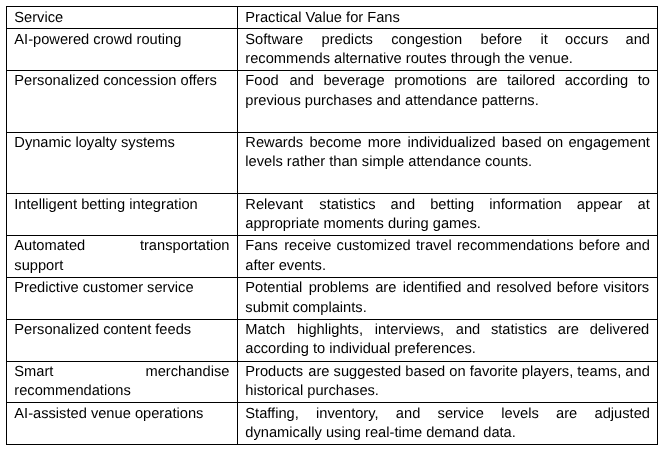
This growing emphasis on personalisation is changing how sports organisations think about fan relationships. Instead of delivering the same experience to everyone, stadiums are increasingly attempting to create thousands of slightly different experiences within the same event.
What a Typical Stadium Visit Could Look Like:
> A smartphone automatically suggests the fastest route to the venue based on traffic conditions, weather forecasts, and transportation availability.
> Digital tickets activate personalized welcome experiences that recognize previous attendance history and supporter preferences.
> Concession recommendations appear before halftime, reducing waiting times and helping fans avoid crowded locations.
> Betting content adapts dynamically to favorite teams and sports, creating more relevant experiences without overwhelming casual spectators.
> AI systems identify unusually long queues before they become serious problems, improving operational efficiency.
> Supporters receive customized replay packages immediately after matches, focusing on favorite players and key moments.
> Merchandise suggestions become event-specific, reflecting what happened during the game rather than generic catalog offerings.
> Transportation guidance updates continuously, helping fans leave crowded venues more efficiently.
> Loyalty rewards reflect actual engagement levels, encouraging deeper participation throughout the season.
> The entire experience feels seamless, even though hundreds of connected systems are operating simultaneously behind the scenes.
The future stadium may contain more software than many technology companies. Yet its success will still be measured by something remarkably simple: whether fans leave wanting to come back.
Conclusion
The stadiums of the future will combine physical atmosphere with digital intelligence. Connectivity, augmented reality, predictive analytics, and personalization are gradually transforming how supporters experience live sports.
The most successful venues will not be those with the most technology, but those that use technology to strengthen emotion, convenience, and engagement. In the end, fans will still come for unforgettable moments, but the way those moments are delivered is changing rapidly.


