



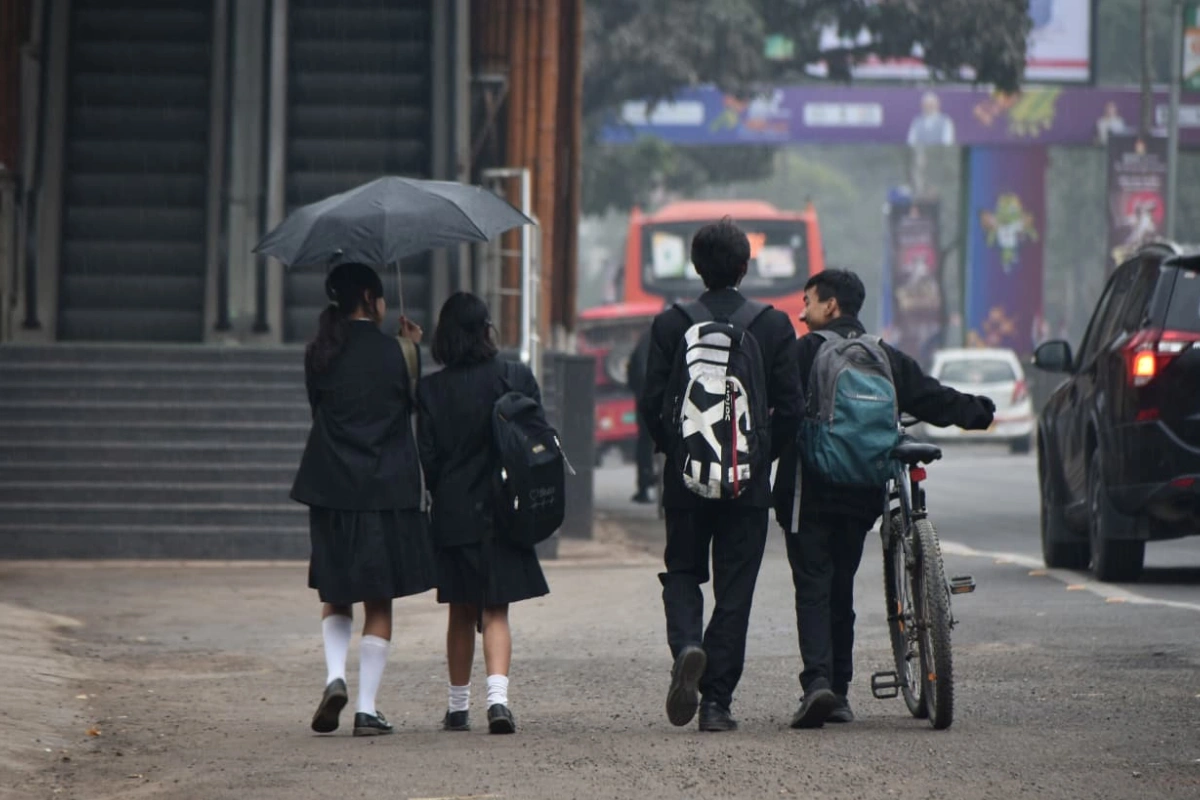
School bags light, NEP heavy: Can Assam carry the weight of education reform?
By all appearances, Assam's education department has launched yet another compliance drive. Circulars have been issued. Inspectors have been activated. Schools have been warned. The latest directive from the Inspector of Schools, Kamrup (Metro), marked "Most Urgent", instructs institutions to ensure that students do not carry school bags heavier than prescribed limits. For Classes I and II, the bag should not exceed 1.5 kg. For Class X, the limit is 5 kg.
The order sounds reasonable. It is also not new.
Assam first issued similar instructions in 2018. The National Education Policy (NEP) 2020 reinforced the idea through its School Bag Policy, prescribing that school bags should not exceed 10 per cent of a child's body weight. Since then, reminder after reminder has been issued. Dibrugarh saw fresh instructions. Sivasagar issued another circular on June 6 this year. Kamrup Metro followed on June 16.
Yet overloaded bags remain a common sight across Guwahati.
And that raises a question far larger than the weight of a school bag.
If Assam continues to struggle with one of the simplest and most visible provisions associated with NEP 2020, how does it expect to implement the rest of the policy, arguably the most ambitious education reform attempted in independent India?
The Smallest Reform Becomes the Biggest Challenge
The irony is difficult to ignore.
Reducing school bag weight requires no massive infrastructure project, no billion-rupee budget, no legislative amendment and no complicated restructuring of institutions. It simply requires schools to rationalise timetables, avoid unnecessary books, reduce homework in lower classes and comply with government instructions.
Yet even this has become a battleground.
Parents across Guwahati report schools finding creative ways around the rules rather than genuinely complying with them.
One parent whose child studies in a prominent private school said the institution recently instructed students to carry lunch boxes separately rather than inside their school bags.
"The bag becomes lighter on paper. But the child still carries the same load," the parent said.
Another parent said her child's school discouraged students from bringing steel water bottles because they added to the weight.
"They are not reducing the burden. They are simply redistributing it," she remarked.
Several parents argue that schools are more concerned with passing inspections than addressing the actual issue.
"The child carries a bag, a lunch carrier, an art folder, a project file and a water bottle separately. The weight is still there. Only the accounting has changed," said a father from Beltola.
Such stories reveal a deeper problem. Compliance is being treated as a statistical exercise rather than an educational reform.
And if that is the attitude toward school bag regulations, what happens when schools are asked to implement the far more complex components of NEP?
NEP Was Sold as a Revolution
When the Union Cabinet approved NEP 2020, it was projected as a historic transformation of India's education system.
The policy promised nothing less than a complete redesign of learning. It introduced the 5+3+3+4 structure, emphasised early childhood care and education, sought to reduce rote learning, proposed multidisciplinary education, advocated mother-tongue instruction, promoted vocational skills, envisioned flexible academic pathways, and promised critical thinking, creativity and holistic development.
Education experts hailed it as a paradigm shift. Political leaders described it as a visionary blueprint.
Six years later, however, Assam's implementation experience presents a much less inspiring picture.
The school bag controversy has inadvertently exposed the gulf between policy ambition and implementation reality.
"If authorities have to issue the same order every year, it means implementation has failed every year," observed a retired education administrator in Guwahati.
"The issue is not school bags. The issue is governance."
Schools Still Waiting for NEP
The uncomfortable truth is that many of NEP's most transformative elements remain largely absent from Assam's schools.
The foundational stage, considered the heart of the policy, is still evolving across many institutions. Anganwadi-school integration remains patchy. Teacher training remains inadequate. Curriculum redesign remains
incomplete. Infrastructure gaps remain glaring. The mother-tongue instruction policy remains controversial.
Many private schools have quietly continued with their existing systems.
A principal of a leading Guwahati school, speaking anonymously, said schools are caught between government expectations and parental realities.
"Parents are paying substantial fees because they want English-medium education. The policy may have good intentions, but schools cannot ignore market realities," he said.
Another school administrator was more direct.
"NEP assumes ideal conditions. Assam does not have ideal conditions."
According to him, the shortage of trained teachers, lack of clarity in implementation and absence of adequate teaching materials have left schools confused.
"We receive circulars. We attend workshops. But practical implementation remains unclear."
The result is predictable. Schools adopt selective compliance. Some changes are showcased, many are postponed and others are quietly ignored.
Circular Raj Cannot Replace Reform
Educationists increasingly warn that Assam risks reducing NEP implementation to a paperwork exercise.
The school bag saga offers a perfect example.
Since 2018, authorities have repeatedly issued instructions. Yet every few months, another reminder becomes necessary.
The pattern is revealing. The government issues directives, schools acknowledge them, inspections occur and temporary compliance follows. The situation gradually returns to normal, another circular is issued, and the cycle repeats.
"Reform through circulars has its limits," said an education researcher based in Guwahati.
"You cannot transform education simply by issuing instructions. You need capacity building, teacher preparation, infrastructure and sustained monitoring."
That observation becomes even more relevant when examining higher education, where NEP implementation has already moved beyond circulars and into classrooms.
The results have been far from smooth.
Universities Become Testing Grounds
While schools remain hesitant, colleges and universities have become Assam's primary laboratories for NEP implementation.
The rollout of the Four-Year Undergraduate Programme (FYUP) has generated widespread confusion.
Institutions have been asked to redesign curricula. New assessment systems have emerged. Multiple exit options have been introduced. Administrative procedures have changed. Faculty workloads have increased.
Students have struggled to understand the new framework.
A professor at a state university said the transition has often felt rushed.
"Implementation happened before preparation," he remarked.
"We are redesigning systems while simultaneously trying to operate them."
According to faculty members, uncertainty remains widespread regarding course structures, credit transfers and academic progression.
Many teachers privately admit that they themselves are still learning the system.
"Students ask questions that teachers cannot always answer because the guidelines keep evolving," said one faculty member.
"The policy is moving faster than the institutions."
The Rural-Urban Divide Widens
One of NEP's stated goals is educational equity.
Yet critics argue that implementation may be producing the opposite effect.
The introduction of the Common University Entrance Test (CUET) has emerged as a major concern. While intended to standardise admissions, many educators believe it disproportionately affects rural students.
A college teacher from Upper Assam said students from urban areas with access to coaching centres enjoy significant advantages.
"Digital literacy, internet access and coaching support have become critical," he said. "Many rural students begin the race several steps behind."
Teachers in Barak Valley report similar concerns. Students struggle to navigate changing admission systems. Parents remain confused. Schools are unable to provide adequate guidance.
The promise of accessibility increasingly appears complicated by new barriers.
The Infrastructure Question Nobody Wants to Answer
Perhaps the biggest obstacle confronting NEP implementation is infrastructure.
The policy assumes modern classrooms, trained teachers, technology access, adequate staffing and resource availability.
In many parts of Assam, those assumptions remain aspirational.
Several government schools continue to struggle with basic facilities. Teacher vacancies persist. Digital infrastructure remains uneven. Laboratory facilities remain inadequate. Training programmes often fail to reach all educators.
A senior academic from the Northeast recently described the situation bluntly.
"This is aspiration without preparation."
His criticism resonates strongly in Assam because every unresolved school bag issue points to a larger administrative challenge.
If authorities cannot consistently ensure compliance with a simple measurable norm, how will they oversee curriculum restructuring, pedagogical transformation and institutional redesign across thousands of schools?
Parents Are Beginning to Ask Questions
Parents are not debating educational philosophy.
They are asking practical questions.
Why are children still carrying excessive loads?
Why are schools finding loopholes?
Why are repeated government directives producing limited results?
And most importantly, if a relatively straightforward reform remains elusive despite years of instructions, what confidence should they have in the implementation of a policy as vast as NEP?
A mother from Guwahati summed up the frustration.
"They keep talking about transforming education. First show us that you can solve the school bag problem."
Her comment may sound simplistic.
In reality, it captures the essence of the challenge.
Public trust is built through visible success. When small reforms fail repeatedly, confidence in larger reforms inevitably erodes.
A Test Assam Cannot Afford to Fail
The debate over school bags is no longer about kilograms.
It has become a symbol.
A symbol of the distance between policy announcements and classroom realities.
A symbol of the tendency to celebrate reform before implementation.
A symbol of an education system where circulars often travel farther than actual change.
The National Education Policy remains one of the most ambitious educational blueprints India has ever produced.
Its objectives are laudable.
Its vision is expansive.
Its potential is undeniable.
But ambition alone cannot reform classrooms.
Execution does.
Six years after NEP's launch, Assam's schools still struggle with one of its most basic mandates: ensuring children do not carry excessively heavy bags.
That reality should concern policymakers far more than the weight of a backpack.
Because if the state finds it difficult to implement the lightest component of NEP, the burden of implementing the entire policy may prove far heavier than anyone anticipated.


