



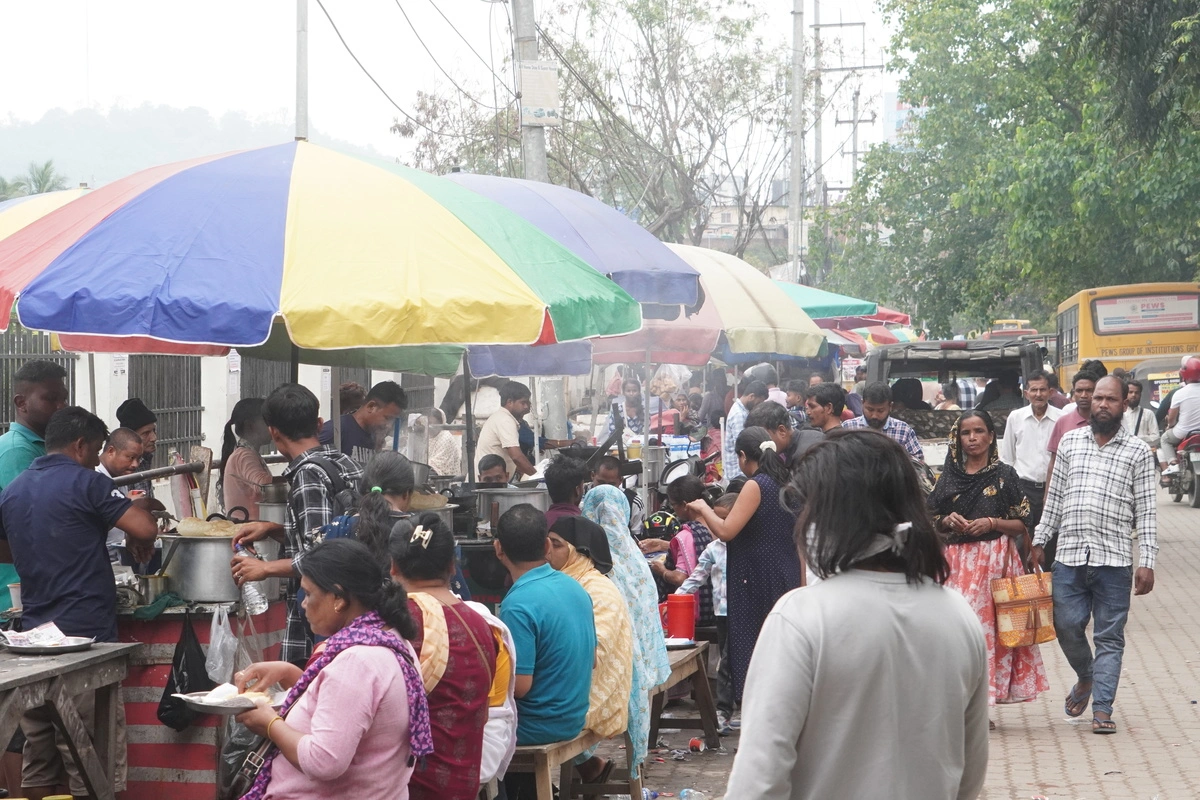
The Assam government's latest announcement of a fresh two-month survey of Guwahati's street vendors should have been a routine administrative exercise under a law enacted more than a decade ago. Instead, it has exposed a far more uncomfortable reality: twelve years after Parliament passed the Street Vendors (Protection of Livelihood and Regulation of Street Vending) Act, 2014, Guwahati still does not have a credible, updated and legally compliant map of its street-vending economy. Meanwhile, pavements, roadsides, flyover spaces and market stretches continue to evolve into largely unregulated trading corridors.
ALSO READ: ‘I’ll Give My 100% for Guwahati,’ Says DoHUA Minister Kaushik Rai
Chief Minister Himanta Biswa Sarma has announced that, beginning August 16, the government will undertake a "census-type" data collection drive covering what he estimates to be nearly one lakh roadside traders in Guwahati. According to him, the exercise will examine the nature of their trade, where they come from, and who controls these businesses. He has also framed it as a way to understand how many employment opportunities "Assamese people" may have lost in the city's informal retail economy.
On paper, it sounds like decisive action. In reality, however, it raises a more fundamental question: why is Guwahati still preparing to conduct a street-vendor survey in 2026 when the 2014 Act made such a survey the very foundation of any legal vending policy?
That lies at the heart of Guwahati's problem. The issue is no longer limited to street encroachment, pedestrian inconvenience, traffic bottlenecks or unhygienic roadside trade. The deeper failure is institutional. For years, the Guwahati Municipal Corporation (GMC) has spoken about vending zones, eviction drives, rehabilitation, vendor certification and regulation without first completing the one exercise that the law treats as non-negotiable, a comprehensive survey of street vendors.
The result is the worst of both worlds. The city has neither protected vendors' livelihoods through a lawful and transparent framework nor safeguarded roads, footpaths and other public spaces from chaotic occupation. Instead, Guwahati has drifted into a shadow system where vendors remain vulnerable, citizens continue to be inconvenienced, and public space is governed less by law than by ad hoc political decisions, selective eviction drives and allegations of local "nexus" control.
The consequences are visible across the city every day. New stretches are quietly transforming into vending belts. BK Kakati Road, near the police headquarters, has emerged as one of the latest examples, with fish and meat vendors occupying roadside space and, according to residents, even carrying out open slaughtering, worsening congestion and sanitation concerns. Similar scenes are no longer unusual in parts of Lachit Nagar, Ganeshguri, Ulubari, Beltola, Panbazar, Fancy Bazaar, Jalukbari and several other localities where vendors spill onto pavements and carriageways, only to be removed during eviction drives before gradually returning again.
This is precisely the kind of urban disorder the 2014 Act sought to prevent, not by criminalising street vendors, but by creating a formal, rules-based system. The law requires local bodies to conduct a survey of all existing street vendors, issue certificates of vending or identity cards, and regulate them through notified vending and no-vending zones after following due process. The objective was straightforward: end arbitrary evictions, prevent random encroachments and replace both with a balanced framework that protects livelihoods while preserving public order.
In Guwahati, that framework remains frustratingly incomplete.
The GMC has repeatedly announced vending zones. In March 2024, it notified 81 vending zones across 61 municipal wards, claiming they would accommodate more than 6,000 street vendors. The categories included free vending zones, mobile food vending zones, time vending zones and a dedicated fruit vending zone. By August that year, the corporation announced that the locations had been finalised and vendors would soon be accommodated in phases. By the end of 2024, the Mayor again stated that the notified zones would become operational in 2025.
Yet one glaring contradiction has remained unresolved: how did the city proceed to notify dozens of vending zones when it still lacked a current, comprehensive survey identifying exactly who needed to be accommodated?
The numbers themselves reveal the scale of that disconnect. GMC's own official page on street vending still highlights an earlier survey that identified 7,182 vendors in Guwahati and states that vending zones were created to accommodate them. That page, updated as recently as June 2026, continues to refer to the earlier survey exercise and completed vending zones at locations such as GMCH and Sixmile. Yet the Chief Minister now estimates there are nearly one lakh roadside shops and traders in the city. Even allowing for seasonal fluctuations, mobile operators and possible exaggeration, the gap between 7,182 and one lakh is not merely a statistical discrepancy, it points to a serious governance failure.
And that institutional failure has consequences far beyond poor paperwork.
If the city continues to rely on vendor data collected more than a decade ago while the actual number of vendors has multiplied dramatically, any zoning plan built on that outdated foundation is destined to fail. It means notified vending zones are too few, too small and too late. It means enforcement becomes arbitrary because the authorities do not know whom they are regulating, whom they are required to rehabilitate and whom they can legally remove. It also means every eviction drive becomes open to challenge because the state cannot convincingly demonstrate that lawful alternatives have been provided.
That is why the latest announcement feels less like a new beginning and more like an admission that the earlier process has failed.
The history of delays only reinforces that scepticism. GMC had earlier engaged the Delhi-based All India Institute of Local Self Government to conduct a detailed survey, with the exercise expected to be completed within six months. Later, the civic body announced that it would be finished by August 2023. It wasn't. Now, in mid-2026, even a senior GMC official working on vendor issues has said that there has been no formal instruction regarding the Chief Minister's newly announced survey and that officials on the ground are still unclear about how it will be carried out.
That admission should concern every resident of Guwahati. If the Chief Minister has publicly announced a major two-month exercise to map nearly one lakh traders, yet the municipal machinery expected to execute it says it has received no directions, the city may once again be witnessing a headline without the administrative preparedness to back it up.
The city has been here before.
In 2020, the Assam government introduced the Assam Street Vendors (Protection of Livelihood and Regulation of Street Vending) Scheme, 2020. That move itself prompted questions because the legal framework already existed in the form of the 2014 central Act. The problem was never the absence of legislation; it was the failure to implement it. A new scheme could not substitute for the survey, vendor certification, zoning, rehabilitation and due process obligations that had already remained pending for years.
Meanwhile, the lived reality of street vendors has been one of constant uncertainty. Eviction drives continue, but rehabilitation remains elusive. In Jalukbari, vendors were removed under "no vending, no parking" enforcement. In Ulubari too, vendors have repeatedly faced the threat of eviction with little clarity on relocation. In 2025, The Sentinel reported that even after identifying 81 vending zones, GMC had failed to provide actual spaces, leaving vendors to continue operating on roadsides and footpaths while periodic eviction drives carried on.
That contradiction lies at the heart of Guwahati's predicament. The government wants a cleaner, more orderly and less congested city. Vendors want the right to earn a livelihood without the constant fear of being uprooted. Residents want their roads and footpaths back. GMC wants to project an image of proactive governance. Yet without a completed survey and a credible allotment mechanism, every stakeholder remains trapped in the same cycle of uncertainty and distrust.
Vendors themselves are not necessarily opposed to regulation. Many have repeatedly said they are willing to relocate if they are allotted proper spaces, provided basic amenities and assured of a transparent process. What they fear is eviction without rehabilitation. For them, a stall on a pavement is not merely a planning violation; it represents school fees, rent, medicines and food. When the city removes them in the morning but offers no alternative by evening, it effectively transfers the burden of its planning failures onto some of its poorest citizens.
At the same time, residents are equally justified in asking why Guwahati's roads, footpaths, drains, medians and even flyover edges are steadily being surrendered to unregulated commerce. A city cannot simply allow every available patch of public land to evolve into a vending cluster. Pedestrian rights matter. Traffic flow matters. Public hygiene matters. Road safety matters. A city that cannot distinguish between a footpath and a marketplace has stopped governing its public spaces.
That is also why the Chief Minister's framing of the proposed survey carries political significance. By emphasising domicile, district of origin and the question of who is "taking" economic opportunities, the government has positioned the exercise as more than an urban-management initiative. It is also being projected as a political and social audit of Guwahati's informal economy.
That framing may generate headlines. It does not, however, answer the legal question confronting GMC: will this finally become the survey mandated under the Street Vendors Act, followed by vendor certification, transparent enumeration, ward-wise allotment and properly notified vending plans? Or will it become another data-gathering exercise that produces demographic talking points without delivering genuine urban order?
Because what Guwahati needs is not another list.
It needs a functioning system.
That system must begin with a genuine, citywide enumeration of every category of vendor, stationary and mobile, seasonal and permanent, food vendors, fish and meat sellers, fruit and vegetable vendors, tea stalls, informal kiosks and under-flyover operators. They must be mapped according to location, operating hours, nature of trade and dependence on public space. The database must then be reconciled with the Town Vending Committee framework prescribed under the law, followed by the publication of draft lists, the hearing of objections and the issuance of identity cards or certificates of vending. Only then can the city credibly, and legally, decide who can operate where.
The numbers, too, must withstand scrutiny.
If Guwahati truly has close to one lakh roadside traders, then 81, or even 83, vending zones with a combined capacity of around 6,000 people cannot possibly be considered a solution. They amount to little more than a token response. Either the government's estimate of one lakh vendors is significantly inflated, or GMC's present zoning framework is hopelessly inadequate for the scale of the problem. Both cannot be true simultaneously.
The city must also confront the question of corruption more directly. For years, allegations have persisted that unauthorised vendors in certain areas pay daily collections to local operators and, at times, to civic or political intermediaries in exchange for being allowed to continue business. While every allegation cannot be independently verified, the consistency of these claims is too striking to dismiss outright. Informal vending in Guwahati increasingly appears to function through parallel permission structures, not legal licences or formal allotments, but negotiated tolerance. That is precisely the kind of grey economy that flourishes when governments delay lawful regulation for years.
Ultimately, Guwahati's vendor crisis is not merely about encroachment.
It is about the collapse of sequence.
The law laid down a clear roadmap: survey first, identify vendors, notify vending zones, rehabilitate, regulate and only then enforce. Guwahati blurred those steps, reversed the order and repeatedly postponed the foundation. The result is a city with notified vending zones but no comprehensive allotment, eviction drives without meaningful rehabilitation, official figures that few believe, and a street economy expanding far faster than the government's paperwork.
The August survey will therefore be judged not by the announcement itself, but by three simple tests.
First, will it actually be completed within the promised timeframe, using a publicly disclosed methodology, ward-wise data and an official vendor register?
Second, will it be followed by the legal steps mandated under the Street Vendors Act, vendor certification, publication of final lists, grievance redressal, transparent allotment and properly notified vending zones, or will it end with speeches about who came from where?
Third, will the government finally align the number and capacity of vending zones with the actual scale of street vending in Guwahati, instead of pretending that a few dozen notified pockets can accommodate an informal economy spread across an entire city?
Until those questions are answered, Guwahati's latest street-vendor survey risks becoming exactly what its predecessors became: another promise made in the name of regulation while the streets continue to regulate themselves.
And that is the real scandal.
More than twelve years after Parliament enacted a law designed to protect livelihoods while bringing order to urban vending, Guwahati is still behaving as though it is discovering the problem for the very first time.
The law was never the missing piece. Political announcements were never the missing piece. Committees were never the missing piece. Implementation was.
A city cannot continue to announce surveys every few years while postponing the one thing that gives those surveys meaning, a transparent, legally compliant and continuously updated system of identifying, accommodating and regulating its street vendors.
Nor can it continue to swing between two equally flawed extremes: allowing unchecked encroachment on one hand and conducting periodic eviction drives on the other. Both approaches merely treat the symptoms while leaving the underlying disease untouched.
The choice before Guwahati is not between vendors and pedestrians. It is not between livelihoods and law. Nor is it between development and regulation.
The real choice is between governance and improvisation.
Well-regulated street vending is not an obstacle to a modern city; it is one of its defining features. Around the world, successful cities have demonstrated that informal commerce and orderly urban planning can coexist, provided governments are willing to build transparent systems, enforce them fairly and maintain them consistently.
Guwahati has reached a point where it can no longer afford to rely on temporary fixes, selective enforcement or headline-driven administration. As the gateway to Northeast India and a city aspiring to attract greater investment, tourism and international attention, it deserves a street-vending policy that functions every day, not only when public pressure mounts or political priorities shift.
The proposed survey offers an opportunity to reset the system. But only if it marks the beginning of implementation rather than the beginning of yet another survey.
Otherwise, twelve years from now, Guwahati may once again find itself counting vendors instead of regulating them, announcing reforms instead of delivering them, and debating the same questions that the law answered more than a decade earlier.
The city does not need another ceremonial beginning.
It needs the State Government and the Guwahati Municipal Corporation to finally complete the job they were required to do years ago.


