



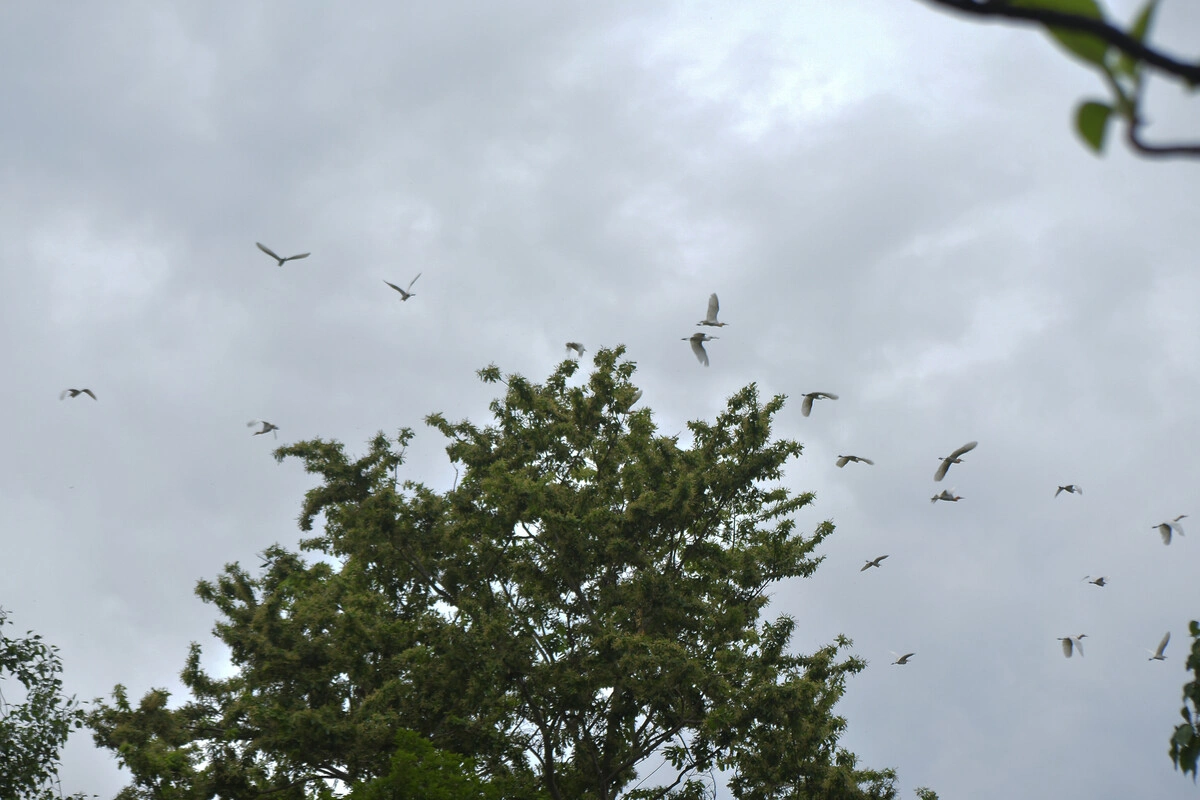
A Ramsar wetland has shrunk to a fraction of its size. Campus species lists have quietly shortened over two decades. And a city that keeps building, filling, and paving, one waterbody at a time. This is the story of Guwahati.
ALSO READ: Assam Orders New Guwahati Vendor Survey Amid Longstanding Legal and Policy Gaps
A group of ornithologists surveyed the Gauhati University campus in the 1980s and 1990s and documented over a hundred bird species, among them were the Pheasant-tailed Jacana, the Crested Serpent Eagle, and the White-backed Vulture.
When researchers returned to conduct a fresh count between 2007 and 2009, the list had dropped to 109 species across 44 families. The jacana, the eagle, and the vulture were all gone. Not relocated. Gone.
The numbers show that the once-diverse habitats of the university campus deteriorated during the 2000s due to developmental activities. Most important bird habitats degraded rapidly due to the filling up of wetlands for construction work and encroachment in nearby hillside areas.
That early warning from a university campus has since become the story of an entire city.
A City That Grew Without a Plan
Guwahati has been one of India's fastest-expanding cities for two decades, with its population now well past a million in the urban agglomeration. Its skyline keeps rising, and its highways keep multiplying. A satellite image analysis of land use from 1990 to 2020, published in a study, found a substantial and steady reduction in vegetation cover, cultivated land, and most critically, wetlands.
Researchers noted that the city had become one of the most unplanned cities in India, with deforestation of hills triggering landslides and flash floods, and the transformation of wetlands into high-rises and shopping malls depleting groundwater.
For birds, this is not an abstraction. It is the erasure of nesting trees, foraging patches, and the shallow waters that sustain fish-eating species.
Construction noise in the city during the breeding season disrupts breeding patterns. Floodlights and city lighting confuse nocturnal migrants. The slow strangulation of wetland corridors that connect Guwahati to the broader Brahmaputra Valley, one of the world’s great flyways, is another concern.
A 60-year-old resident of west Guwahati, recalling his memories of visiting Deepor Beel as a youngster to enjoy its wildlife, said: “The dirty water couldn’t sustain fish species like it used to. Birds need fish for food. There’s barely any fish now, so why would birds come here to starve?”
Sayam U. Chowdhury, ornithologist and researcher at the University of Cambridge’s Conservation Research Institute, explained the mechanism: “When waterbodies are drained, polluted or heavily altered, it destroys the habitats and food resources these birds depend on during their non-breeding season.”
The Beel That the City Ate
No story of bird loss in Guwahati is complete without Deepor Beel. Created thousands of years ago as a former channel of the Brahmaputra, the freshwater lake on the city’s southwestern edge was, until recently, one of northeast India’s most remarkable wildlife sites. It was designated a Ramsar wetland of international importance in 2002 and declared an Important Bird Area by BirdLife International in 2004. It is home to roughly 200 resident bird species and 70 migratory species, according to surveys. Among them are the Greater Adjutant, one of the world’s rarest storks, and the Slender-billed Vulture, critically endangered.
The numbers that tell its story are stark. Once spread over 4,000 hectares, Deepor Beel has now shrunk to approximately 500 hectares, an 87 per cent reduction. A satellite imagery study found wetland landscape coverage declining from 33.5 per cent of its study area in 1990 to 19.4 per cent by 2007, a trend that has continued to worsen. By 2025, the wetland area had shrunk to less than half its original size, according to research tracking unauthorised urban settlements and waste disposal.
The Asian Waterbird Census of 2025 confirmed what ecologists had feared: bird counts at Deepor Beel crashed from 26,747 birds in 2023 to 12,245 in 2025, a decline of more than 54 per cent in just two years. The species count also fell from 155 species in 2024 to 105 in 2025.
The Gauhati High Court, in April 2024, halted a government attempt to denotify Deepor Beel as a wildlife sanctuary, a move that would have stripped its legal protections, ruling that it was not the right time for such a decision. It also ordered that no construction or development activities take place in or around the wetland until its boundaries are officially defined.
But conservationists say the damage had already been building for years. The Boragaon landfill operated by the Guwahati Municipal Corporation sits adjacent to the beel, leaching toxins into its water. Industrial and hospital waste flows in from the city’s catchments. A railway track already cuts through its periphery, and a new multi-track line is now planned through it.
A young environmentalist warned of the future impact, saying: “Deepor Beel will someday become a garbage dump if encroachment continues at the current rate.”
Campus Canaries
The university campuses of Guwahati, due to some of the region’s most detailed bird documentation, serve as a kind of long-term ecological record, canaries in the coal mine of the city’s biodiversity.
A 2022 study published in the Journal of Threatened Taxa surveyed the Indian Institute of Technology Guwahati (IITG) campus over three years and documented 152 bird species across 50 families. The numbers were impressive, more than double the global average of 66 species per campus found in a survey of over 300 universities worldwide. But within those numbers were warning signs. Of the 152 species, one was critically endangered (the Slender-billed Vulture), one endangered (the Greater Adjutant), and two vulnerable.
More telling was what was missing. When the study compared its list against a checklist compiled at the same campus between 2000 and 2002, five species had vanished entirely: The Eurasian Wryneck, the Little-ringed Plover, the Osprey, the Eurasian Marsh Harrier, and the Common Kestrel.
“The reason behind their disappearance from the campus could be the deterioration of water bodies and marshy areas,” the authors wrote, “besides the peripheral vegetation that came up due to construction activities.”
The study’s beta-diversity analysis, a measure of how different species communities are across habitats, found that specialist species, those restricted to specific habitats, made up nearly 36 per cent of water-body birds and 33 per cent of eco-forest birds. In construction and secondary growth zones, that number fell to 13–17 per cent. Specialists were being replaced by generalists, common, adaptable species like the House Crow, the Common Myna, and the Black Drongo, as habitats homogenised.
“The percentage of specialist species decreases due to construction work and associated disturbances,” the study concluded.
Citizen science data from eBird tells a similar story at Cotton University in the heart of the city. The platform, which aggregates bird sightings submitted by volunteers, lists 90 species recorded on campus by 148 birders across 989 checklists. Its “iconic birds” include the Oriental Honey-buzzard, which appears 13 times more frequently here than the regional average, yet is observed only once every three years. The Black-crowned Night Heron, the Medium Egret, and the Little Cormorant, species that should be routine sightings in a city flanked by the Brahmaputra, appear instead as occasional visitors.
At Gauhati University, the pattern was identical. The 2012 study found that species diversity was significantly higher in undisturbed habitats compared to moderately and severely disturbed zones.
Frugivorous birds that depend on fruit-bearing trees still made up 20 per cent of total species, but only because enough trees remained. “The high percentage of frugivorous birds shows that the campus still has sufficient fruiting trees to support them,” the study noted. The implicit warning: remove those trees, and that percentage collapses.
Wild birds such as parakeets and owls are in decline, especially in urban and suburban areas. The dwindling parakeet population has been attributed specifically to the loss of fruit-bearing trees like guava, which are increasingly being cleared for construction. In Guwahati’s Garbhanga woodland area, improved road connectivity, picnicking, and construction have disrupted biodiversity, putting species like the Oriental Dwarf Kingfisher and the Slender-billed Oriole at risk.
But in the reckoning of infrastructure budgets and smart city dashboards, the loss of a jacana or a kestrel seldom registers. Bird surveys from campuses and wetlands are published in scientific journals and then quietly archived. The data accumulates; the construction continues.
A new ring road project is now being routed through wetlands, forested hills, and wildlife habitats on Guwahati’s eastern and southern fringes, raising fresh alarm among ecologists. The city’s own 2035 planning documents acknowledge that shrinking wetlands “directly affect groundwater recharge and biodiversity, including migratory birds,” even as approvals proceed.
Researchers at IITG offered a clear directive at the end of their study. Given the high beta-diversity they measured, meaning each habitat on campus supports distinct bird communities, the conservation effort for the avian community of the IITG campus should be directed towards each habitat uniformly. No single patch can be sacrificed for development without losing species that exist nowhere else on campus.
It is a prescription that applies, at a larger scale, to Guwahati itself.


