



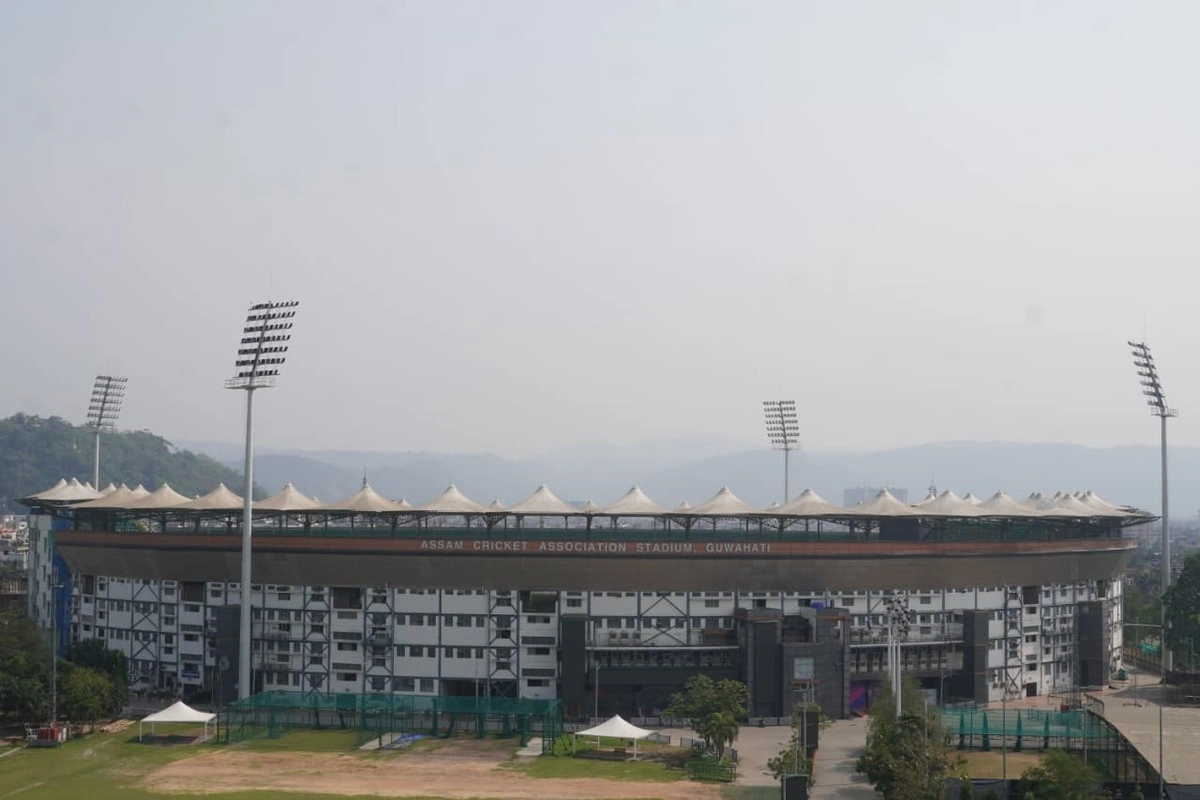
Assam has built world-class cricket infrastructure, now it's time to build players
There was a time when Assam lacked both quality cricketing infrastructure and players capable of representing the state at the national level. Today, however, the infrastructure deficit has been addressed remarkably well. Cricket-specific stadiums and training facilities are now coming up across the state. The physical foundation has largely been laid, but the real test of Assam's cricketing ecosystem is only just beginning.
ALSO READ: Football Fever Drives Strong Jersey Sales in Guwahati's Ulubari Sports Stores
Riyan Parag, Uma Chetry, Jintimani Kalita and Abu Nechim are among the few cricketers from Assam who have represented the country or earned a place in the Indian Premier League (IPL).
Unfortunately, they remain few in number. While both Riyan Parag and Uma Chetry have donned the Indian jersey, their appearances have been intermittent and neither has yet cemented a permanent place in the national side.
There is no denying Riyan Parag's remarkable rise. Over successive IPL seasons, he has established himself as one of Assam's finest cricketing ambassadors. In the 2026 edition, he was entrusted with the captaincy of the Rajasthan Royals and justified the faith placed in him by leading the franchise to the playoffs while making valuable contributions with the bat.
Yet one Riyan Parag here and one Uma Chetry there will not be enough in the long run.
Assam now needs a consistent pipeline of elite cricketers who can bring sustained glory to the state while inspiring thousands of young boys and girls to view sport as a serious career option rather than merely a hobby.
Gone are the days when Assam did not even have a dedicated cricket stadium. For decades, the state depended almost entirely on Nehru Stadium in Guwahati. While it hosted several international fixtures and important domestic tournaments, the venue was regularly shared with football and even non-sporting events, taking a heavy toll on the quality of both the pitch and the outfield.
Back then, structured coaching academies were also few and far between. Youngsters blessed with natural ability had limited opportunities to receive professional coaching and systematically develop their skills.
Cut to the present, and Assam now boasts some of the finest cricketing facilities in the country. Equally encouraging is the fact that the current leadership of the Assam Cricket Association (ACA) appears committed to taking the game forward with a more hands-on approach. This marks a welcome departure from an earlier era when the association was frequently dogged by allegations of corruption and administrative mismanagement.
Today, with a steady stream of international fixtures and high-profile IPL matches being played at the Barsapara Stadium, youngsters across Assam have the opportunity to watch some of the world's best cricketers from close quarters.
It would not be an exaggeration to say that Assam today possesses adequate cricketing infrastructure. Even the remote town of Umrangso in Dima Hasao district now boasts a picturesque cricket stadium. Guwahati, meanwhile, is on the verge of getting another international cricket stadium at Amingaon. With a planned seating capacity of around 20,000 spectators, construction of the facility is progressing at a healthy pace.
Assam also enjoys a rare administrative advantage. The incumbent Secretary of the Board of Control for Cricket in India (BCCI), Devajit Lon Saikia, hails from the state. The ACA must seize this opportunity by going the extra mile to identify, nurture and prepare the next generation of cricketers for the national stage.
After years of discussion and planning, the ACA finally announced the launch of the Assam Premier League (APL) on June 21. Modelled on the IPL, the tournament is scheduled to be held from August 1 to August 23 at the Barsapara Stadium.
To ensure maximum visibility, the league will be broadcast on Star Sports and streamed on JioHotstar. According to ACA officials, the APL has been conceived not as a commercial venture but as a platform to discover and nurture fresh talent.
During the official launch of the league, BCCI Secretary Devajit Lon Saikia made it clear that the success of the APL would not be measured by revenue or commercial returns, but by the number of young cricketers it inspires and the sustainable careers it creates.
"We have very clearly told you that this is not a commercial venture," Saikia told the owners of the eight APL franchises. "You cannot expect returns on your investment in the way IPL franchise owners do. This is not a platform for commercial activities. It has essentially been conceived to promote the game."
He also reminded franchise owners that broadcasting the APL on major television networks and digital platforms would naturally attract the attention of national selectors, offering local players an unprecedented opportunity to showcase their talent before a much wider audience.
The inaugural edition of the league will feature eight franchises representing different regions of the state: Jorhat Stallions, Tezpur Titans, Dibrugarh Warriors, Barak Legends, Nagaon Rangers, Barpeta Braves, Guwahati Royals and Charaideo Sunrisers.
Speaking at the launch of the APL at the 91Yards Club in Barsapara, Chief Minister Himanta Biswa Sarma also expressed hope that the tournament would become a platform for discovering hidden talent and preparing players for both the IPL and the Indian national team.
"If we can produce even one or two cricketers through the APL and gradually help them reach the IPL and eventually the Indian team, it will be a remarkable achievement," the Chief Minister said. "This is a new experience and a new beginning. Nobody knows where this journey will lead us. But initiatives of this nature often succeed. Even when the IPL was launched, few imagined it would become the phenomenon it is today."
The Chief Minister, who himself once headed the Assam Cricket Association and understands sports administration closely, also made an important observation. While acknowledging that Assam has made significant progress in developing sports infrastructure, he cautioned that the effort would remain only half complete if it failed to consistently produce elite athletes.
He summed it up with a striking analogy: "It will be like hardware without software."
He further remarked, "At some point, people will begin asking why so much public money is being spent if we are unable to produce high-quality players. I believe the APL has the potential to bridge that crucial gap."
His observation goes to the heart of the issue.
For years, Assam's sporting discourse revolved around the lack of infrastructure. That argument no longer holds. Today, the state has international-standard venues, dedicated cricket academies, regular exposure to top-level cricket and, now, a professionally structured state league designed to identify emerging talent.
The conversation, therefore, must evolve. The question is no longer whether Assam has enough stadiums. The question is whether it has built an ecosystem capable of consistently producing elite cricketers.
That is precisely why the launch of the Assam Premier League assumes significance. It is not merely another domestic tournament on an already crowded cricket calendar. It is an attempt to bridge the long-standing gap between grassroots cricket and the professional game.
For talented youngsters from districts that have traditionally remained outside the spotlight, the APL could become the stage that finally brings them into the national conversation. It gives them competitive match exposure, television visibility and, perhaps most importantly, an opportunity to perform in front of selectors who might otherwise never have noticed them.
If administered well, the league has the potential to become the missing link in Assam's cricketing pathway.
The conception of the Assam Premier League is undoubtedly ambitious and welcome. More importantly, it has the potential to create a much-needed bridge between raw talent and the professional game.
However, once the initial glamour fades, the television cameras are switched off and the floodlights dim, everything will come down to one simple question.
Has the league succeeded in producing cricketers capable of competing at the highest level?
That, ultimately, will determine whether the APL has fulfilled its purpose.
The success of the league cannot be measured by television ratings, sponsorship revenues or packed stadiums. Nor can it be judged by the excitement surrounding its inaugural edition. Its real success will lie in the number of players it consistently produces for the IPL, the domestic circuit and, eventually, the Indian team.
That is also how Assam's massive investment in cricket infrastructure should be evaluated. Building stadiums is the easier part. Building cricketers is infinitely more difficult.
Infrastructure can be created through financial investment. Elite players, however, are produced only through sustained planning, quality coaching, competitive exposure, scientific training and a robust talent-identification system.
Assam has already crossed the first milestone. It has built stadiums that rival some of the finest in the country. It has created training facilities across the state, brought international cricket to Guwahati, and now launched its own franchise-based league.
The harder challenge begins now. Can the system consistently produce players who are good enough to represent India?
Can Assam ensure that Riyan Parag and Uma Chetry are not remembered as exceptions, but as the first names in a long list of international cricketers from the state? That is the benchmark that truly matters.
If, over the next decade, the APL succeeds in creating a steady pipeline of cricketers capable of breaking into the IPL and the Indian team, it will justify every rupee spent on Assam's cricketing infrastructure.
If it fails, the state risks being remembered as one that built world-class stadiums without producing enough world-class players to fill them.
Assam has built the infrastructure. Now it must build the players.


