



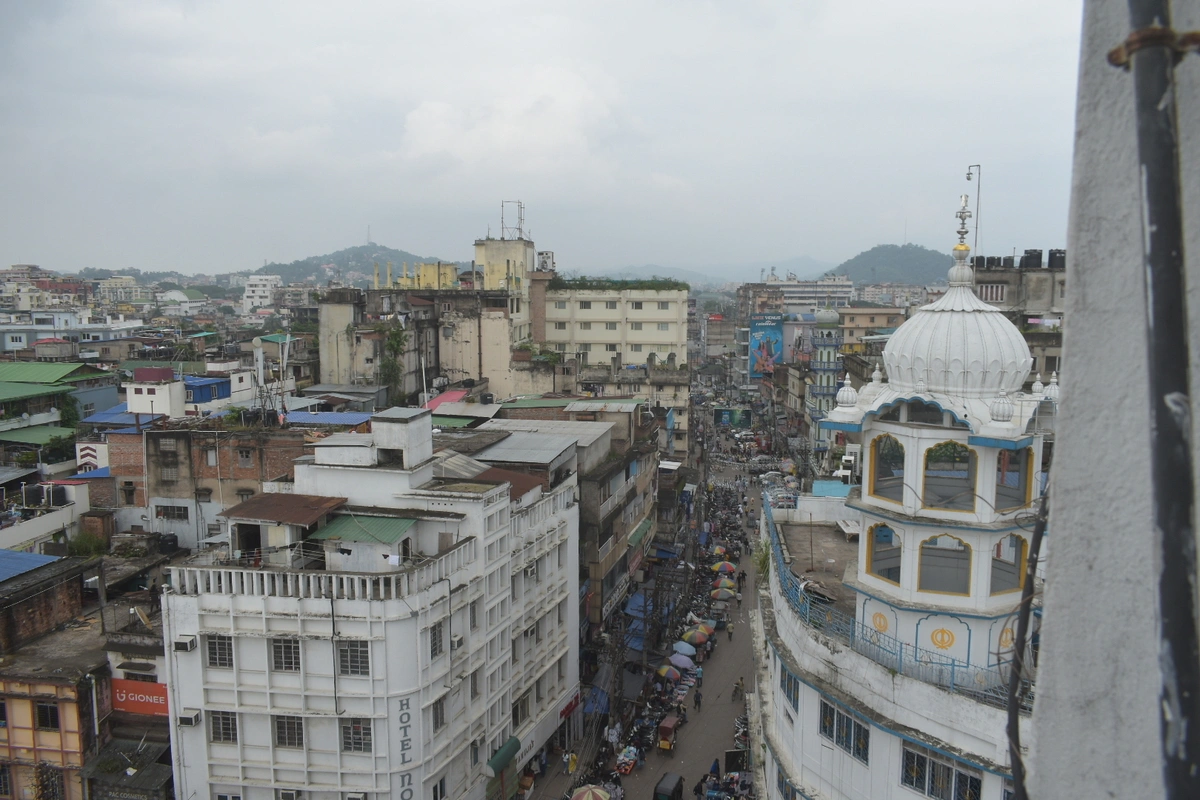
Guwahati’s grand urban redesign dream faces a reality check
The idea of redesigning Guwahati is as ambitious as it is unsettling. For a city that has grown organically, and often chaotically over decades, the promise of a structured, modern and decongested urban future is undeniably appealing on paper. But beneath the glossy projections and master plans lies a fundamental question: can Guwahati truly be redesigned, or is the exercise destined to spiral into confusion, displacement and administrative overreach? As authorities push ahead with a sweeping vision under the proposed Master Plan 2045, the city stands at a crossroads between transformation and turmoil.
ALSO READ: Rapid Urban Expansion in Guwahati Drives Sharp Decline in Bird Diversity
The momentum behind Guwahati’s redesign has been building steadily. From plans to revamp Fancy Bazar, the city’s commercial lifeline to proposals for satellite townships and expanded urban boundaries, the scale of change being envisioned is unprecedented. Yet the lack of clarity surrounding the approval of the master plan raises immediate concerns. While master plans for smaller towns like Rangapara, Gohpur and Bokakhat were approved in November 2023, Guwahati’s blueprint remains under revision. This delay is not merely procedural; it reflects the sheer complexity of attempting to reimagine a city that is already bursting at its seams. “It is evident that there are talks ongoing regarding redesigning Guwahati, but how far it will be possible only time can tell,” admitted a source in Dispur, underscoring the uncertainty clouding the entire exercise.
At the heart of the redesign narrative lies an undeniable truth: Guwahati is choking under its own weight. Population projections tell a stark story, from just over 7 lakh in 1991 to nearly 15 lakh in 2021, with estimates suggesting the figure could cross 38 lakh by 2045. Infrastructure, however, has not kept pace. Congested roads, inadequate drainage, unregulated construction and vanishing wetlands have turned everyday life into a logistical challenge. A senior official from the Town and Country Planning department did not mince words: “Guwahati is imploding and certainly it has to be decongested or redesigned.” The urgency is real. Whether the proposed solutions match the scale of the crisis, however, remains deeply debatable.
One of the flagship ideas is the gradual decongestion of core areas like Fancy Bazar, Pan Bazar and Uzan Bazar through Local Area Plans (LAPs). The stretch from Bharalumukh to Uzan Bazar, spanning 300 hectares, is among the first to be targeted. Officials argue that these densely packed commercial zones, marked by narrow lanes and buildings standing shoulder to shoulder, are ripe for redevelopment. “The buildings are too close to each other. There is so much congestion, and it requires redevelopment,” said a GMDA official. The plan envisions wider roads, better zoning and modern infrastructure. Yet the practicality of executing such a transformation in a live, functioning marketplace remains questionable. Relocation of businesses, resistance from traders and the risk of prolonged economic disruption could turn the process into a drawn-out battle rather than a smooth transition.
The government’s strategy also hinges on decentralisation, shifting key economic and administrative functions to North Guwahati and other satellite regions. With the Bharalumukh–North Guwahati bridge already operational, authorities believe traffic and commercial pressure can be redistributed. There are even discussions about relocating wholesale markets, courts and hospitals, alongside proposals for a second airport and an “aerocity” in North Guwahati. “The idea is to take major markets and establishments out so that Guwahati can breathe,” said a senior official. On paper, the strategy aligns with global urban planning trends, where satellite cities ease the burden on overburdened urban cores. But critics argue that North Guwahati itself lacks the foundational infrastructure needed to absorb such a shift.
Social activist and Padma Shri awardee Ajoy Kumar Dutta offered a scathing critique of the assumptions underpinning the plan. “I keep hearing about redesigning Guwahati and it will be a drastic idea. If there can be New Delhi or New Mumbai, why can’t there be a New Guwahati?” he asked, suggesting that building a parallel city may be more feasible than overhauling the existing one. He was particularly critical of the proposal to shift Fancy Bazar’s wholesale market, calling it “ahistorical” and dismissive of the area’s cultural significance as Panchatirtha. “Even North Guwahati is not planned. There is no proper drainage, sewerage, or basic infrastructure,” he added, warning that the same mistakes could simply be replicated in a new location.
Indeed, the absence of robust foundational infrastructure remains the Achilles’ heel of Guwahati’s redesign ambitions. Stormwater drainage, sewerage systems, waste management and flood control are still inadequate across large parts of the city. Seasonal flooding continues to paralyse daily life, exposing the fragile underbelly of urban planning. Experts argue that without addressing these core issues, any attempt at cosmetic or structural redesign will be superficial at best and disastrous at worst. “You cannot redesign a city by just building flyovers and shifting markets,” said an urban planner familiar with the project. “The basics have to be fixed first.”
To its credit, the proposed master plan does attempt to incorporate modern planning principles. There is a strong emphasis on green belts, ecological conservation and blue-green infrastructure. Plans for integrating wetlands, creating botanical gardens and establishing bird sanctuaries signal a shift towards sustainability. Officials claim these measures will not only enhance the city’s resilience to climate change but also improve quality of life. “We are trying to strike a balance between development and environmental preservation,” said an official involved in drafting the plan. Yet given Guwahati’s track record of encroaching upon wetlands and forest areas, scepticism persists over whether these promises will translate into action.
Another critical dimension is governance. The proposed establishment of the Guwahati Satellite Cities Development Authority (GSCDA) is intended to streamline planning and execution. Alongside it, schemes like AMRUT’s Local Area Plan are expected to build local capacity and enable structured development. But bureaucratic overlap, poor inter-agency coordination and political considerations have historically hampered urban projects in the city. The delay in approving the master plan is itself indicative of these systemic challenges. Without clear timelines, accountability and meaningful public participation, the redesign risks becoming yet another prolonged bureaucratic exercise.
Perhaps the most contentious aspect of the debate is feasibility. Guwahati is not a blank slate; it is a densely populated, economically active and culturally layered city. Flyovers, haphazard constructions and unregulated expansions have already locked in certain patterns that are difficult, if not impossible, to undo. “Guwahati cannot be redesigned because of the flyovers and unplanned structures,” Dutta argued bluntly. This raises a larger dilemma: is it wiser to attempt a risky overhaul of the existing city, or to focus on building new, well-planned urban spaces that can gradually ease the burden on Guwahati?
There is also the human cost to consider. Large-scale redesign often entails displacement, of traders, residents and informal workers who form the backbone of the city’s economy. While officials speak of modernisation and efficiency, there is little clarity on rehabilitation, compensation and stakeholder engagement. Without inclusive planning, the project risks deepening socio-economic divides and triggering public backlash.
As Guwahati hurtles towards an uncertain urban future, the stakes could not be higher. The need for decongestion and modernisation is undeniable, but the path to achieving it is fraught with challenges. The Master Plan 2045 offers a vision, but vision alone is not enough. Execution, grounded in realism and inclusivity, will determine whether the redesign becomes a model for urban transformation or a cautionary tale of overambition.
For now, the city waits, caught between hope and apprehension. Guwahati may indeed need a redesign, but unless it is rooted in meticulous planning, infrastructural readiness and public consensus, the dream of a modern metropolis could quickly descend into mayhem. In the end, the question is not just whether Guwahati can be redesigned, but whether those redesigning it truly understand the city they are trying to change.


