


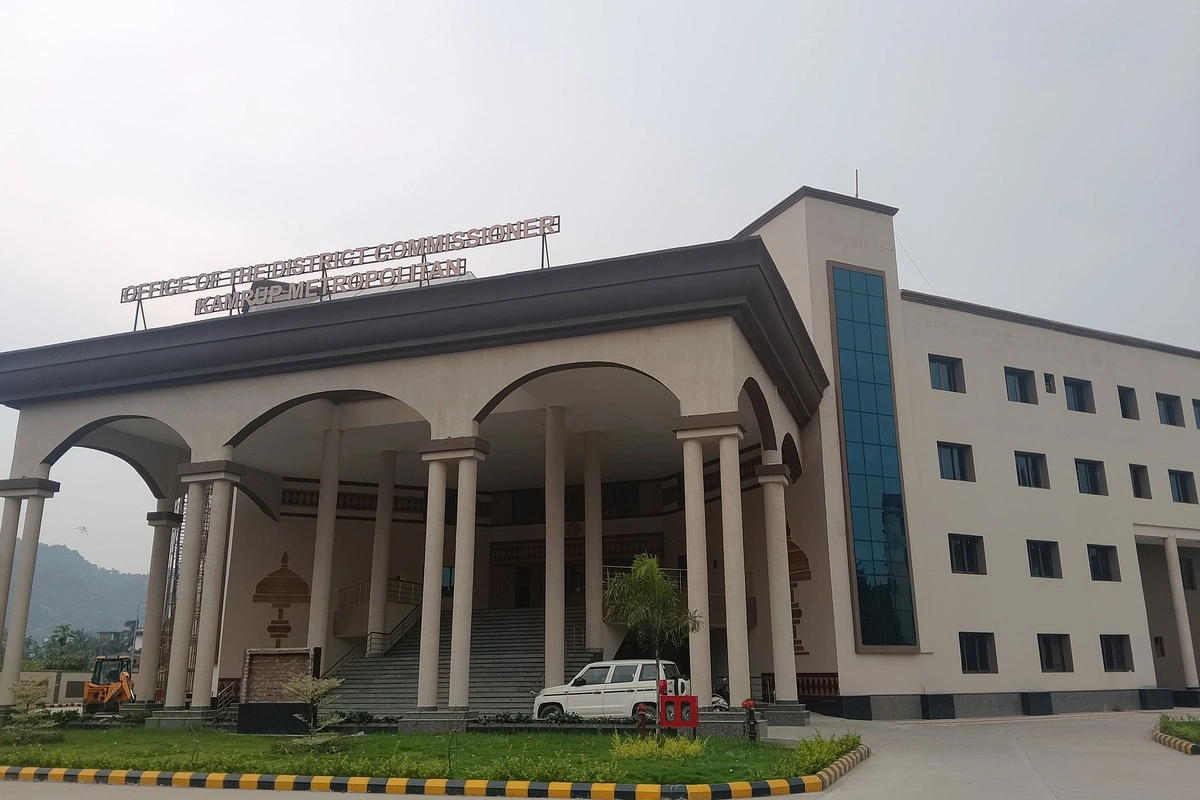
GUWAHATI: After years of overcrowded corridors, scattered offices and long public queues, Kamrup Metropolitan district is finally set to get a new administrative headquarters, with the Deputy Commissioner’s office complex at Rupnagar nearing completion and likely to be inaugurated on August 15.
ALSO READ: ASRLM to Mark International Day of Yoga Across Rural Assam With AYUSH Department
Built at an estimated cost of around Rs 81 crore, the new office is expected to replace the district administration’s current cramped set-up and bring a wide range of public-facing services under one roof — a shift that officials say could significantly ease access to everything from land records and registrations to pensions, revenue work and grievance redressal.
Sources in the Public Works Department (PWD) said the building is now in its final phase and is expected to be completed by the end of this month. “The new DC building will have four floors. It will be completed by the end of this month,” a PWD official told G Plus.
The upcoming complex, officially named the Commissioner’s Office, Kamrup Metropolitan District, has been conceived as more than just a new government building. It is being projected as a central administrative hub for one of Assam’s busiest urban districts, where public dealings with the administration have steadily outgrown the capacity of the existing office.
For years, the present Kamrup Metro DC office has struggled under the weight of rising public footfall and expanding administrative responsibilities. Citizens visiting the office for land mutation, certificates, pension-related work, registrations and other routine services have often had to navigate congested spaces, limited seating, inadequate parking and departments functioning in a fragmented manner. The new building is meant to address precisely those long-standing problems.
According to official records, the project received revised Administrative Approval under order number AA/PWB_2025-26_4736 dated June 4, 2025, with the approved amount fixed at Rs 8,120.33 lakh. The construction work was awarded to Anand Builtech Private Limited, while the formal work order was issued under F.W.O. No. CE/TB-IV/77/2021/22 dated November 22, 2022. The revised tender value of the project stands at Rs 7,786.24 lakh.
Construction began on November 23, 2022, and the official completion deadline on paper remains March 20, 2026. But officials now say the project is moving faster than the recorded schedule and is likely to be ready for use months in advance. The latest departmental update shows 79.79 per cent financial progress and 88 per cent physical progress, indicating that the core civil work is almost complete and only finishing, fittings and service installations remain.
The building has been designed with future expansion in mind. Though currently being developed as an RCC structure with four operational levels, it carries provision for extension up to G+5, reflecting the expectation that Kamrup Metro’s administrative requirements will continue to grow in the years ahead.
More importantly, the complex is structured around the idea of reducing the burden on citizens who routinely have to deal with multiple branches of the district administration. The ground floor has been planned as the public interface zone, with space for a facilitation centre, central receipt section, RTI office, E-Stamp services and other functions that generate daily footfall. Officials said this was done deliberately so that basic services remain accessible without forcing people to move across floors and offices for every small task.
The upper floors will bring together a range of district offices that currently operate with space limitations or in disconnected arrangements. These include the Revenue Circle, Treasury, Excise, Food and Civil Supplies, Pension, Sub-Registrar and E-DIST sections, along with the chambers of the Deputy Commissioner, Additional Deputy Commissioners and other key administrative functionaries. The complex will also house the Zila Parishad office, NIC facilities, tribunal and labour court spaces, and other district-level branches.
In practical terms, that means much of the routine administrative traffic of Kamrup Metro — from revenue and registration work to quasi-judicial hearings and official coordination — will be pulled into a single campus. For the public, that could translate into fewer referrals from one office to another, less time spent locating departments and a more streamlined interface with the district administration.
The project also seeks to fix one of the most persistent problems at the current DC office: lack of parking and poor site planning. Officials said the new complex will provide parking for 24 vehicles within the building and additional space for around 80 vehicles outside, apart from support infrastructure such as CCTV surveillance, LAN connectivity, DG sets, transformer facilities, a sewage treatment plant, underground water tank, boundary wall and security installations.
That broader infrastructure matters because the challenge at the existing office has never been only about the age of the building. It has also been about the mismatch between Guwahati’s growth and the administrative infrastructure meant to serve it. Kamrup Metropolitan district sits at the heart of Assam’s largest city, where population growth, urban expansion and rising dependence on district-level clearances have dramatically increased pressure on government offices. Yet the physical spaces from which those services operate have not kept pace.
In that sense, the Rupnagar DC complex is not merely a construction project; it is also a delayed response to a larger urban governance problem. Guwahati’s administrative load has grown sharply over the past decade, but the systems that citizens encounter on the ground — office space, counters, waiting areas, parking and service integration — have remained stubbornly outdated. The new complex offers an opportunity to correct at least part of that gap.
Still, the real test will begin after the inauguration. A new building by itself will not automatically guarantee better service delivery unless the transition is managed efficiently, departments are shifted without confusion, and the public-facing systems inside the complex are made functional from day one. Citizens will judge the new DC office not by its size or cost, but by whether it actually cuts waiting time, reduces crowding and makes government work less exhausting.
For now, however, the nearing completion of the Rupnagar complex marks a significant moment for Guwahati’s civic administration. If the August 15 inauguration goes ahead as expected, Kamrup Metro will soon move out of an office arrangement that has long appeared too small for the city it serves — and into a headquarters built for the scale of a growing urban district.


