


Women’s cricket is being reshaped not only by visibility or broadcast reach, but by financial infrastructure that determines how reliably money moves across borders, tiers, and participants.
As the sport expands globally, traditional banking frictions – slow settlement, high fees, and currency barriers – disproportionately affect women’s leagues, where margins are thinner and operational buffers smaller.
Digital money changes this balance by making participation economically viable at scale.
This shift extends beyond governing bodies into adjacent analytical and transactional environments, including modeling and wagering systems used by top arab casinos, where settlement speed, liquidity access, and transparent balances directly influence market depth.
Digital money does not change how women’s cricket is played, but it materially changes how value circulates around it.
Cross-Border Payments and Prize Distribution Become Scalable
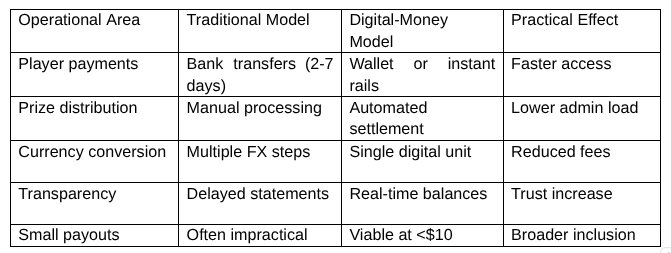
Women’s cricket operates across regions with uneven banking infrastructure, multiple currencies, and fragmented payout standards, particularly outside top-tier international tournaments. Digital money reduces these constraints by standardising settlement and lowering transaction friction for players and organisers.
A real-world reference point can be seen in how international cricket bodies and leagues increasingly rely on centralised digital payout systems for women’s competitions.
In recent ICC-sanctioned women’s tournaments, prize money and match fees have been distributed through digital payment rails that significantly reduced delays compared to traditional cross-border transfers, ensuring that players in regions such as South Asia, Africa, and the Caribbean received funds within days rather than weeks.
Similar mechanisms are now common in domestic women’s leagues, where faster payouts directly affect player availability and retention.
Digital Money in Women’s Cricket Operations
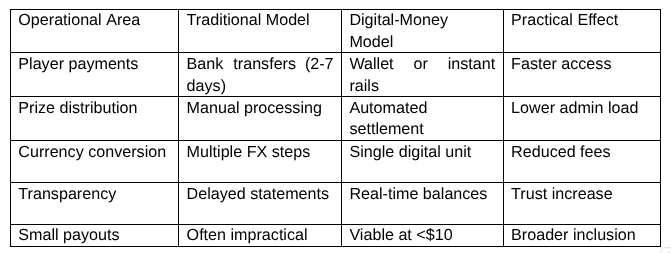
At lower and mid tiers of women’s cricket, predictable and timely payment often matters more than headline prize totals, making digital settlement an enabling factor rather than a convenience.
Sponsorship, Micro-Monetisation, and Fan Spending
Digital money also reshapes how women’s cricket monetises its audience. Instead of depending almost entirely on large sponsorship contracts, leagues increasingly support smaller, repeat transactions that compound gradually.
Digitised Revenue Streams in Women’s Cricket:
> Micro-sponsorship activations enabling contributions as small as $1-5, widening sponsor participation beyond major brands
> Direct-to-fan purchases such as digital content or access passes priced in single-digit amounts, reducing friction for casual supporters
> Recurring wallet-based spending, increasing lifetime fan value without requiring large one-off commitments
> Instant settlement for creators and athletes, shortening revenue delays from weeks to minutes
> Lower transaction fees, often 1-3% versus 5-8% on traditional card-based micro-payments
These mechanisms matter because women’s cricket audiences are global and digitally native but not uniformly high-spending. Digital money allows revenue to scale horizontally rather than relying on a narrow sponsor base.
Digital Money, Data, and Secondary Markets
The third area where digital money shapes women’s cricket is in data-linked and secondary markets, where settlement speed and transparency directly affect participation. Betting, fantasy contests, and performance-based incentives all rely on fast, reliable financial flows.
A concrete example is the growth of women’s cricket markets on digital-first platforms, where faster wallet-based settlement has enabled higher match coverage and more frequent participation compared to legacy systems.
Data providers and market operators increasingly treat women’s cricket as a stable input because near-instant settlement reduces churn and allows users to recycle balances across matches rather than waiting for delayed withdrawals.
Effects on Data-Driven and Secondary Systems
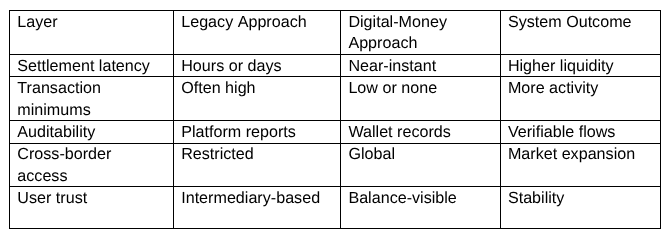
In emerging segments such as women’s cricket, these characteristics determine whether secondary markets remain sporadic or develop consistent depth over time.
Conclusion
Digital money shapes women’s cricket by removing structural friction rather than amplifying hype. Faster payments, viable micro-transactions, and transparent settlement allow the sport to grow globally without inheriting legacy financial constraints.
As women’s cricket expands across regions and formats, digital money functions as an enabling layer that stabilises participation, monetisation, and trust.


