



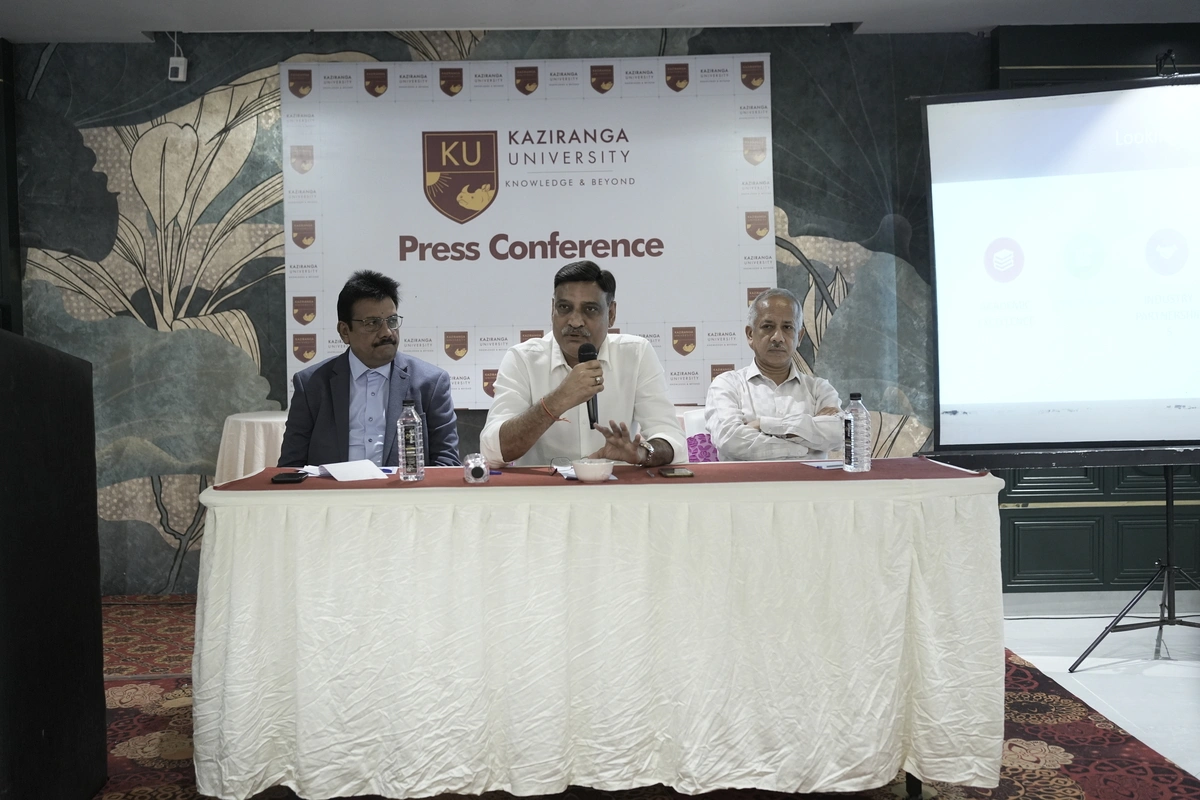
Kaziranga University on Monday, July 6, unveiled a roadmap aimed at positioning the institution as a strategic knowledge and innovation partner in the development of Assam and the North-East through education, research, innovation, entrepreneurship and industry collaboration.
The roadmap, announced at a press conference by Pro Chancellor of Kaziranga University, Basant Khetan, aligns with the aspirations of Viksit Assam and Viksit Bharat 2047. The initiative includes a ₹1 crore KU Startup Fund, a ₹3 crore Scholarship Programme, the establishment of an Intel AI Lab, new academic programmes and expanded institutional collaborations.
The ₹1 crore KU Startup Fund will support student-led innovation and entrepreneurship, while the ₹3 crore Scholarship Programme is designed to ensure that deserving students are not denied access to quality education due to financial constraints.
The university also announced specialised programmes in Electric Vehicle Technology and Industrial Robotics, internationally recognised Data Analytics programmes in collaboration with the Institute of Analytics, UK, and experiential learning initiatives such as the Bajaj General Quest Hackathon and PwC Launchpad.
"The future of universities lies beyond awarding degrees. Universities must become engines of innovation, entrepreneurship, skill development and societal transformation. Our vision is to build Kaziranga University into a nationally respected institution that empowers youth, strengthens communities and contributes directly to the sustainable development of Assam and the North-East, " Khetan said.
Khetan said Assam is witnessing significant development in infrastructure, healthcare, digital connectivity, logistics, advanced manufacturing and sustainable development. He added that growing strategic cooperation between India and Japan, along with increasing global interest in the North-East, is expected to create opportunities in sectors such as sustainable agriculture, silk and sericulture, food processing, river and water management, flood resilience, biodiversity, climate adaptation, advanced manufacturing, semiconductors, artificial intelligence and future technologies.
According to the roadmap, future academic programmes will increasingly focus on artificial intelligence, quantum technologies, semiconductor technologies, smart agriculture, Brahmaputra River Studies, climate resilience, nature-based solutions, healthcare innovation, entrepreneurship and global employability in line with the National Education Policy (NEP) 2020. The university said its objective is to prepare students for emerging industries while nurturing problem solvers, innovators, entrepreneurs and job creators.
The university is also expanding international collaborations through joint research, faculty exchanges, dual-degree pathways and globally benchmarked academic programmes to connect talented youth from the North-East with leading universities, industries and research institutions across the world.
Speaking at the press conference, Vice Chancellor Dr M. L. Gaur, who assumed office in February 2026, outlined the university’s academic roadmap and emphasised the need to align education with the demands of the future economy.
“The next decade belongs to the North-East. Universities cannot continue teaching yesterday's curriculum for tomorrow's economy. We are preparing students for careers that are still emerging by integrating knowledge with skills, research with innovation, and education with entrepreneurship. Our objective is to transform job seekers into job creators,” Gaur said.
The university said it is expanding collaborations with CSIR-NEIST, Tocklai Tea Research Institute, AIIMS, IITs, NITs and leading industries. It added that advanced discussions are underway with Apollo Hospitals, NEC Japan, Intel, Edulateral, Larsen & Toubro (L&T) and the National Skill Development Corporation (NSDC) to strengthen research, skill development, internships, innovation and employment opportunities for students.
The university said it aims to integrate education with the region’s ecological, agricultural, scientific and cultural strengths while contributing to sustainable development, entrepreneurship and inclusive growth.
(This is a syndicated feed)


