



The real shift in education is not about degrees, it is about readiness
Across the education landscape today, there is a growing conversation around the value of college degrees. Questions are being raised about outcomes, employability, and return on investment.
ALSO READ: Opinion | Mandate Without Illusion: Assam After the Verdict
A closer look suggests that education itself is not losing relevance. What is changing is the environment in which it operates. Pathways are expanding, options are multiplying, and expectations from students are evolving at a much faster pace than before.
This is not a moment of decline. It is a moment of transition- a fundamental shift in how education connects to the future of work and life.
An Expanding System, A More Complex Journey
Education today offers far greater flexibility than it did even a decade ago.
Students can move across disciplines, explore interdisciplinary programs, combine skills with degrees, and engage with global opportunities. Institutions are introducing new formats, industry-linked programs, and more experiential learning models.
This expansion reflects progress.
At the same time, it has made the student journey significantly more complex.
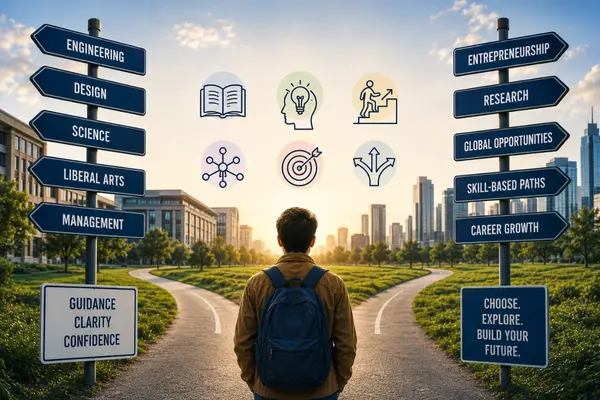
What was once a relatively linear pathway has now become a multi-layered system of choices. Students are expected to navigate this system early, often without a clear framework to interpret what these options mean for their long-term direction.
In emerging student markets such as the Northeast, where access to opportunities is expanding rapidly alongside rising aspirations, this complexity is even more pronounced, making clarity and guidance critical to how students engage with these choices.
The shift, therefore, is not just in what education offers. It is in how it needs to be navigated.
Where the Focus Must Now Strengthen
As the system expands, the ability to make sense of it becomes central.
Students today benefit from:
> Understanding how academic choices connect to career pathways
> Interpreting emerging fields and evolving roles
> Making decisions that remain adaptable over time
This requires more than access to information. Students today are surrounded by data, options, and constant inputs, but the real value lies in their ability to interpret these choices with clarity and insight. Structured, sustained guidance plays a critical role in helping students make meaning of their decisions as they move through different stages of their learning journey.
In many cases, the challenge is not the absence of opportunity. It is the absence of continuity in how these opportunities are understood, evaluated, and acted upon.
How Institutions Are Responding
Institutions have already begun aligning with this shift.
There is visible movement toward:
> Interdisciplinary learning structures
> Integration of skills within academic programs
> Stronger industry engagement
> And more flexible academic pathways
These changes reflect a system that is actively evolving to stay relevant.
As this evolution continues, the role of institutions expands beyond delivering education to enabling students to engage with it meaningfully.
Reframing the Role of Schools and Guidance
In an increasingly layered education landscape, decision-making becomes a critical capability.
Students are not just choosing courses. They are shaping pathways that influence long-term direction.
This makes early exposure, structured guidance, and continuous engagement essential components of the learning process.
When students are supported in understanding their strengths, exploring possibilities, and connecting choices to outcomes, they are better prepared to navigate complexity with clarity and confidence.
Guidance, in this context, becomes a system-level function, one that supports both access and outcomes.
A More Relevant Question for Education
The ongoing “degree vs. employability” debate often simplifies a much larger transformation.
Degrees continue to hold value. What is evolving is how they are positioned within a broader ecosystem of skills, experiences, and long-term career pathways.
As education systems expand and diversify, the focus is gradually shifting toward readiness: how well students are prepared to interpret, reflect, adapt, and move forward within this landscape with clarity and purpose.
This calls for alignment across the system:
> Institutions that are designed for flexibility
> Schools that build decision-making capability
> And students who are supported in engaging with their choices more intentionally
Looking Ahead
Education is becoming more dynamic, more flexible, and more connected to the realities of the world beyond the classroom.
This is a positive and necessary shift.
As this evolution continues, its success will depend not only on what the system offers but also on how effectively students are supported in navigating it.
Because the real question today is not whether education works.
It is how well it prepares students to navigate complexity with clarity, move from information to insight, make decisions with confidence, and build pathways with intent.
In that sense, readiness is no longer an outcome of education. It is its purpose.
(The author is an education and career guidance professional. The views and opinions expressed in this article are solely those of the author)


