



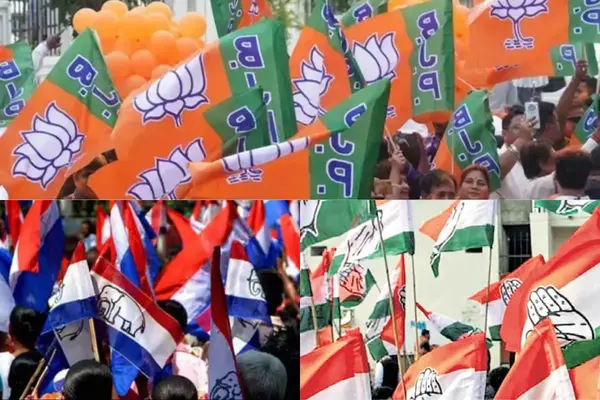
The people of Assam have delivered their verdict with clarity. It is, by any measure, a sweep for the Bharatiya Janata Party (BJP) and its allies, reaffirming their dominance and consolidating their position as the principal political force in the state. Yet, beneath the surface of this emphatic mandate lies a more complex political reality, one that demands reflection not only from the vanquished opposition, but equally from the victors themselves.
ALSO READ: Opinion | Guwahati's Voter Verdict: Resilience Over Rhetoric
It is tempting to interpret this electoral success as an unending ascent. But political history, both in Assam and elsewhere, suggests otherwise. The BJP in Assam appears to have reached a plateau, an apex of organisational strength, electoral dominance, and narrative control. From here, the trajectory is less about rapid expansion and more about sustaining credibility. The arc of political parties is rarely linear; it rises, stabilises, and, if complacency sets in, gradually declines. The real test for the BJP will not be in winning elections, it has mastered that art, but in governing in a manner that justifies the faith reposed in it over the long term.
The transformation of the Asom Gana Parishad (AGP) is emblematic of the shifting political sands. Born out of the Assam Movement with a strong regional identity and ideological clarity, the AGP today appears to have undergone a metamorphosis that distances it from its founding ethos. The party that once stood as a custodian of Assamese aspirations now risks being perceived as an adjunct in a larger political arrangement. For many who recall the fervour and sacrifices of the movement, this shift is not merely political, it is deeply emotional. One wonders how the founding fathers of the party would view its present incarnation.
The position of the Bodo community and other tribal communities of Assam also reflects a pragmatic recalibration. Political loyalty, in many parts of the country, has increasingly aligned itself with the flow of resources and development funds. In this context, the leadership across Bodo and other indigenous tribal groups has chosen to remain aligned with the ruling dispensation at the Centre and the State, less as an ideological endorsement and more as a strategic choice shaped by developmental priorities and political stability. It underscores a broader trend in Indian politics where governance, resource allocation, and institutional access often shape alliances more than doctrinal commitments.
The BJP’s campaign promises were both expansive and specific, more roads, more schools, more medical institutions, more universities, and, significantly, more government jobs and welfare doles. Alongside this developmental agenda was the reiteration of a long-standing political commitment: the identification and expulsion of illegal immigrants, particularly from Bangladesh. These promises resonated with a broad cross-section of voters. Development, identity, and security were woven into a narrative that the electorate found credible enough to endorse.
In contrast, the opposition’s campaign appeared disjointed and ineffective. Allegations of corruption were voiced with intensity, but they failed to strike a chord with the electorate. This raises a critical question: why did these charges not translate into political traction? The answer perhaps lies in the credibility deficit of the accusers themselves. When a party like the Indian National Congress (Congress), burdened by its own history of governance in the state, raises the banner of probity, it faces an uphill task in convincing voters. The message, however valid, is undermined by the messenger.
The road ahead for the opposition is neither easy nor short. It requires a fundamental rethinking of strategy, structure, and leadership. For the Congress, incremental adjustments will not suffice. What is needed is a comprehensive makeover, one that addresses not only organisational weaknesses but also the perception of past omissions and commissions. This involves bringing in new leadership, redefining its ideological positioning in the context of Assam’s unique socio-political landscape, and reconnecting with grassroots realities.
Regional parties, on the other hand, must resist the temptation of premature electoral contests without adequate preparation. Their strength lies in their ability to articulate local aspirations and mobilise communities around shared concerns. To do this effectively, they must invest in building robust organisational structures that can sustain long-term political engagement. More importantly, they must rise above narrow community-based politics and work towards unifying the Assamese people across ethnic, linguistic, and religious divides. The idea of “Axomiya” must be inclusive and forward-looking if it is to serve as a viable political foundation.
Yet, while the spotlight is currently on the opposition’s need for reinvention, the greater responsibility rests with the government that has been elected to power. Electoral victory provides legitimacy, but governance determines legacy. The BJP-led alliance government now faces the task of translating its promises into tangible outcomes.
Infrastructure creation: roads, schools, hospitals, universities is undoubtedly essential. But infrastructure, by itself, does not guarantee development. A school building does not ensure education; a hospital does not ensure healthcare; a road does not ensure economic prosperity. These outcomes depend on the quality of service delivery, the efficiency of administration, and the motivation of the people who operate within these systems.
There is, however, an equally urgent dimension that can no longer be treated as a seasonal or secondary concern, urban management and flood and erosion control. In a rapidly expanding city like Guwahati, unplanned growth, encroachment of wetlands, and inadequate drainage have turned monsoon rains into an annual crisis. Waterlogging is no longer an inconvenience; it is an economic disruptor, a public health hazard, and a daily indignity for citizens. Urban governance must therefore be elevated to the same level of priority as poverty alleviation and employment generation. Planned drainage systems, protection and restoration of natural water bodies, scientific zoning, and accountable municipal management are not luxuries, they are necessities.
Beyond the city, the perennial challenge of floods and riverbank erosion continues to erode not just land, but livelihoods and social stability across Assam. The Brahmaputra River, while central to the state’s identity and ecology, remains a source of recurring devastation. Embankments alone have proved to be an inadequate response. What is required is a comprehensive, long-term strategy that integrates river management, catchment area treatment, afforestation, sediment control, and community-based disaster preparedness. Addressing floods and erosion must be seen not merely as relief work, but as a core development priority, on par with tackling poverty and unemployment.
Containing petty corruption, dismantling drug cartels, and breaking the hold of entrenched syndicates will be another decisive test of governance. These are not abstract challenges; they affect everyday life, whether it is a citizen seeking a basic service, a young person vulnerable to substance abuse, or a small entrepreneur navigating informal networks of control. The credibility of the government will increasingly be judged by its ability to curb these distortions of the system. Strong enforcement is necessary, but equally important is systemic reform, simplifying procedures, reducing discretionary powers, leveraging technology, and ensuring swift and visible accountability.
Equally important is the moral compass that must guide those in power. The BJP has long articulated its commitment to Antyodaya, the principle that governance must reach the last person in the queue. This ideal cannot coexist with a culture of personal enrichment or opportunism. Government functionaries and party karyakartas alike must internalize the discipline of austerity and the ethic of sacrifice. Public life, especially under a banner that invokes service, demands restraint. The temptation to treat electoral victory as an opportunity to “make hay while the sun shines” must be consciously resisted. If Antyodaya is to be more than a slogan, it must reflect in personal conduct, simple living, transparency in action, and a visible commitment to service before self.
This is where the need for moral and ethical leadership becomes paramount. Assam today does not merely require administrators; it requires leaders who can inspire. The challenge is not just to build assets, but to ensure that they are used effectively. Schools must become centres of learning, not just structures with classrooms. Hospitals must provide compassionate and competent care, not merely exist as institutions. Roads must facilitate the movement of goods and people, connecting farmers to markets and opportunities to individuals. Cities must function, rivers must be managed with foresight, and governance must carry a moral purpose.
The limits of coercion in governance are well known. One can mandate attendance, enforce rules, and impose penalties, but these measures can only achieve so much. True transformation comes from within, from a sense of purpose and commitment among those who deliver services and those who receive them. The old adage remains relevant: you can take a horse to water, but you cannot force it to drink. Governance, therefore, must move beyond compulsion to inspiration.
For the BJP, this means identifying and nurturing leaders who command respect not merely through authority, but through integrity and vision. It means fostering a culture within the administration that values performance, accountability, and empathy. It also means engaging with civil society, educators, healthcare professionals, and entrepreneurs to create an ecosystem where development is a shared endeavour.
At the same time, the government must remain mindful of the socio-political sensitivities that define Assam. Issues such as immigration, identity, and cultural preservation require careful handling. While electoral rhetoric may simplify these matters, governance demands nuance and balance. Policies must be guided by constitutional principles, humanitarian considerations, and the long-term interests of the state.
The verdict of the people is both an endorsement and a warning. It endorses the BJP-led alliance’s ability to connect with voters and present a compelling narrative. But it also warns against complacency. Political dominance, if not accompanied by responsive governance, and anchored in ethical restraint can quickly erode.
For the opposition, this is a moment of introspection and renewal. For the ruling party and its allies, it is a moment of responsibility and restraint. Assam stands at a critical juncture, with the potential to harness its resources, talent, and cultural richness for sustained progress.
The path forward will depend not only on policies and programmes, but on the quality of leadership and the collective will of its people. Elections may determine who governs, but it is governance that determines the future.
(The writer is a former member of the Indian Administrative Service and served the Government of Assam in various capacities. All views and opinions expressed in the article are his own)


