


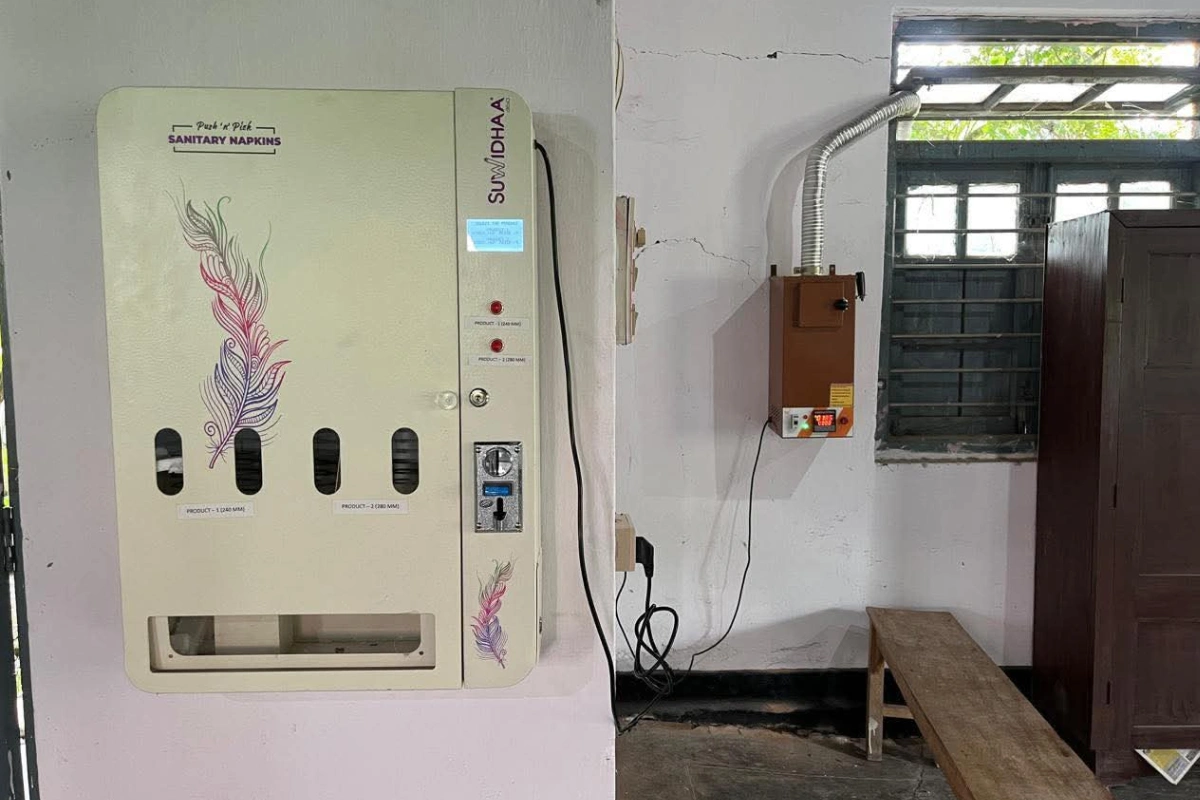
Sanitary napkin vending machines are meant to support students, but across Guwahati colleges many remain absent or non-functional
Periods don't check class schedules, exam timetables, or attendance records before arriving. And when they do show up unexpectedly, students often rely on one thing, a sanitary napkin vending machine.
ALSO READ: Guwahati's Growth Comes at a Cost: The Slow Disappearance of Urban Commons
For many young women, managing menstruation on campus should not be a challenge. A sanitary napkin vending machine, now a common feature in educational institutions, is meant to provide immediate access to menstrual hygiene products during emergencies. However, a ground reality check across several colleges in Guwahati reveals a mixed picture, while some institutions have functional facilities, others are struggling with non-operational machines, leaving students to depend on temporary arrangements or personal preparedness.
The availability of sanitary napkins within educational institutions is more than just a convenience. It is a necessity that directly impacts students' comfort, attendance, and overall well-being. Yet, despite increasing awareness around menstrual hygiene, many colleges continue to face issues related to maintenance and accessibility of these facilities.
At Cotton University, the situation appears relatively positive. The Girls' Common Room Secretary stated that the university currently has two sanitary pad vending machines, both of which are functioning properly.
"Currently we have two pad vending machines and they function properly. Girls can use them whenever necessary," she said.
The availability of working machines ensures that students can access sanitary napkins during emergencies without having to leave the campus or depend on others. However, the situation is not the same across all institutions.
Moving to Gauhati Commerce College, students currently do not have access to a sanitary napkin vending machine. Acknowledging the issue, the college's student union body stated that they have already raised the matter with the authorities.
“We have already brought this issue to the attention of the authorities and urged them to take necessary action for the installation of a sanitary napkin vending machine as soon as possible. As an alternative arrangement, sanitary napkins have been kept in the wardrobe for use by students until the vending machine is installed and becomes operational," the union body said.
While the temporary arrangement may provide some relief, students still lack the convenience and accessibility that a dedicated vending machine offers. The dependence on manual distribution also raises concerns about availability during emergencies.
A similar issue was observed at B. Borooah College, where students reported that the installed vending machine is not functioning. One student highlighted the practical difficulties faced during unexpected situations.
"The machine is not working, and sometimes it becomes very difficult to find a napkin within the institution. Most of us carry sanitary napkins personally, but sometimes we forget, and some students do not buy them regularly. That creates the main problem," she said.
Her statement reflects a reality that many female students experience. While carrying sanitary products has become a common practice, emergencies are unpredictable. A functional vending machine serves as a crucial backup, especially during long academic hours.
Responding to the issue, the Girls' Common Room Secretary of the college said that the matter has already been communicated to the concerned authorities.
"Yes, I have already informed the concerned authority. The issue will be resolved during the summer break," she said.
Students, however, continue to wait for a permanent solution.
The situation is particularly concerning given that Handique Girls' College is an all-women's institution, where menstrual hygiene facilities should be among the most essential services available on campus. Despite catering exclusively to female students, the college continues to face issues with a non-functional sanitary napkin vending machine, raising questions about the maintenance and prioritisation of such basic facilities.
A representative from the student body stated that complaints have been made repeatedly to the concerned authorities regarding the malfunctioning machine.
"I have complained many times to the concerned authorities, and they have promised to repair it soon," she said.
The recurring issue across institutions highlights a larger concern, not just the installation of sanitary napkin vending machines, but their regular maintenance and functionality. In many cases, machines are installed but later become non-functional due to a lack of monitoring, repairs, or replenishment.
Commenting on the situation, social worker Anindita Bhuyan, who is associated with an NGO in Guwahati, emphasised the broader implications of inadequate menstrual hygiene facilities in educational institutions.
"As per reports, every month one in four girls in India misses school because of their period. Nearly 23 million girls drop out of school each year after reaching puberty," she said.
According to Bhuyan, the issue goes beyond simply placing a vending machine on campus. It concerns sustained access to menstrual hygiene products and the willingness of institutions to address the needs of female students.
Drawing from her own experiences as a student in some of Guwahati's reputed educational institutions, she pointed out that many facilities are introduced with good intentions but are often neglected later.
"As a graduate of some of Guwahati's most prestigious educational institutions, I have encountered the issue of menstrual hygiene and the availability of napkins. Most of the time, during college or university elections, educational institutions install one sanitary napkin vending machine solely to garner votes and support from female students. Later, these machines stop working and there are no sanitary pads available. As a result, we suffer the most," she said.
She further highlighted another often-overlooked issue, the absence of proper disposal facilities.
"Even the authorities did not provide a separate dustbin in the female toilet. As a result, many female students, including me, leave college or university early during their periods due to a lack of access to change napkins," she added.
Bhuyan believes that despite growing discussions around menstrual health, long-term and sustainable solutions remain absent.
"Many students continue to suffer from these problems, but no permanent solution has been designed or seriously considered by government bodies or educational institutions," she said.
The findings from various colleges in Guwahati present a contrasting picture. While institutions like Cotton University have functional facilities, several others continue to struggle with either the absence of vending machines or machines that remain non-operational. Students are often forced to rely on temporary arrangements, personal preparedness, or simply leave campus when adequate facilities are unavailable.
As conversations around menstrual health and hygiene become increasingly mainstream, the focus must shift from merely installing sanitary napkin vending machines to ensuring that they remain functional, accessible, and properly maintained. For thousands of female students, a working vending machine is not just a facility, it is a necessity that supports dignity, health, and uninterrupted education. The challenge now lies in turning promises into lasting solutions.


