


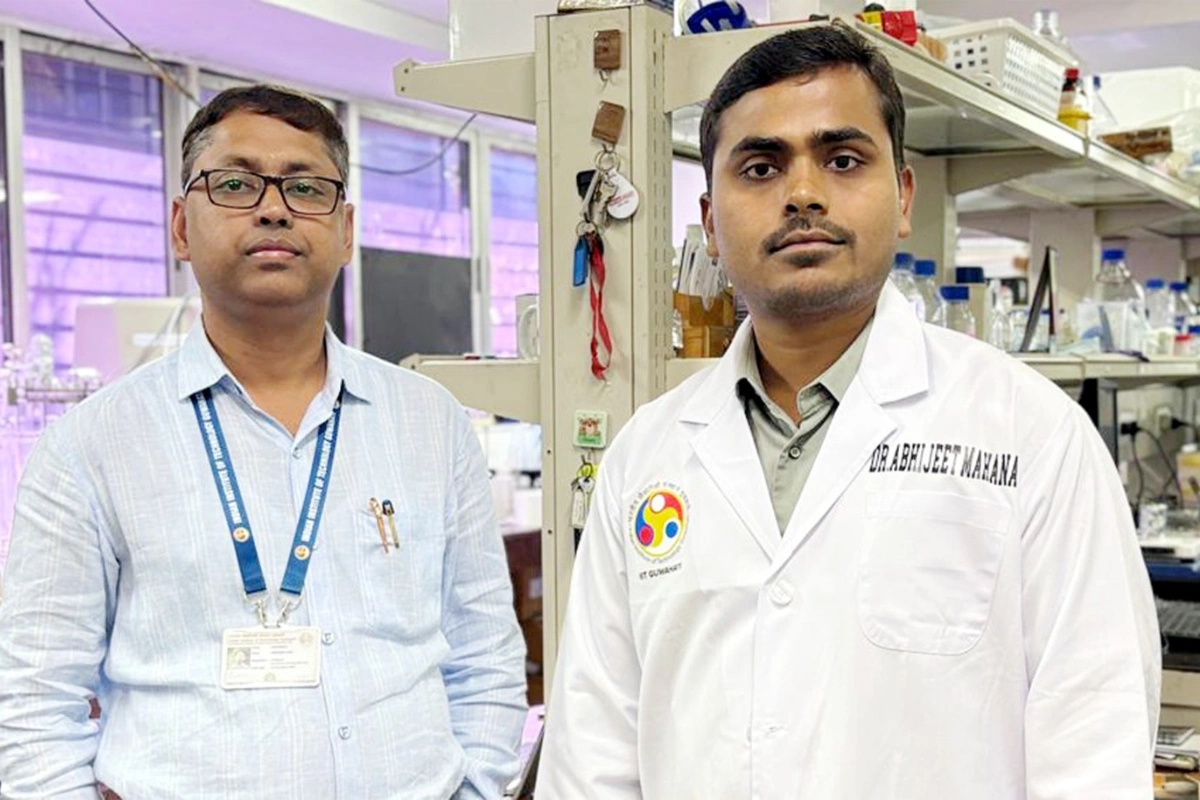
GUWAHATI: Researchers at the Indian Institute of Technology (IIT) Guwahati have developed a biological material derived from blue-green algae that can remove toxic lead from contaminated water, offering a sustainable and environmentally friendly alternative to conventional water treatment methods.
ALSO READ: Assam Eyes ₹500 Crore Investment to Develop Luxury River Cruise Tourism on Brahmaputra
The study, led by Prof. Debasish Das from the Department of Biosciences and Bioengineering, found that exopolysaccharides (EPS), a sticky, sugar-rich substance produced by cyanobacteria, can remove up to 66.2% of lead from contaminated water under controlled laboratory conditions.
The research addresses a growing public health concern in India. According to a 2020 report by UNICEF and Pure Earth, more than 275 million children in the country had blood lead levels at or above hazardous limits. In addition, data from the Central Ground Water Board (CGWB) indicates that 20–30% of groundwater samples tested across major Indian cities exceeded the World Health Organization's recommended safety limits for lead.
Unlike conventional water treatment methods such as chemical precipitation, membrane filtration and ion exchange, which are often expensive, energy-intensive and capable of generating secondary pollutants, the IIT Guwahati team's approach relies on naturally occurring cyanobacteria, commonly found in ponds, lakes, reservoirs, paddy fields and other freshwater bodies.
The researchers discovered that the EPS produced by these algae has a strong ability to bind with lead particles through naturally occurring chemical groups, enabling efficient removal of the heavy metal from water. They also observed that the algae can naturally alter its chemical composition in response to lead contamination, further enhancing its lead-capturing ability.
As part of the next phase of the research, the team plans to test the EPS on real industrial wastewater containing multiple toxic metals, study the recyclability of the biosorbent, and develop a scalable system for continuous water treatment.
The researchers noted that the study is currently at the laboratory stage, and the findings require further validation before they can be considered for commercial or large-scale applications.


