


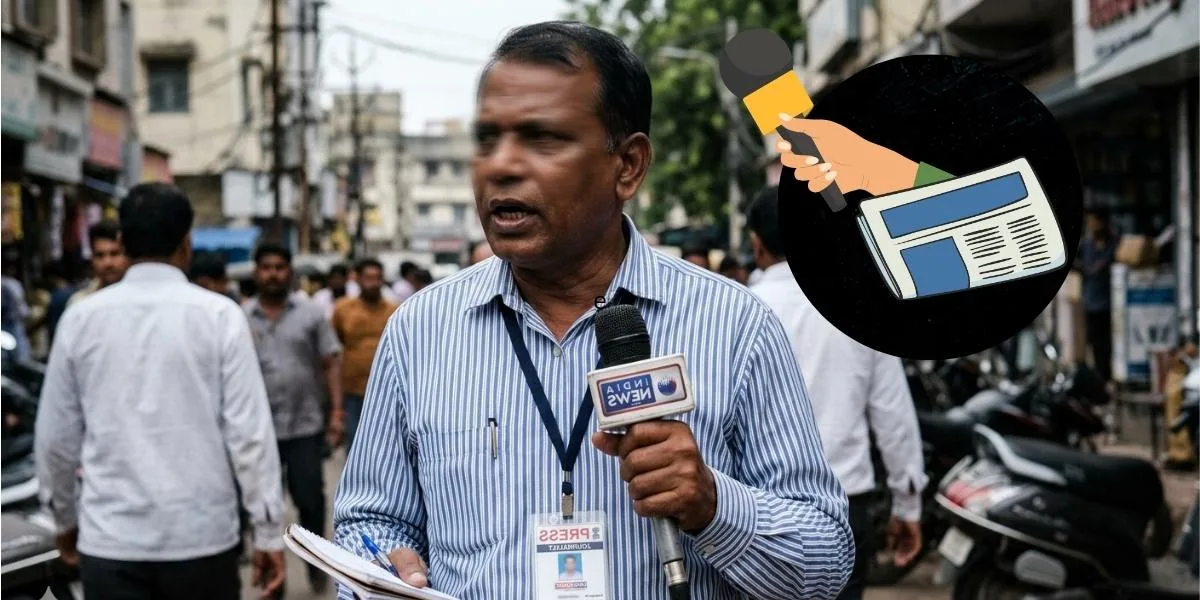
Known as the fourth pillar of democracy, media freedom and impartiality largely depend on the overall safety and financial independence of journalists. Journalists are often fascinated by the social and intellectual status of ‘journalists’ and forget that they too are workers. They forget that they are deprived of their salary, leave, future funding, job security and other benefits. Journalists have lost their labor status and rights despite enjoying their intellectual and social status. Not only in Assam, many journalists are working in regional media across the country. Not only financial conditions, lack of adequate leave and insecurity of livelihood also make life miserable for journalists. Barring a handful of news outlets, the salaries paid to journalists (except those at the editorial level) by the authorities of most news outlets are below the minimum wage.. There is no guarantee when a journalist will lose their job. When journalists working in the field are killed on the job, Most news outlets do not have liability and compensation for injuries or accidents. Many news outlets do not have facilities like provident fund or health insurance. The situation for journalists is even worse, especially at some of the digital news outlets that have proliferated in recent years.
Recently the central government introduced new labor codeHe has put journalists in more trouble. According to the government, new reforms have been introduced in this labor law. However, on closer inspection, there is only one objective behind the labor law reforms – to facilitate foreign investment and capitalists. Indeed, the reforms are on the verge of destroying the labor rights and legal status that Indian journalists, along with workers in other sectors, have struggled for over the past seven decades.
When India became independentThat is, journalists were not given the status of workers in the Industrial Disputes Act of 1947. As a result, journalists were deprived of the legal protections enjoyed by other employees of news organizations. They had no guarantee of salary or employment and depended entirely on newspaper sales.
The Central Government later set up the Press Commission under pressure. Parliament on the recommendation of the Press Commission The Working Journalists and Other Newspaper Employees (Conditions of Service) and Miscellaneous Provisions Act, 1955. They were formulated. This Act provides a safeguard for journalists. by law A general journalist required three months’ notice for dismissal and an editor six months’ notice. minimum wageFixed working hours, holidays with pay, provident fund and high rate of gratuity were provided. According to 5(2) of this Act, if an editor resigns for reasons of principle or ideology, he can defend himself in court. It was a very powerful weapon in protecting the intellectual and professional freedom of journalists.
Wages constituted for determining and regularly revising the salaries of journalists b‘RDS was one of the most significant aspects of this Act. A wage bench headed by Justice GR Majithia‘rd offers some advice on this. These recommendations were accepted by the central government in 2011 and the Supreme Court ordered their implementation in 2014.. 2015 Chanat this b‘Expeditious implementation of Board recommendations The Government of Assam has reconstituted a tripartite committee chaired by the Minister of Labor and Welfare. But the recommendations boomeranged as the committee took no action“And till date, most of the news organizations in Assam have not implemented these recommendations. As far as we know, Assam Tribune Group was the only news organization in Assam that implemented the recommendations of the Majithia Board. wages, regular wages growth, House rent allowance, Conveyance and Medical Allowance, News organizations pay for overtime work.
The current government has consolidated the old 29 labor laws into four statutes or codes. In this Dr ‘Occupational Safety, Health and Working Environment Code,The Journalists Act of 1955 and 1958 have been consolidated. 143 of the ActThe former law was completely repealed. Although it looked like a simple administrative merger, in reality it rendered the 70-year struggle of journalists meaningless.. The special notice period of 3-6 months in the earlier Act is now proposed to be reduced to 1 month in the same manner for general workers. Wage revision and specific provisions for wages bLegal system like ‘RD’ has been done away with completely. Important clauses like conscientious objection have been completely ignored in the new labor law.
Amidst this crisis, the media world is undergoing massive changes— The all-encompassing rise of digital media. Ironically, the biggest limitation of the 1955 Act was that it only applied to print or print media journalists. Journalists of television, radio and digital news portals are excluded from the purview of this Act. Recently, organizations like Scroll.in and Tiranga TV have laid off journalists. These digital journalists are losing their jobs instantly without any payment or advance notice. The need of the hour was to modernize the old law and bring journalists of digital and electronic media under its purview. But instead, the government has repealed the old laws in the name of consolidating all the laws and pushed the journalists of all the media into an insecure situation.
Journalists are not just ordinary employees of a business; They are the conscience and protector of the society. It is essential for a journalist to have job security and legal protection to fearlessly uncover the truth, speak out against corruption and question those in power.
Labor reforms and Violating the legal rights of journalists in the name of ease of doing business will not only harm the working class, but also undermine the foundations of democracy. Collective legal protections, rather than individual contracts, are the true safeguards of press freedom. In the current scenario, it is necessary for journalists’ associations, news agency owners, intellectuals and the government to come together to reconsider the shortcomings of the new labor law. If not, journalists living in constant insecurity will never be able to provide impartial and objective news to the society.
post Journalist! A hapless worker behind intellectual status appeared first Northeast Now (Assamese).