



Resolving Guwahati’s urban floods requires political will, something that has been in short supply. The city’s flooding problem is not new, not unknown, and not unsolvable. What is missing is the urgency to act decisively.
ALSO READ: Poultry Transport in Assam Raises Questions Over Animal Welfare
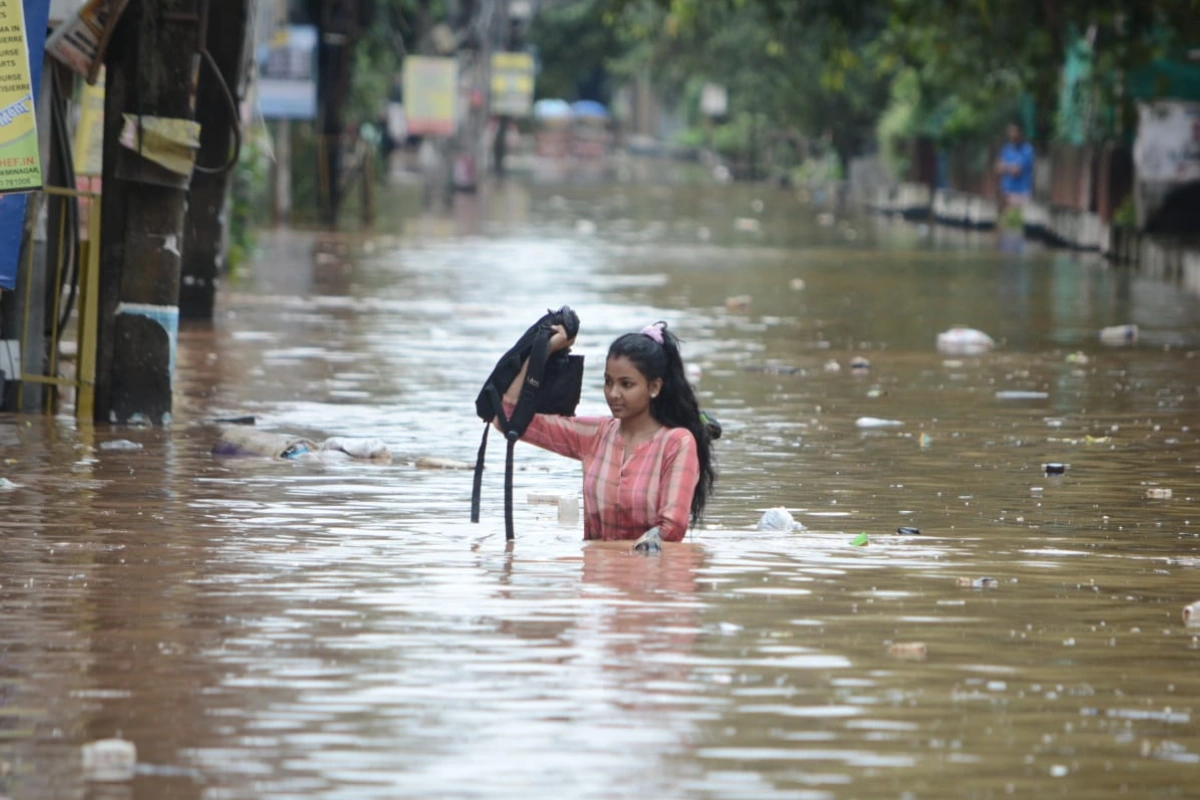
A few minutes of hail and intense rainfall, nothing extraordinary for a city accustomed to the monsoon, was enough to bring large parts of Guwahati to a standstill once again. Streets turned into streams, vehicles stalled mid-road, and residents waded through knee-deep water in localities such as Anil Nagar, Nabin Nagar, Rukminigaon and stretches along NH-27. The scenes were painfully familiar. For a city that calls itself the gateway to the Northeast, Guwahati continues to be held hostage by a crisis that is no longer purely natural—it is the result of decades of neglect, indecision and fragmented urban planning.
Each time the city floods, a familiar blame game unfolds. Citizens accuse the government of incompetence. The government, in turn, points fingers elsewhere, sometimes even beyond state borders. But amid this noisy exchange, the most important question is often ignored: what is the actual solution? Why, despite experiencing repeated floods for more than two decades, has Guwahati failed to build a system capable of coping with even moderate rainfall?
The answer lies in the absence of a functional, city-wide drainage strategy.
Padma Shri awardee, social activist and former legislator Ajoy Kumar Dutta does not mince words. "Crores of rupees have been spent in the name of the Smart City project in Guwahati. Without a stormwater drainage system and an underground sewerage network, a city cannot become smart," he told G Plus. His observation cuts to the heart of Guwahati's problem, development without the necessary foundations.
Dutta points out that the need for a comprehensive drainage network was recognised not yesterday, but nearly half a century ago. According to him, discussions on a proper stormwater drainage system and underground sewerage network date back to 1974, when the Guwahati Municipal Corporation (GMC) was first constituted. The GMC council, led by Mayor Radha Gobinda Baruah, had already pushed for a comprehensive drainage plan and initiated discussions with international funding agencies.
According to Dutta, the World Bank had agreed to fund the project, committing Rs 78 crore in two phases and offering an additional Rs 6 crore for preliminary surveys. "Out of turn, the President requested World Bank for funding and a meeting was held in Delhi," he recalled, describing what could have been a defining moment in Guwahati's urban history.
But that opportunity never translated into action. Political differences between the then state government and the non-Congress-led GMC allegedly stalled the initiative. "There was a hindrance from the government for the project to be implemented in Guwahati," Dutta alleged. Eventually, the project was shifted to Hyderabad.
The consequences of that missed opportunity are visible every monsoon.
"Whatever work is ongoing now is just wastage of money as, without proper planning, construction of drainage systems is of no use," Dutta said. His criticism extends beyond past failures to the present approach, where piecemeal construction continues to take precedence over a comprehensive and integrated drainage strategy.
Experts argue that Guwahati's flooding crisis is not merely the result of clogged drains. It reflects a much deeper breakdown of the city's natural hydrology. Rivers such as the Bharalu and Bahini have been reduced to narrow, polluted channels incapable of carrying heavy stormwater flows. Wetlands that once absorbed excess rainwater have steadily disappeared under encroachments, while extensive hill-cutting has accelerated surface runoff during heavy showers.
"Urban flooding in Guwahati is man-made. When you choke wetlands and cut hills, water has nowhere to go," said an urban planner associated with previous drainage studies. "You cannot solve this by just building drains. You need to restore the ecosystem."
Multiple studies over the years, from international agencies to the Tahal Group's report in 2008, have already identified the city's problems and recommended practical solutions. Yet, as Dutta observed, "None of the suggestions are implemented by the authorities till now."
The government, however, maintains that progress is being made. Recently, the Housing and Urban Affairs Department directed consultants to revise the Comprehensive Drainage Master Plan and the Detailed Project Report for the Bahini-Bharalu basin. While reviewing the proposals at Janata Bhawan, Housing and Urban Affairs Minister Kaushik Rai emphasised the need for "practical and sustainable solutions" and instructed officials to address the existing gaps in the plan.
On paper, it is progress. On the ground, it is yet another delay.
The Guwahati Metropolitan Development Authority (GMDA) has been working on this master plan for more than two years, yet it remains unapproved. In a city that witnesses flooding multiple times every monsoon, such delays are not merely bureaucratic, they have real consequences for thousands of residents.
"Every year we hear about plans, DPRs and revisions. But on the ground, nothing changes," said a resident of Rajgarh, one of the city's worst-affected localities. "Water enters our homes within minutes of rain. How long are we supposed to wait?"
That frustration is shared across Guwahati. For many residents, the problem is no longer a lack of ideas but a persistent failure to implement them.
Meanwhile, infrastructure projects continue to move ahead, often without fully addressing flood risks. The proposed flyover at Jorabat, part of the ambitious Rs 6,100 crore ring road project, has already raised concerns among locals. The junction is notorious for waterlogging, with recent rainfall leaving commuters stranded for nearly nine hours.
A source in the National Highways Authority of India (NHAI) said the project would incorporate drainage improvements. "The development of this stretch will also improve the drainage system to address the waterlogging issue," the source said.
Residents, however, remain sceptical.
"If the existing flyover area already floods, building another one without fixing the drainage will only make things worse," said a local shopkeeper. "We need solutions, not bigger structures."
This disconnect between infrastructure expansion and environmental realities lies at the heart of Guwahati's flooding crisis. Flyovers, wider roads and Smart City projects cannot compensate for the absence of a comprehensive drainage network.
Urban planners argue that any meaningful solution must begin with a legally enforceable drainage master plan, one that integrates land use, water flow and ecological preservation. "A drainage plan is not just an engineering document; it is a governance tool," said a senior engineer familiar with urban flood management. "It must dictate where construction can happen and where it cannot."
Equally critical is the protection and restoration of wetlands. Natural wetlands, including Deepor Beel, once acted as buffers by absorbing excess rainwater and reducing flood intensity. Today, many have been encroached upon, degraded or disconnected from the city's natural drainage system.
"Eviction of encroached wetlands is non-negotiable," said an environmental activist. "If you don't restore these natural buffers, no amount of drainage infrastructure will work."
Experts also emphasise the urgent need to desilt existing drains and rivers. Years of accumulated silt, unchecked dumping of waste and poor maintenance have significantly reduced the carrying capacity of Guwahati's drainage channels. Despite periodic desiltation drives, the problem persists because the effort remains reactive rather than sustained.
"People must also take responsibility," a municipal official said. "Throwing garbage into drains is one of the major reasons for clogging. Strict enforcement is necessary."
Yet enforcement alone cannot repair a structurally broken system. What Guwahati needs is a coordinated, multi-agency approach in which the GMC, GMDA, Water Resources Department and other stakeholders work under a unified command rather than in isolation.
"Right now, too many agencies are working in silos," said an urban governance expert. "Flood management requires integration. Otherwise, one department's work will simply undo another's."
Technology, too, has a role to play. Real-time flood monitoring systems, GIS-based mapping and predictive modelling can help authorities respond more effectively. But technology cannot become a substitute for physical infrastructure or ecological restoration. At best, it is an enabler, not the solution.
Funding, often cited as a constraint, is not the primary challenge. As Dutta's account of the 1974 World Bank proposal illustrates, resources were available even then. Today, governments continue to invest thousands of crores in urban infrastructure. The real issue is not the availability of money, but how priorities are set.
"You cannot spend on beautification while ignoring drainage," Dutta said. "First fix the basics, then think of making the city attractive."
That observation captures the dilemma facing Guwahati today. Over the years, the city has added flyovers, widened roads and pursued Smart City projects. Yet every monsoon, a few hours of heavy rain are enough to bring daily life to a halt. Development cannot be measured only by what rises above the ground; it must also be judged by the systems that function beneath it.
Ultimately, resolving Guwahati's urban flooding requires political will, something that has been in short supply. The city's flooding crisis is not new, not unknown and certainly not unsolvable. What has been missing is the determination to move beyond studies, reports and announcements and translate decades of recommendations into action.
Another monsoon has arrived, and with it the familiar images of submerged roads, stranded commuters and neighbourhoods cut off by floodwaters. These scenes dominate headlines every year, only to fade from public attention once the rains subside. Until the focus shifts from temporary relief to long-term planning, Guwahati will continue to relive the same crisis every monsoon.
The choice before policymakers is straightforward: continue relying on fragmented, reactive measures or commit to a comprehensive strategy rooted in scientific planning, institutional accountability and respect for the city's natural drainage network. Piecemeal interventions may offer temporary relief, but they will never solve a problem that has been decades in the making.
For more than 50 years, Guwahati has known what needs to be done. It has commissioned studies, prepared plans and debated solutions. What it has consistently failed to do is implement them.
The city does not need another committee, another revised DPR or another monsoon review meeting. It needs the political courage to execute what has long been understood.
For a city that has waited half a century for a comprehensive drainage system, the time for excuses has long passed.


