


Guwahati’s Nehru Stadium enters a new era as redevelopment work begins to transform the ageing venue into a modern football-specific arena aimed at boosting Assam’s sporting infrastructure
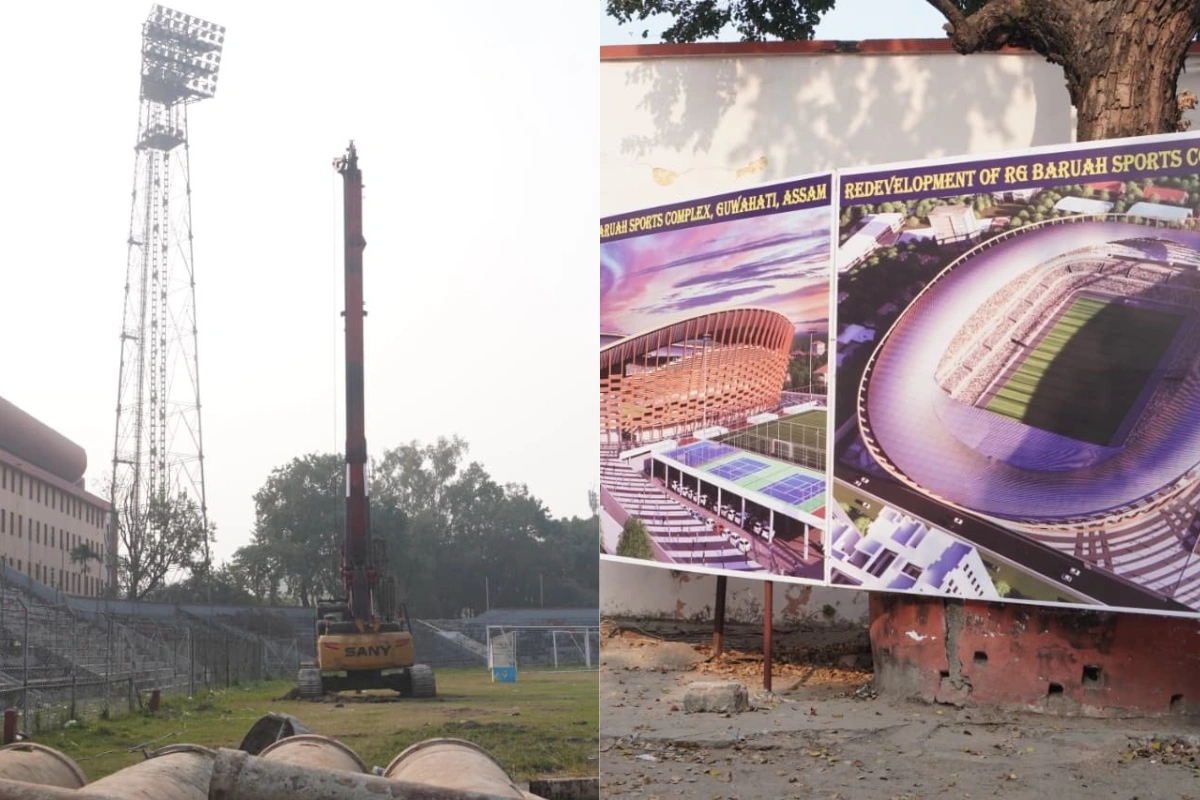
Guwahati’s Nehru Stadium is undergoing a massive transformation, with the Assam government moving ahead with a ₹765 crore redevelopment project aimed at converting the aging multi-purpose venue into a FIFA-standard football stadium.
ALSO READ: Roads Without Space: Illegal Parking Turns Guwahati’s Streets Into Daily Bottlenecks
Officially known as the Radha Govinda Baruah (RG Baruah) Sports Complex, the stadium is being redeveloped as a dedicated football arena, marking one of the biggest sports infrastructure projects undertaken in Assam in recent years.
For decades, Northeast India has remained one of the country’s strongest football belts, consistently producing talented footballers who have represented India at various levels and featured prominently in domestic competitions, including the Indian Super League (ISL). Despite the region’s rich footballing tradition and continuous contribution of players to the national circuit, the absence of world-class sporting infrastructure has remained a longstanding challenge.
The redevelopment of Guwahati’s Nehru Stadium is now being viewed as a major step towards addressing that infrastructure gap and strengthening Assam’s position on India’s football map. The project is expected to transform the aging venue into a modern football-specific stadium capable of hosting national and international matches while also providing improved facilities for athletes and spectators.
Established in 1962 under the supervision of Radha Govinda Baruah, the stadium was named after India’s first Prime Minister Jawaharlal Nehru. Over the past sixty years, the venue evolved into one of Guwahati’s most prominent sporting landmarks and played host to several major football and cricket events, including domestic tournaments and important sporting fixtures involving teams from across the country.
In its earlier form, Nehru Stadium functioned as a multi-purpose venue with an estimated seating capacity ranging between 15,000 and 25,000 spectators. Although the infrastructure lacked many modern amenities seen in newer stadiums across India, the ground continued to remain one of Assam’s most recognised and historically significant sports venues, closely associated with the state’s football culture and sporting legacy.
The stadium hosted 13 Men’s One Day International cricket matches between 1983 and 2010. Several prominent cricketers, including Sachin Tendulkar, Sunil Gavaskar, Kapil Dev, Vivian Richards and Brian Lara, have reportedly graced its grounds during different international fixtures. It also hosted domestic tournaments such as the Ranji Trophy, Duleep Trophy and Deodhar Trophy.
For football lovers, the stadium became closely associated with the Bordoloi Trophy, one of the region’s most prominent football tournaments. Clubs from Bangladesh, Thailand, Iran, Uzbekistan and the former Soviet Union participated in different editions of the tournament over the years. The venue also hosted football competitions such as the Santosh Trophy and the Federation Cup.
As the years progressed, the old structure increasingly struggled to match modern sporting requirements. The rise of specialised venues, including the Assam Cricket Association Stadium at Barsapara, gradually shifted major cricket activities away from the old multi-purpose ground.
As the years progressed, the old structure of Nehru Stadium increasingly struggled to keep pace with the changing demands of modern sports infrastructure. The emergence of specialised venues, particularly the Assam Cricket Association Stadium at Barsapara, gradually shifted major cricket fixtures away from the aging multi-purpose ground. As sporting demands evolved, the need for a modern and dedicated football facility became more prominent.
Against this backdrop, the Assam government initiated plans to redevelop the venue into a football-specific stadium. The new blueprint represents a major departure from the stadium’s earlier multi-sport identity, with the focus now entirely on football infrastructure. Authorities aim to transform the venue into a modern arena equipped to host national and international football matches while meeting FIFA standards.
The demolition of the original 1962 structure began in late 2025 after receiving formal clearance from the Assam Cabinet. Engineering and infrastructure company Larsen & Toubro (L&T) was later awarded the contract for the redevelopment work.
One of the biggest changes in the redesigned stadium is the removal of the athletics track. Unlike the Arjun Bhogeswar Baruah Sports Complex (also known as the Indira Gandhi Athletic Stadium or the Sarusajai Sports Complex), where the running track creates distance between spectators and the field, the new Nehru Stadium layout places the stands closer to the football pitch.
Officials associated with the project state that this design is intended to create a more football-centric atmosphere and improve the viewing experience for spectators.
The upcoming stadium will feature an all-seater configuration with a planned capacity of 25,000 spectators. Authorities state that the seating arrangement is being designed to ensure clear sightlines from all sections of the stadium.
Apart from the main stadium, the broader Radha Govinda Baruah Sports Complex will include additional sports infrastructure. According to the project plan, the campus will feature an Olympic-sized swimming pool along with dedicated indoor facilities for badminton, squash, table tennis and martial arts.
A sports hostel capable of accommodating nearly 180 athletes and officials is also planned within the complex. The integrated accommodation facility is expected to support athletes participating in training camps and tournaments.
The redevelopment project additionally includes modern broadcasting infrastructure, including press boxes, interview areas and technical spaces designed for live sports coverage.
Authorities have also planned an integrated parking facility with space for nearly 1,500 vehicles.
Until now, the Arjun Bhogeswar Baruah Sports Complex in Sarusajai remained Guwahati’s primary football venue and the home ground of NorthEast United FC. The stadium hosted matches during the 2017 FIFA U-17 World Cup and continues to host football fixtures. However, it remains a multi-purpose stadium equipped with an athletics track.
The redevelopment of Nehru Stadium into a dedicated football venue is expected to significantly change the sports infrastructure landscape of Guwahati.
Construction work at the site is currently underway. While Public Works Department officials have stated that the exact completion and turnaround time remains fluid as construction has only recently begun, the redevelopment project continues to move forward.
The old structure that stood at the centre of Guwahati’s sporting culture for more than sixty years may now be disappearing from the city’s skyline, but authorities believe the redeveloped stadium will play a major role in shaping the future of football in Assam and the wider Northeast region.


