



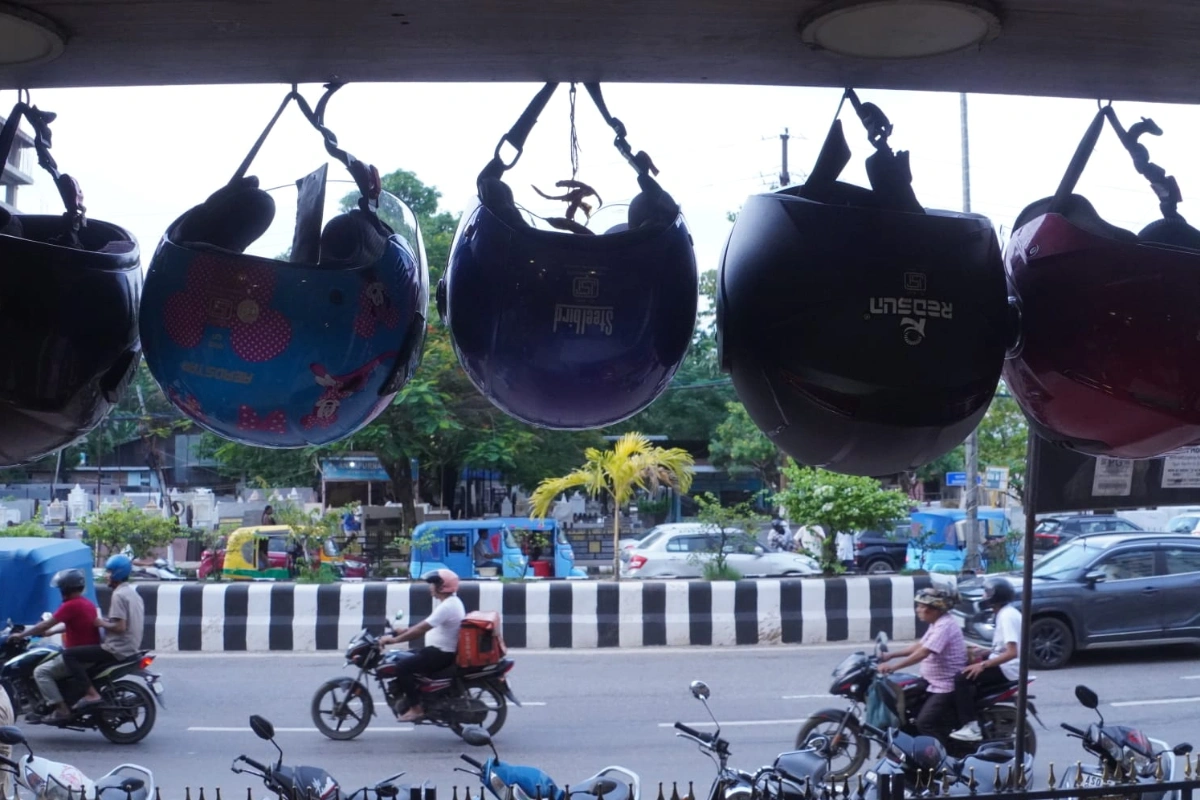
Helmet choices in Guwahati reflect the growing gap between affordability, safety and legal compliance
Every day, thousands of two-wheelers navigate Guwahati's crowded roads. While helmets have become a common sight, so have riders riding without them. As traffic violations continue to rise, one question stands out: are people wearing helmets because they genuinely value their safety, or simply because they fear a traffic fine?
ALSO READ: Guwahati: ₹213-Crore Kamakhya Ropeway Project Still Awaiting Construction
Despite strict traffic laws and regular awareness campaigns, traffic violations continue to rise across the city. In June, the Guwahati Traffic Police expressed concern over a sharp increase in traffic offences, revealing that drink-and-drive cases in May had risen nearly tenfold compared to April. Other violations, including wrong-way driving, speeding, triple riding and riding without protective gear, also witnessed a significant spike.
According to official data, drink-and-drive cases increased from just 41 in April to 396 in May. Meanwhile, the Integrated Traffic Management System (ITMS) detected nearly 12,000 cases of two-wheeler riders travelling without helmets, while traffic personnel manually booked around 700 more during enforcement drives.
The figures suggest that despite surveillance cameras, stricter enforcement and monetary penalties, many riders continue to ignore one of the most basic road safety measures.
For a two-wheeler rider, a helmet is often the only protection against a severe head injury. Yet for many commuters, it appears to be more of a legal requirement than life-saving equipment.
A visit to several helmet stores across Guwahati reveals that affordability plays a major role in purchasing decisions. While premium helmets are widely available, most customers continue to opt for models that fit their budget.
Retailers broadly classify helmets into three categories based on price and features.
The largest share of the market falls in the ₹600 to ₹3,000 range, making it the preferred choice for most riders.
According to one helmet store owner, nearly four to five brands fall into this category, making it the best-selling segment.
"Most of the customers in Guwahati fall under this category. It includes students, working professionals and most women riders. These helmets offer an affordable option for daily commuting," he said.
For many buyers, spending beyond this range is difficult as they already have to manage fuel expenses, vehicle maintenance and other daily costs.
The next category, priced between ₹4,000 and ₹8,000, is often considered the best value for riders looking for better quality and additional safety features. However, according to another helmet retailer, this segment attracts a much smaller group of customers.
"There are people who buy these helmets, but they are generally enthusiasts or those who ride long distances. These helmets are expensive for students and regular commuters," he said.
Beyond this lies the premium segment, where helmets range from ₹8,000 to ₹20,000. These models are lighter, offer better ventilation and often include advanced features such as Bluetooth connectivity. While these helmets promise greater comfort and protection, they remain beyond the reach of many everyday riders.
Yet not every rider is willing, or able, to spend even on the budget category. For many, the cheapest available helmet is enough, as long as it helps avoid a traffic challan.
Roadside vendors continue to attract customers looking for low-cost helmets.
One roadside helmet seller said people from different age groups purchase helmets from him every day.
"The helmets start from around ₹200 to ₹300," he said.
When asked whether these helmets provide sufficient protection, his response was straightforward.
"The price is equal to the safety. The cheaper the helmet, the lower the protection."
The popularity of such helmets highlights another reality of the market. While many resemble standard protective gear, some lack proper certification and are often purchased simply to comply with traffic checks rather than to provide meaningful protection during an accident.
The consequences of choosing cheaper helmets are often felt most by passengers, particularly those who rely on app-based bike taxi services. While riders are expected to carry a helmet for themselves as well as one for their passenger, the condition of these helmets often raises concerns.
A woman who frequently uses online bike taxi services said the helmets provided to passengers are usually in poor condition.
"I always get helmets that are in the worst condition. The sponge inside is damaged, and it feels like if I meet with an accident, the helmet won't protect me properly," she said.
However, bike taxi riders say maintaining high-quality helmets for passengers is easier said than done.
One bike service rider explained that purchasing premium helmets for both the rider and the passengers is financially challenging.
"Helmets are expensive. We also have to provide one for passengers, and because we travel throughout the day, they get damaged quickly. Buying the best helmets every time is simply not possible," he said.
He added that passengers often complain about the condition of the helmets, but replacing them frequently significantly increases operating costs.
The differing perspectives highlight a challenge faced by both commuters and service providers. While passengers expect helmets that are safe, clean, and well-maintained, many riders struggle to replace worn-out helmets regularly because of the cost.
Yet, regardless of whether a helmet costs ₹300 or ₹20,000, one factor matters more than its price, its safety certification.
The most common certifications found on motorcycle helmets are ISI, DOT and ECE.
The ISI (Indian Standards Institute) certification, now regulated by the Bureau of Indian Standards (BIS), is mandatory for all helmets legally sold and used in India.
The DOT (Department of Transportation) certification is the official helmet safety standard followed in the United States, while the ECE (Economic Commission for Europe) certification is recognised across more than 50 countries and is regarded as one of the most widely accepted international safety standards.
Safety experts recommend that riders purchase helmets carrying at least the mandatory ISI certification. Helmets with DOT or ECE certification undergo additional international safety testing.
Despite the availability of certified helmets across different price ranges, traffic data suggests that many riders still do not see helmets as essential safety equipment.
Nearly 12,000 helmet violations were detected through Guwahati's Integrated Traffic Management System in a single month, while another 700 riders were booked by traffic personnel during manual enforcement. The figures raise an important question: if people feared road accidents more than traffic fines, would so many still choose to ride without a helmet?
Traffic police have strengthened enforcement through AI-enabled surveillance, regular checking drives and stricter penalties. Yet the continued rise in violations suggests that enforcement alone may not be enough to change rider behaviour.
Road safety experts have long argued that compliance driven solely by the fear of fines rarely develops into a lasting habit. Real change, they say, comes only when people recognise that helmets are meant to protect their lives, not merely to avoid a challan.
The debate surrounding helmets goes beyond price. While a quality helmet may seem expensive, the financial and emotional cost of a serious head injury can be far greater. Medical treatment, rehabilitation, loss of income and lifelong disabilities often place an enormous burden on victims and their families.
At the same time, affordability remains a genuine concern. Students, gig workers, delivery executives and daily commuters may not always be able to invest in premium safety gear, leading many to settle for cheaper alternatives.
But this brings the conversation back to a larger question: are riders choosing low-cost helmets because that is all they can afford, or because any helmet is enough to avoid a traffic challan? And if a helmet is purchased solely to comply with the law, does it still serve its true purpose?
As Guwahati's roads become busier and traffic violations continue to rise, the discussion is no longer just about wearing a helmet; it is about the kind of protection riders are actually choosing. Is a helmet seen as essential safety equipment, or merely as another document to avoid a fine during a traffic check?
Perhaps the real question is not how much a helmet costs, but how much value people place on their own safety. Until that mindset changes, the debate over helmets in Guwahati is likely to remain caught between two ideas: protection from an accident, or protection from a penalty.


