


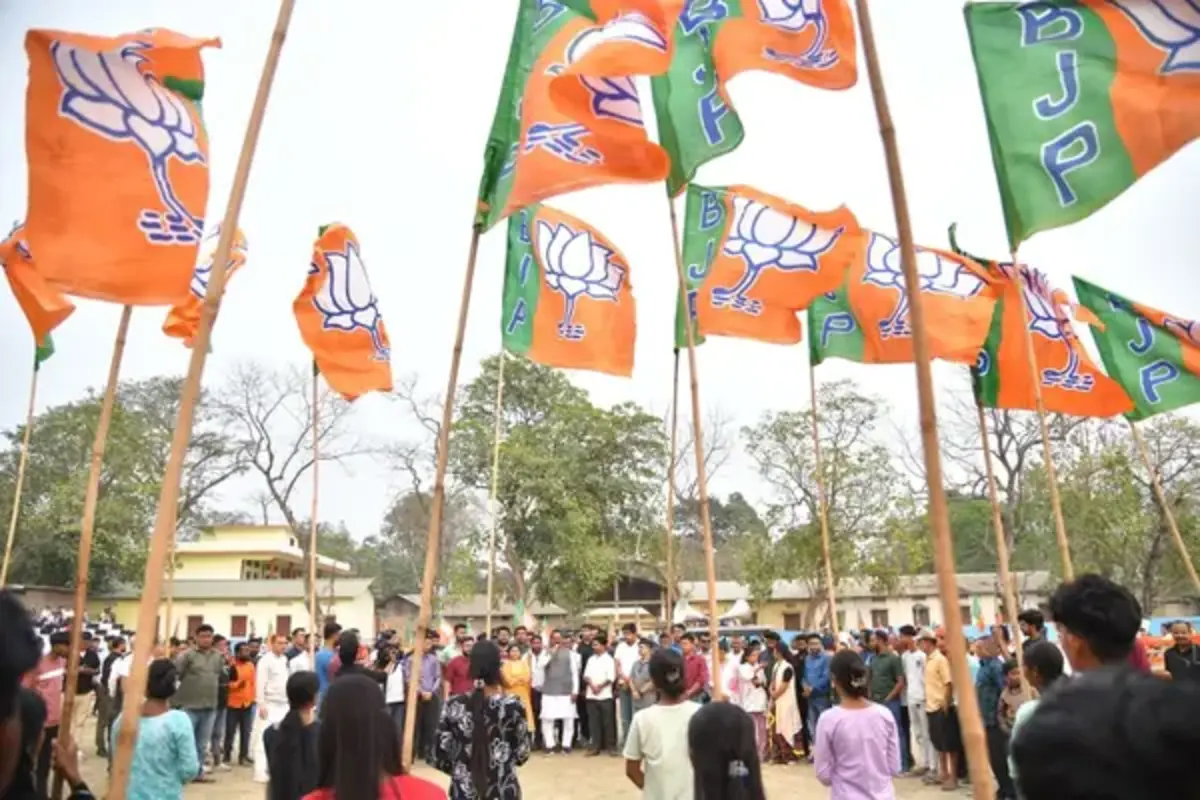
GUWAHATI: The Bharatiya Janata Party’s emphatic return to power in Assam for a third consecutive term is not merely an electoral win—it is a case study in political strategy, organisational discipline, and narrative control. Led by Chief Minister Himanta Biswa Sarma, the BJP managed to buck the conventional anti-incumbency trend that often plagues ruling parties in Indian states.
ALSO READ: BJP Debut Wins for Ex-Congress Turncoats Bhupen Borah and Pradyut Bordoloi in Assam Elections 2026
As trends solidified on May 4, the party surged ahead of a fragmented opposition, reinforcing its dominance in the Northeast. What stands out is not just the scale of victory, but the method: a calibrated blend of governance delivery, identity politics, and electoral machinery that functioned with precision. In a state with 126 seats and a history of volatile mandates, the BJP’s ability to retain power reflects a structural advantage it has steadily built over the past decade.
At the heart of this victory lies what may be called the “Sarma Doctrine”—a hyper-localised, leader-driven campaign that fused governance with emotive politics. Sarma positioned himself as both an administrator and a cultural guardian, repeatedly invoking themes of indigenous identity and protection of land and resources.
The “jati, mati, bheti” narrative—community, land, and home—remained central, resonating strongly across Assamese society. Alongside this, the BJP strategically deployed the “infiltrator” discourse, sharpening polarisation while consolidating majority sentiment. Critics argue this was divisive, but electorally it proved effective. As one political observer noted, the campaign was “not just about governance, but about defining who belongs,” a framing that shifted the electoral debate away from anti-incumbency and toward identity consolidation.
Equally significant was the BJP’s emphasis on welfare delivery and infrastructure development, which provided tangible benefits to voters. Schemes like Orunodoi and improvements in connectivity, roads, and public services helped the party counter dissatisfaction with a narrative of performance. This dual strategy—combining welfare politics with identity messaging—mirrors the broader national template under Prime Minister Narendra Modi.
Analysts point out that BJP’s electoral success across states, including Assam, stems from “a mix of economic development, welfare handouts, and appeals to Hindu nationalism.” In Assam, this formula was adapted to local conditions with remarkable efficiency. High voter turnout—over 85%—suggests that the party’s outreach successfully mobilised both rural and urban voters. The BJP’s booth-level management and vast grassroots network further ensured that this support translated into votes, reflecting a level of organisational depth that the opposition struggled to match.
If BJP’s strategy was cohesive, the opposition’s approach was anything but. The Congress-led alliance, despite attempting to unify multiple regional forces, failed to present a compelling alternative narrative. Internal contradictions, leadership gaps, and inconsistent messaging diluted its challenge. The alliance, though broad on paper, often appeared disjointed on the ground. As one report bluntly observed, the opposition was “fragmented and ineffective,” allowing the BJP to dominate the electoral discourse. Even critics of the BJP concede that its ability to “neutralize opposition leadership” was a decisive factor. Moreover, defections and shifting loyalties further weakened the anti-BJP front, reinforcing the perception that the ruling party was the only stable political force in the state.
Ultimately, the BJP’s victory in Assam underscores a larger political reality: elections are no longer won solely on governance or ideology, but on the ability to integrate multiple layers of strategy into a coherent whole. The party’s success lay in its capacity to simultaneously deliver welfare, control the narrative, mobilise identity, and out-organise its rivals. For Himanta Biswa Sarma, this win cements his position as one of the BJP’s most formidable regional leaders. For the opposition, it raises urgent questions about strategy, unity, and relevance. And for Assam, it signals continuity—but also the consolidation of a political model that blends development with deeply polarising themes.


