


Encroachments, illegal parking and prolonged bus halts turn the GMCH main entrance into a daily bottleneck, delaying critical care and putting patients at risk
“We are doing social service here, not for ourselves,” a public bus driver told GPlus when questioned about why buses halt for long periods right in front of the Gauhati Medical College and Hospital (GMCH), even as ambulances wait behind in traffic.
ALSO READ: Cold Drinks See Low Demand in Guwahati Amid Unseasonal Cool Weather
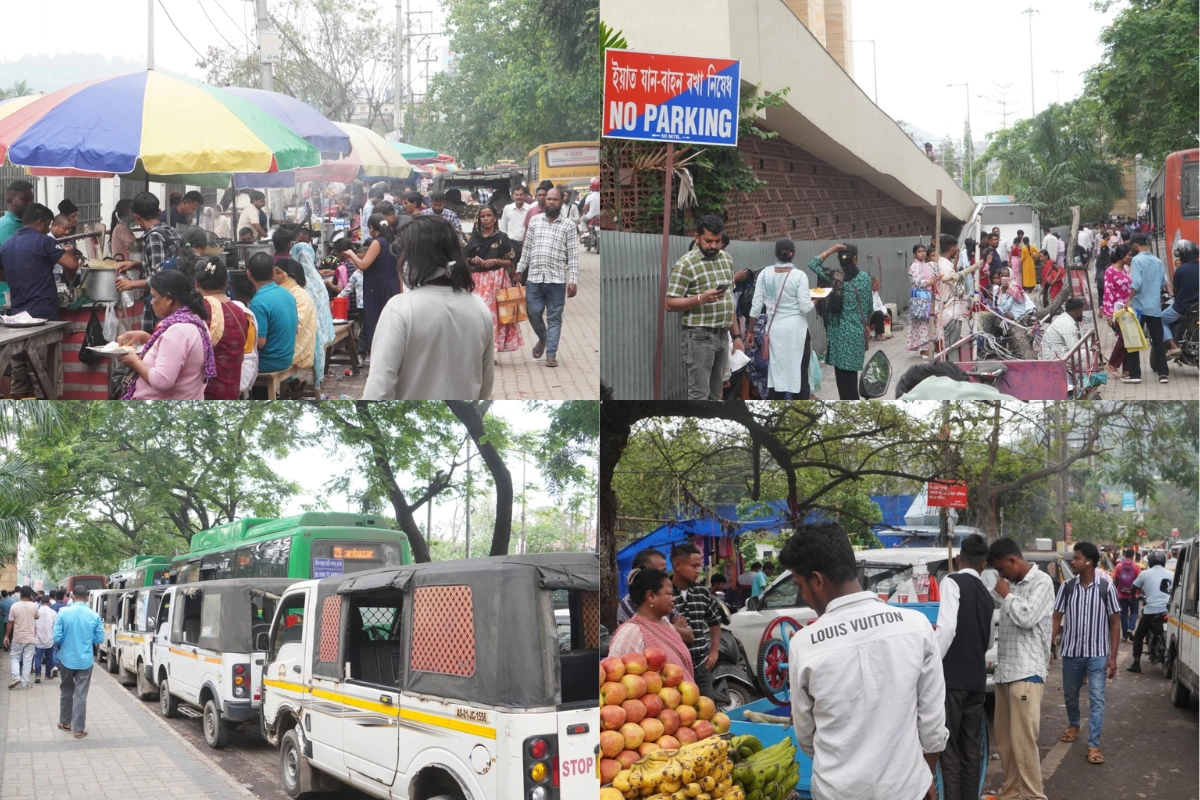
Every time one visits the GMCH, the scene is strikingly similar, food stalls and clothing shops line the streets, two-wheelers are parked haphazardly covering half the road, and buses halt for extended durations, often blocking the path for ambulances. This is the situation unfolding daily outside one of the most important healthcare institutions in Assam and the Northeast.
What should ideally be a clear and accessible stretch for emergency movement has instead turned into a congested and unregulated zone, raising serious concerns about patient safety and traffic management.
With thousands of patients and attendants visiting GMCH every day, the pressure on surrounding roads is immense. However, instead of facilitating smooth access, the approach roads to the hospital frequently turn into bottlenecks, particularly during peak hours.
The main entrance road is often encroached upon by makeshift stalls selling food, fruits, garments, and other essentials. Many of these vendors operate without formal authorisation, occupying footpaths and spilling onto the carriageway, leaving little room for pedestrians and vehicles alike.
Adding to the congestion, buses, trekkers, and e-rickshaws routinely stop directly outside the hospital, waiting for passengers for extended periods. Despite designated stops nearby, this stretch has effectively become an informal transport hub.
Illegal parking further worsens the situation. Two-wheelers and cars are often seen lined up along both sides of the road, including in clearly marked no-parking zones. In many instances, nearly half the road width is taken up by parked vehicles, leaving only narrow passages for moving traffic.
Ambulances, which require immediate and unobstructed access, are among the worst affected. Several instances have been observed where emergency vehicles struggle to pass through the congested stretch, losing valuable time amid honking and gridlock.
On Thursday, April 29, when GPlus visited the site, the situation was particularly strained as a single Assam Home Guards (AHG) personnel was seen attempting to control the flow of buses, trekkers, e-rickshaws, private vehicles, and pedestrians. The scale of traffic far exceeded what one individual could effectively manage.
Speaking to GPlus, a local commuter visiting the hospital said, “Due to public transport vehicles parking on the road and halting for long durations, the traffic is unprecedented. Additionally, footpaths are fully encroached upon by vendors. We can neither walk on the sidewalks nor safely on the road because of moving vehicles. It’s a total mess.”
For patients and their families, navigating this chaos becomes an added burden during already stressful times. Many are forced to walk between stationary vehicles or through crowded roadside stalls just to reach the hospital gate.
Another individual, who was accompanying his sister to GMCH, said, “An overbridge is required here so that patients can move from one side to the other safely.”
The unchecked spread of vendors continues to be a major contributor to the problem. While they cater to the daily needs of patients and attendants, the lack of designated vending zones has resulted in widespread encroachment.
“We have no other place or option but to set up our carts here. Where else will we go? GMC officials keep removing our carts, but due to the lack of a proper vending zone, we are forced to return. Otherwise, how will we earn our livelihood?” said a fruit seller stationed right outside the main entrance of the hospital.
Public transport behaviour also plays a significant role in congestion. Buses halting for prolonged durations block lanes and encourage other vehicles to stop indiscriminately, leading to further traffic buildup.
A green bus conductor told GPlus, “We have stopped the bus here for around 10 minutes.” Despite the long halt, he appeared unaware of the permitted stopping duration. “I don’t know about these rules; you can ask ASTC officials. As per them, we have been allowed to line up our buses here,” he added.
A resident doctor at GMCH highlighted the seriousness of the issue, especially during emergencies: “The traffic here is extremely chaotic, and the presence of street vendors adds to the problem for patients trying to reach the hospital. When patients need to move from one side to another, this congestion causes delays, which can be critical during emergencies. Buses, in fact, should not be parked here as it is a narrow road.”
Despite the visible scale of the issue, enforcement remains limited. Traffic personnel are often outnumbered, making it difficult to regulate both vehicular movement and roadside encroachments effectively.
An official deployed at the site spoke about the challenges, saying, “This is the main GMCH entrance, where vehicles from Rupnagar, Dispur, and Narakasur Hill converge, and we have to manage all that traffic. Every day, around 40,000 to 50,000 people visit GMCH. Whenever we try to stop traffic, drivers often do not obey signals, and pedestrians take risks by crossing between moving vehicles instead of waiting. Green buses also stop in the middle of the road, ignoring signals. Ambulances face major difficulties. We are trying our best to manage the situation as it is our responsibility.”
The situation outside GMCH reflects broader challenges of urban management in Guwahati, where rapid growth has outpaced infrastructure and enforcement. Experts have long pointed to the need for stricter regulation, designated vending spaces, and improved traffic planning in high-footfall areas such as hospital zones.
Until coordinated measures are implemented, the road outside one of the region’s most critical healthcare institutions is likely to remain choked where access to life-saving care begins with navigating through disorder.


