


A market under siege: Tension simmers in Fancy Bazar over plans that threaten its core
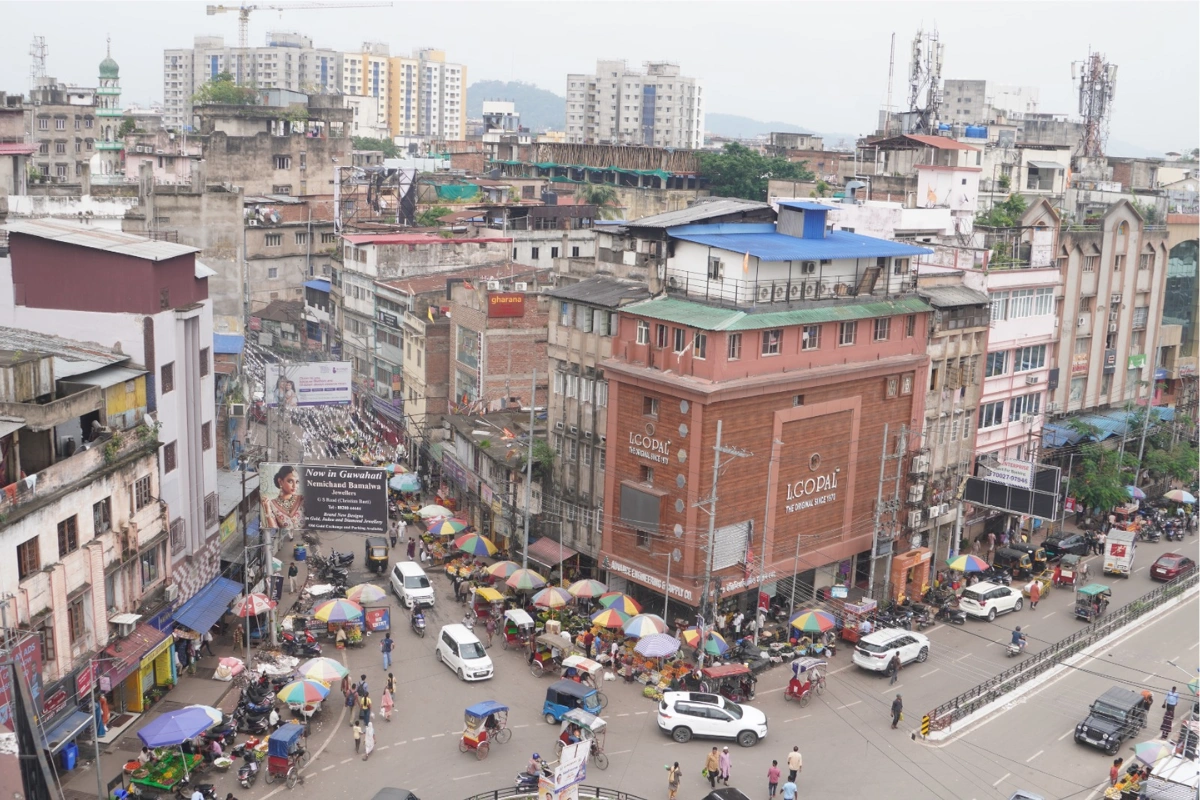
The uneasy calm of Fancy Bazar is beginning to fracture, and beneath the familiar chaos of honking vehicles, narrow lanes and crowded shopfronts, a deeper unrest is taking shape, one that could soon spill onto the streets in the form of a full-blown civic backlash. What was once dismissed as routine inconvenience is now being seen by residents and traders as a systematic dismantling of an already fragile urban ecosystem, driven by ambitious but poorly sequenced redevelopment plans that risk pushing the area into prolonged disruption.
ALSO READ: Smart City Water ATMs Run Dry in Guwahati
At the heart of the anger lies the impending closure of the Old Jail parking facility near Botanical Garden Guwahati, a move that many believe will cripple the daily functioning of one of the busiest commercial zones in Assam. For years, the parking lot has acted as a pressure valve for the relentless inflow of vehicles into Fancy Bazar. Its removal, without a clear and immediate alternative, threatens to turn daily congestion into permanent gridlock. Commuters, transporters and small traders, who form the backbone of the area’s economy are now bracing for longer delays, shrinking access and a direct hit on business. “What was earlier a struggle will now become a nightmare,” said a shopkeeper, summing up the mood on the ground.
The anger is not limited to parking alone. The government’s broader vision to redesign Fancy Bazar through a Local Area Plan (LAP), spearheaded by the Assam Urban Knowledge Hub under the Directorate of Town and Country Planning, has triggered both curiosity and suspicion. Two key arteries, SS Road and GNB Road have been identified as pilot stretches where sweeping changes are being proposed. Officials speak of pedestrian-friendly walkways, underground cabling, organised vending zones, improved drainage, and even the creation of “signature streets” that could redefine the visual identity of the city. But for many residents, these promises ring hollow against the backdrop of decades of neglect.
A senior official involved in the planning process claimed that if the pilot succeeds, the model would be replicated across the entire stretch from Paltan Bazar to Bharalumukh and beyond. The blueprint is undeniably ambitious, covering everything from land use zoning and open spaces to heritage conservation and infrastructure upgrades. A particularly contentious element is the introduction of Transferable Development Rights (TDR), where property owners would be asked to part with small portions of their land in exchange for rights to build additional floors elsewhere or sell those rights in the market. While urban planners hail TDR as a progressive tool to enable development without forced acquisition, many property owners see it as uncertain compensation in a volatile real estate environment.
“There is a trust deficit,” admitted a source within the planning department. “People are not convinced that what they are giving up will be adequately compensated.” This scepticism is compounded by the lack of clarity on timelines. Officials themselves concede that a full transformation of Fancy Bazar could take 10 to 15 years, largely because redevelopment would depend on individual buildings reaching the end of their lifecycle. In other words, the grand vision may unfold in fragments, leaving the area in a prolonged state of transition.
Adding fuel to the fire is the proposal to shift the wholesale market out of Fancy Bazar to North Guwahati. While the idea is being pitched as a long-term solution to congestion, the absence of a clear relocation plan: no fixed site, no timeline, no logistical roadmap has left traders deeply uneasy. For many businesses that have operated in the area for generations, relocation is not just a logistical challenge but an existential threat. “You cannot just uproot an ecosystem and expect it to reassemble itself elsewhere,” said a trader, echoing a sentiment widely shared across the market.
Yet, perhaps the most explosive flashpoint remains the decision to replace the Old Jail parking area with a high-value commercial project. Backed by the state Cabinet, the plan involves a partnership with the Ambuja Neotia Group to build a 300-bed multi-speciality hospital and a premium hotel on nearly three acres of land. With an investment reportedly exceeding Rs 700 crore, the project is being positioned as a landmark development that would boost healthcare infrastructure and tourism. But for residents, the question is simple: at what cost?
Padma Shri awardee and former legislator Ajoy Kumar Dutta has emerged as a vocal critic of the move. “This open space in the heart of Guwahati should be preserved and kept free for the public,” he said, warning that any attempt to commercialise the area would be strongly resisted. His stance has found resonance among a wide cross-section of residents who view the Botanical Garden and surrounding open spaces as rare breathing zones in an increasingly congested city.
The political undertones of the controversy have only intensified the situation. Local businessman and former councillor Rajkumar Tewari did not mince words while reacting to remarks reportedly made by Vijay Gupta, who allegedly labeled opponents of the project as “Bangladeshis or Pakistanis.” Tewari called the statement “deeply offensive” and warned of a “storm of protests” if the government failed to reconsider its approach. “People are upset, and they have every right to be. This is not about politics; it is about survival,” he said, adding that residents are preparing to file a Public Interest Litigation (PIL) after May 4.
Even those directly affected by the parking closure have been left in limbo. Staff associated with the Old Jail parking facility confirmed that they have been asked to vacate the premises following the expiry of their lease. “There is no phased transition. We were simply told to leave,” said one employee. The absence of a structured exit plan has reinforced perceptions that the authorities are prioritising speed over sensitivity, pushing through changes without adequately preparing those who will bear the brunt of them.
Officials from the Guwahati Metropolitan Development Authority have defended the move, arguing that alternative parking spaces exist behind the Botanical Garden. But critics dismiss this as grossly inadequate for an area that handles thousands of vehicles daily. “You cannot replace a major parking hub with a token alternative and expect the system to hold,” said a transport operator.
What makes the situation particularly volatile is the cumulative weight of unresolved issues that have plagued Fancy Bazar for years: poor drainage, chronic waterlogging, ineffective garbage management and haphazard traffic control.
Residents argue that before embarking on grand redesign projects, the authorities should have addressed these basic deficiencies. “Fix what is broken first,” said a local resident. “Then talk about making it beautiful.”
Urban experts, while acknowledging the need for redevelopment, caution that success depends on sequencing and stakeholder engagement. “You cannot impose a top-down vision on a complex, organic market like Fancy Bazar,” said an urban planner. “Any intervention must be incremental, consultative and grounded in local realities.” The current approach, critics say, risks doing the opposite, triggering disruption without delivering immediate relief.
The threat of protests, legal challenges and political fallout looms large, and the government finds itself walking a tightrope between ambition and accountability. The promise of a modern, organised and aesthetically appealing Fancy Bazar is undoubtedly attractive. But unless the transition is managed with far greater care, transparency and empathy, that promise may come at the cost of alienating the very people it seeks to benefit.
For now, the message from the ground is unmistakable: development cannot be a diktat. In a place as intricate and interdependent as Fancy Bazar, it must be a dialogue. And if that dialogue fails, the streets that today carry the weight of commerce may soon carry the sound of resistance.


