



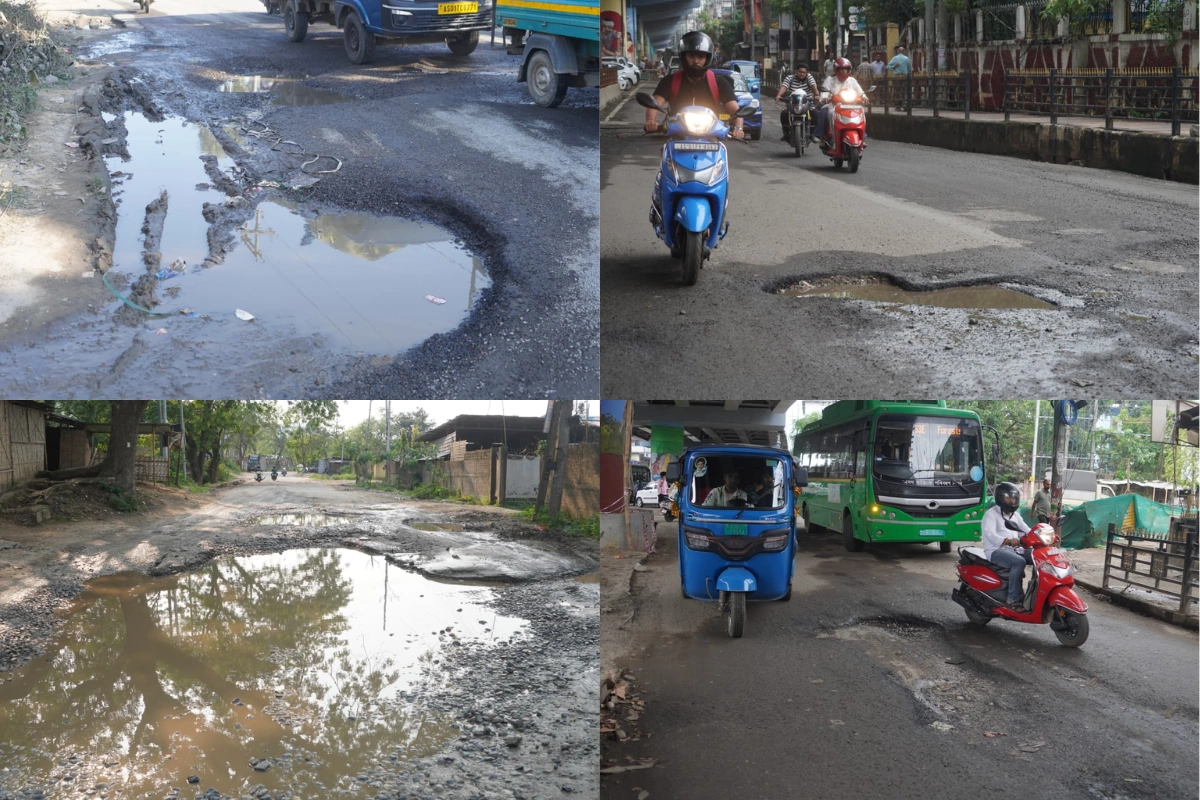
Guwahati’s roads continue to reveal their cracks and failures every time it rains
Every spell of heavy rain in Guwahati does more than just flood roads and slow down traffic. It exposes the city’s fragile road infrastructure once again, leaving behind damaged stretches, deep potholes and broken surfaces that turn daily commuting into a dangerous experience for thousands of residents. As rainwater recedes from several parts of the city, what remains on many roads is a troubling reminder of how weak and neglected the condition of Guwahati’s streets has become over the years.
ALSO READ: Guwahati Ward 44 Still Struggles With Unpaved Roads, Silt and Garbage Issues
Across the city, motorists are now struggling to navigate roads filled with potholes, uneven patches and damaged surfaces. While waterlogging itself remains a major concern during the monsoon, the condition of roads after rainfall often becomes equally risky. Beneath pools of muddy water, potholes remain hidden from sight, catching drivers off guard and increasing the chances of accidents.
For many commuters, especially two-wheeler riders, travelling through the city has become an exercise in caution and uncertainty. A smooth-looking road can suddenly turn into a damaged stretch within a few metres, forcing vehicles to brake abruptly, swerve dangerously or lose balance entirely. Residents say that in several localities, roads which appeared manageable before the rains have now deteriorated rapidly.
The situation becomes worse during the night when visibility is poor and potholes blend into shadows on the road. Many motorists said they are unable to judge the depth of damaged patches until it is too late. Several cases have emerged where commuters suffered injuries after hitting potholes unexpectedly, while vehicles have also sustained damage ranging from punctured tyres to broken suspension systems.
For office-goers, students and delivery workers who spend long hours on the road every day, the condition has become physically exhausting and mentally stressful. Many residents say they leave home expecting delays, traffic congestion and rough rides as part of their daily routine.
“The roads are dangerous after rain. At night you cannot even understand where the potholes are. One small mistake and you can lose balance,” said a commuter who travels regularly through GS Road and adjoining localities.
Another resident stated that even short distances within the city have become difficult to navigate. “You try to avoid one pothole and end up hitting another. Some roads are so damaged that vehicles have to move at crawling speed,” he said.
The problem is not limited to a few isolated areas. From main roads to interior lanes, damaged stretches can be seen across several parts of Guwahati. In many places, potholes have formed repeatedly despite earlier repair work, leading residents to question the quality and durability of road construction.
The condition of roads in Guwahati has remained a long-standing concern, but repeated digging and construction activities have further worsened the situation in recent years. Roads are frequently cut open for drainage projects, water pipelines, cable installations and other redevelopment works carried out by different departments and agencies. Residents allege that once such work is completed, roads are often restored poorly, leaving behind weak surfaces that quickly deteriorate during rainfall.
Many citizens feel the city has entered a cycle where roads are built, dug up and damaged repeatedly without any long-term planning or coordination between departments. As a result, freshly repaired roads often do not last beyond a few months before cracks and potholes begin to appear again.
Speaking to GPlus, an official from the Public Works Department acknowledged that rainfall significantly damages bitumen roads. “Bitumen roads corrode when water accumulates, so it is usually repaired after the monsoon season. In areas where blocks have been installed, several stretches have broken patches due to projects under various departments. To repair those, a procedure needs to be followed which includes estimates and sanctions,” the official said.
While the explanation reflects the technical and administrative process behind repairs, many residents believe such responses have become repetitive and fail to address the urgency of the problem. Citizens argue that waiting until after the monsoon for repairs leaves roads unsafe for months, despite people continuing to use them every day.
The delay in repairs also raises larger questions about preparedness and maintenance. Residents say authorities are aware that heavy rainfall damages roads every year, yet preventive measures appear inadequate. Temporary patchwork often washes away after another spell of rain, creating the same problems repeatedly.
Experts point out that water is one of the biggest enemies of bitumen roads. Once rainwater seeps into cracks, it weakens the base layer beneath the surface, eventually causing potholes and road collapse. However, they also note that good drainage systems and proper construction quality can significantly reduce such damage. In Guwahati, both these aspects remain major concerns.
Poor drainage continues to play a critical role in worsening road conditions. In many parts of the city, rainwater remains accumulated for long periods because drains are clogged, narrow or unable to handle heavy flow. This standing water slowly damages the road surface, leading to rapid deterioration.
The problem becomes more severe in low-lying areas where roads remain submerged for hours or even days after rainfall. Residents of such localities often witness roads breaking apart layer by layer during the monsoon season. In some stretches, large sections of the road surface have peeled away completely, exposing rough stones and loose gravel underneath.
Apart from physical inconvenience, damaged roads are also affecting people financially. Vehicle owners say frequent repairs and maintenance have become unavoidable due to the poor condition of roads. Tyres, shock absorbers and suspension systems are particularly vulnerable to damage caused by potholes and uneven surfaces.
For app-based drivers, delivery workers and small business owners who depend on daily travel for their livelihood, the impact is even more severe. Longer travel times, fuel wastage and vehicle repairs directly affect their earnings. Several commuters also pointed out that traffic congestion worsens when vehicles slow down to navigate damaged stretches, increasing travel time across the city.
Pedestrians too face difficulties, especially during rainfall. Broken roads combined with muddy conditions make walking unsafe in several areas. In places where footpaths are absent or damaged, people are forced to walk on the road itself, increasing the risk of accidents.
Residents also expressed frustration over the lack of accountability regarding road quality. Many questioned why roads continue to deteriorate so quickly despite repeated repair works and public expenditure. The repeated cycle of damage and repair has led to growing public distrust over whether infrastructure projects are being executed properly.
“There is no lasting solution. Every year the same roads break again after rain. It feels like money is spent repeatedly, but the problem never ends,” said a resident of Beltola.
Another major issue highlighted by citizens is the absence of coordination among departments. In many areas, roads repaired by one agency are dug up shortly afterwards by another department for pipeline or grid work. Residents say this not only wastes public resources but also weakens the overall structure of the roads.
The ongoing construction and redevelopment activities across Guwahati, while aimed at improving urban infrastructure, have also contributed to increasing public inconvenience. Heavy machinery, excavation work and temporary diversions often leave roads vulnerable to damage even before projects are completed.
Many people believe the city’s infrastructure growth has not been matched with proper planning and maintenance. While new projects continue to be announced, basic road quality remains a major concern affecting daily life.
The human cost of damaged roads is becoming increasingly visible. Behind every pothole-related accident is a person returning home injured, a family burdened with medical expenses or a commuter left shaken after a close escape. For many residents, travelling through Guwahati now comes with constant anxiety, especially during the rainy season.
Citizens believe that roads are more than just physical infrastructure. They reflect the quality of governance and directly affect the everyday lives of people. When roads remain in poor condition despite repeated complaints and visible damage, it creates a feeling that public inconvenience has become normalised.
As rainfall continues in the coming weeks, residents fear that the condition of roads may deteriorate further unless urgent and effective repairs are undertaken. Many believe that temporary fixes are no longer enough and that the city requires durable road construction, better drainage systems and stronger accountability among agencies responsible for public infrastructure.
For now, Guwahati’s roads continue to reveal their cracks and failures every time it rains. Beneath the puddles and broken surfaces lies a larger story of neglect, poor planning and repeated suffering faced by ordinary people who simply expect safe roads to travel on every day.


