


Overflowing garbage stations across Guwahati are turning roads, drains and neighbourhoods into health hazards
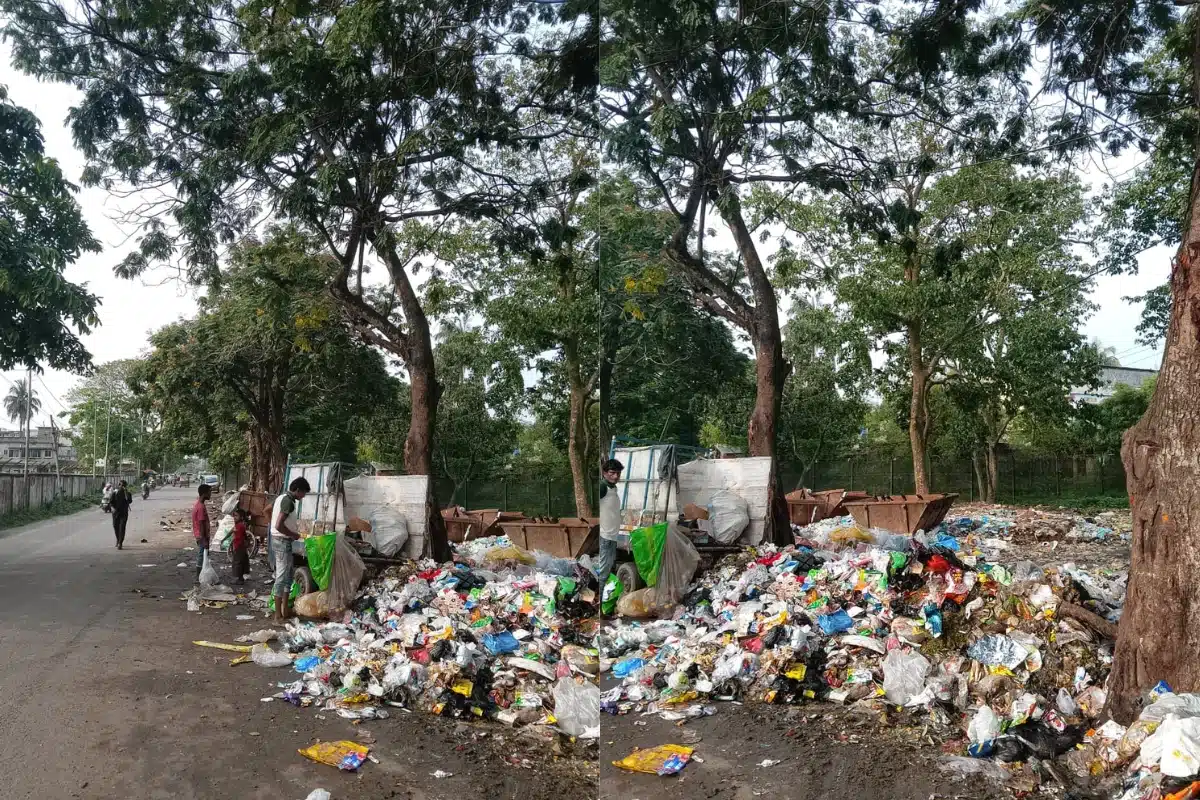
In the Natun Bazar area of Basistha, on the road leading toward the historic Basistha Temple, a peculiar ritual has become a necessity for passersby: the sudden clutching of a handkerchief to the face or the frantic holding of one's breath. This is not a localised inconvenience but a symptom of a systemic failure in Guwahati’s urban planning. Over the last few years, a massive garbage dump has come up out of nowhere, transforming a busy road into a site of filth and unhygiene.
ALSO READ: Assam Faces Hard Times Ahead Amid Inflation Fears and Global Economic Stress
Natun Bazar, however, is merely one link in a chain of urban neglect. Across the city, in Sundarpur, Sijubari, Chabipool, the GMCH area, and Balughat near National Highway, residents are grappling with a similar menace. These sites are officially designated as “garbage transfer stations," intended to serve as temporary drop-off points where mini-vans deposit household waste before it is taken away by larger trucks to the central dumping ground in the outskirts of the city.
In theory, the process is continuous; in practice, it is a stagnant disaster because heaps of garbage on several occasions lie there for hours, or in some cases over a day.
The transition from temporary transit points to semi-permanent landfills has happened in no time.
"It is becoming difficult by the day to stay in this locality. The quantity of garbage being brought into this dump is increasing," a resident living adjacent to the Basistha site shared with GPlus.
The sentiment is echoed by local business owners whose livelihoods are being choked by the proximity of the waste.
A nearby shopkeeper added with visible disgust, "We constantly feel choked because of the foul odour that comes out from the dumping ground."
The structural failure of these stations is most evident during the monsoon. Designed without proper containment or drainage, these sites allow rainwater to mix with biodegradable waste. This creates toxic pools of leachate, a black, foul-smelling liquid that seeps into the soil and flows onto public roads, and drains, contaminating the environment. In fact, a large drain flows by the garbage site in Natun Bazar, possibly carrying toxic leachate from the dump to the rest of Guwahati.
These heaps have become hotspots for disease vectors, with flies, stray dogs, and cattle frequently rummaging through the refuse, creating a scene more akin to a neglected rural area than an ambitious smart Indian city.
The logistical impact of these stations is equally severe. In many areas, the garbage transfer stations have begun to dominate public roads, wreaking havoc on daily commutes.
During the morning rush hour, the road near the Natun Bazar station is often half-occupied by either overflowing heaps of trash or a fleet of idling garbage vans and trucks. This creates a bottleneck that endangers and delays school-goers and office workers alike.
While large trucks eventually clear a significant portion of the waste as the day progresses, the removal is never total. The filth remains, the residue lingers on the asphalt, and the unhygienic conditions persist long after the trucks have departed.
“We are always stuck here for a few minutes due to the constricted road that has resulted from the garbage being spilled on the road or municipality vans and trucks blocking the traffic,” a commuter sitting in a car, told GPlus.
Waste management in Guwahati remains a classic case of the "Not In My Backyard" (NIMBY) syndrome. The current Natun Bazar site is actually a relocated problem. Previously, the collection point was situated in Latakata, but after sustained complaints from residents regarding the stench, authorities moved it to the main road near Natun Bazar.
This move has proven to be a strategic error. By placing the dump at the entry point of the popular Basistha Temple, the city has not only inconvenienced residents but also marred the experience for tourists and devotees visiting the landmark. Local ward councillor Satendra Nath Bhattacharya has expressed a weary willingness to relocate the site once more, provided the public can suggest an alternative location that won't trigger the same cycle of protests. He noted that similar hazards are currently plaguing the Jayanagar area near the National Highway, highlighting that the city is simply shuffling its problems from one street corner to another.
GPlus also found out that another disheartening aspect of this crisis, often not talked much, is the plight of the municipality workers. Employed primarily through NGOs contracted by the municipality, these workers operate in these sites, exposing themselves to diseases. Yet they remain mostly overlooked.
Without wanting to be named, one worker shared his ordeal. "We are barely provided with any safety gear. We still work, because we have to earn our bread and butter" he said, pointing towards his dirty cloths.
Without gloves, masks, or protective clothing, these workers are forced to handle hazardous waste manually. Their struggle is a testament to a systemic neglect that values neither the environment nor the human beings tasked with cleaning it.
The garbage transfer stations of Guwahati are currently less of a solution and more of a symbol. They represent a city that is growing faster than its infrastructure can support.
Unless there is urgent, coordinated intervention at both the administrative and political levels, the residents of Guwahati will continue to live in the shadow of their own refuse. Deep-seated issues like the lack of specialised waste-processing facilities, the absence of worker safety protocols, and poor logistical planning cannot be solved by simply moving a dump a few kilometres down the road. Until the city treats waste management as a core public utility rather than an after-thought, the stench, the filth, and the chaos will remain the everyday reality for thousands who simply want a safe, clean path to walk on.


