


Beneath the polished façade of Guwahati’s highway corridor lies a crumbling network of dangerous service roads, open drains and endless commuter misery
On the surface, the National Highway stretch connecting Khanapara to Jalukbari presents the façade of a modern, efficient transit corridor. However, beneath this “smooth” exterior lies a systemic failure of urban planning and maintenance that endangers thousands of lives daily. The parallel service roads, designed to ease local traffic, have instead become a gauntlet of hazards marked by unauthorised parking, potholes, open drains, wrong-side driving, and chronic artificial flooding.
ALSO READ: Guwahati Clears Culverts and Drains Ahead of Monsoon After Flood Deaths and Public Outcry
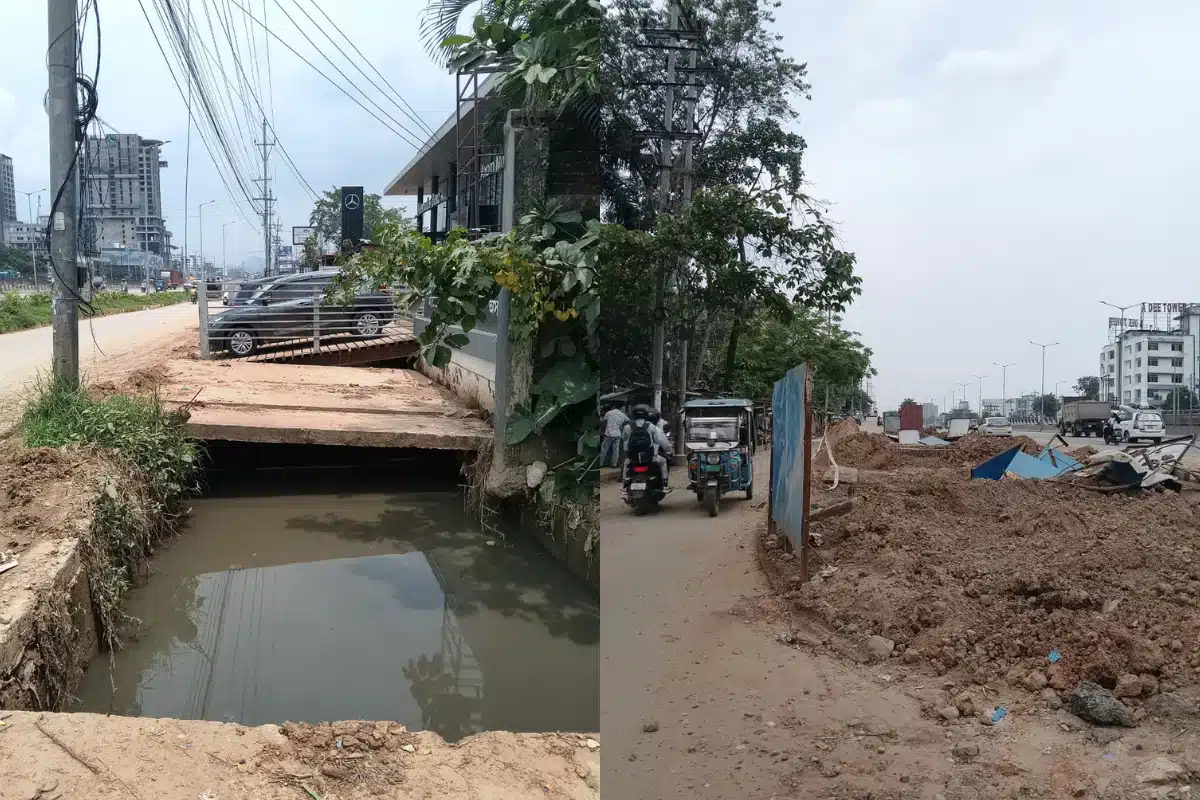
The most glaring example of this administrative lethargy is the service lane opposite Tripura Road, heading towards Basistha. This stretch has remained an unfinished construction site for nearly a year. The consequences of this delay are both chaotic and dangerous.
As the road remains blocked and largely impassable, commuters travelling from Jayanagar or Khanapara are forced to drive on the wrong side to reach Basistha Chariali.
Local businesses are also suffering. Traders along the Tripura Road–Basistha Chariali corridor say the hazardous conditions have driven customers away, turning a once-thriving commercial zone into a stagnant dust bowl.
In dry weather, the area is engulfed in clouds of dust due to never-ending construction work; during rain, it transforms into a swamp of mud and sludge.
The poor condition of the roads is compounded by a dangerous drainage crisis. Large sections of the highway are flanked by wide open drains without any safety barriers or covers.
During flash floods, these drains become invisible death traps.
“When it rains, this place gets completely flooded. It becomes difficult to distinguish the footpath from the open drain,” a local resident from the Lokhra-Nalapara area said, pointing towards an uncovered drain.
During a field visit, GPlus found trucks and other goods-carrying vehicles parked along several stretches of the service roads, often unattended. Such unauthorised parking further chokes the already narrow roads, worsening commuters’ woes.
Even where the condition of the service road is relatively better, rainwater and slush make commuting difficult.
“This area has several warehouses and godowns. When goods-carrying vehicles move through these narrow service roads, regular commuters like us face tremendous inconvenience,” another middle-aged resident told GPlus near Garchuk.
“As part of the pre-monsoon preparedness measures, we have begun intensive de-siltation work along the Jalukbari-Jorabat stretch of NH-27,” said an official at the National Highways Authority of India.
“The exercise involves the removal of accumulated silt, mud, plastic waste and other obstructions from roadside drainage systems to restore the proper flow and carrying capacity of drains,” the official added.
NHAI’s initiative is expected to ensure smooth discharge of rainwater during the monsoon season and reduce the risk of waterlogging and flash floods along the busy highway corridor. The Jalukbari–Jorabat stretch frequently witnesses severe waterlogging during heavy rainfall due to the accumulation of silt and garbage in drains.
As public frustration boils over, the response from authorities has largely remained reactive rather than preventive. The District Disaster Management Authority (DDMA) of Kamrup Metropolitan recently issued a show-cause notice to the authorised representative of Dinesh Chandra Kamakhya Highway Concessions Pvt. Ltd. over alleged negligence leading to severe waterlogging along the same National Highway stretch.
While the notice cites “gross negligence” behind the persistent waterlogging, many residents view it as a bureaucratic attempt to shift blame rather than a sincere effort to expedite repairs. The lack of coordination and communication among government agencies has left citizens feeling abandoned, locals say.
With the peak monsoon season approaching, the present condition of Guwahati’s infrastructure, particularly along the highway corridor offers little reassurance.
For a regional hub aspiring to become a “Smart City” and a symbol of modern development, these recurring infrastructure failures are more than a mere inconvenience. They are a stark reflection of the state of governance and public safety in Guwahati. Until comprehensive, high-priority repairs are undertaken, the city remains one heavy downpour away from another tragedy.


